

Insider #9: Rosewood
Rosewood: History, Characteristics, and How to Spot the Real Thing
Cut a fresh board of Brazilian rosewood and the workshop fills with a sweet, faintly floral smell. That scent gave the timber its English name, and the look of it, chocolate and red-brown streaked with black, has made it one of the most coveted furniture woods of the last four hundred years.
Rosewood is a trade name, not a single tree. The "true" rosewoods belong to the genus Dalbergia, a large family of tropical hardwoods that includes Brazilian, East Indian, Honduran and Madagascar rosewood, along with close cousins like cocobolo, kingwood and tulipwood. Plenty of other dense, dark, figured timbers have been sold under the same name, which is one of the reasons the word on a price tag deserves a second look.
Rosewood can be found in the Ming scholar's chair, the French marquetry commode, the Regency sofa table with its brass inlay, the Victorian parlour piano, and the long, low Danish sideboard that every mid-century collector wants. Each era used it for the same reason: nothing else combines that density, that oily polish and that figure in one board. And in every era, there was never quite enough of it.
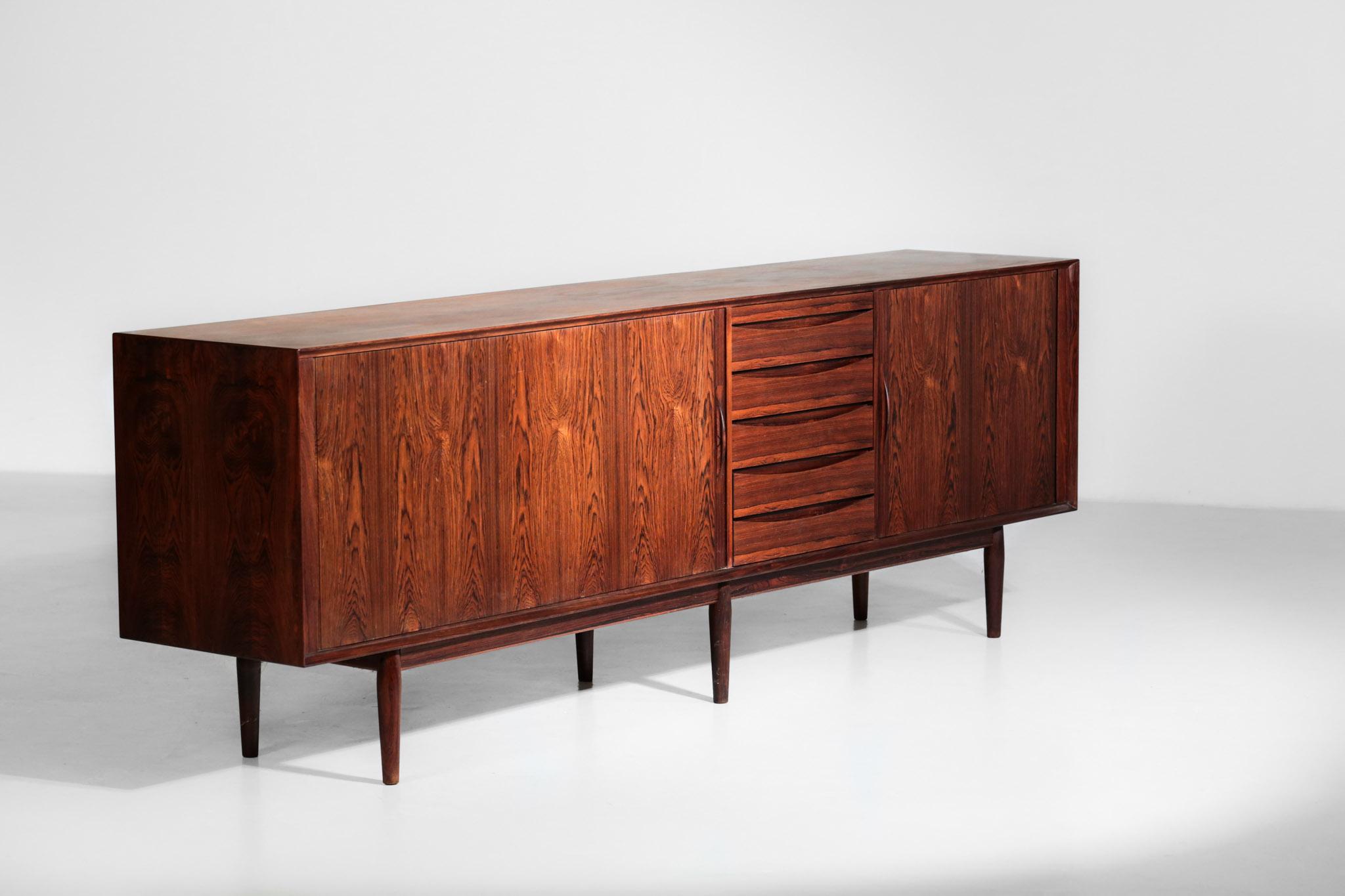
A rosewood sideboard designed by Arne Vodder for Sibast, Denmark, 1960s. Long, flat doors like these were where Danish makers showed off their most dramatic sheets of veneer.
Key Takeaways
- What it is: a family of dense tropical hardwoods, the true rosewoods being Dalbergia species, prized for dark color, dramatic figure and a natural oily luster.
- Where you'll meet it: Ming and Qing Chinese furniture, French eighteenth-century marquetry, English Regency, American Victorian parlour furniture and pianos, and Danish and American mid-century modern.
- The big names: Brazilian rosewood (Dalbergia nigra), the most coveted, and East Indian rosewood (Dalbergia latifolia), the most common in vintage furniture after about 1970.
- Design DNA: rosewood is almost always used to show off its grain, so it tends to appear on plain, flat surfaces as veneer, where the figure can do all the decorating.
- Best tells of authenticity: color and figure that run through the wood rather than sitting on it, open pores with dark streaks, real weight, and figure that never repeats.
- Regulation: Brazilian rosewood has been on the strictest tier of the CITES endangered species treaty since 1992. Buying and selling old pieces within the US is generally fine, but moving them across borders can take paperwork.
- Market note: new rosewood furniture is close to impossible to make legally at scale, so vintage is effectively the only supply. That's a big part of why a rosewood sideboard sells for more than the same model in teak.
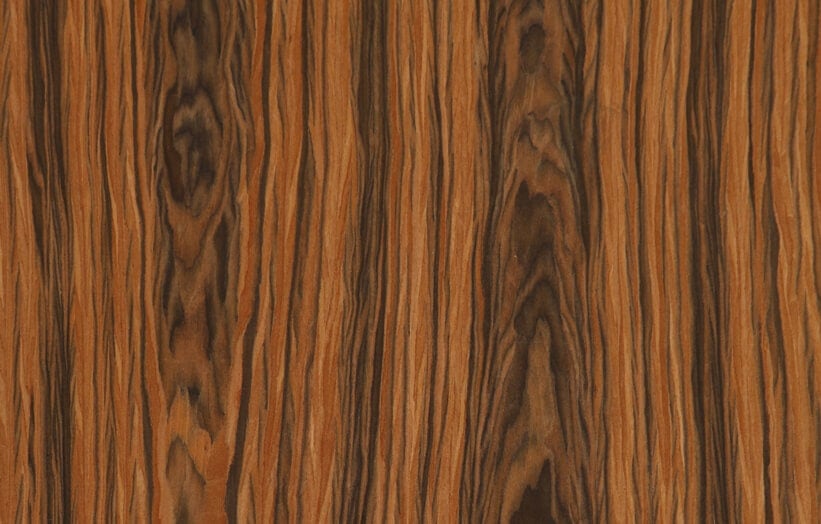
Brazilian rosewood (Dalbergia nigra), sanded and sealed. Note the dark streaks running through a warm red-brown ground. This figure made Brazilian rosewood the most coveted rosewood of all.
A Quick Timeline
|
Period |
Moment |
Why it matters |
|---|---|---|
|
Late Ming, c. 1550–1644 |
Huanghuali furniture flourishes in China |
A Dalbergia species becomes the scholar's timber of choice, and the benchmark for Chinese furniture ever since |
|
c. 1680–1780 |
French ébénistes use kingwood, tulipwood and palissandre |
Rosewood relatives become the colors in Europe's finest marquetry |
|
c. 1800–1830 |
English Regency |
Rosewood with brass inlay becomes the fashionable timber of the age |
|
c. 1840–1870 |
American Rococo Revival |
Laminated rosewood parlour suites and rosewood-cased pianos become status objects |
|
1956 |
The Eames Lounge Chair launches |
Brazilian rosewood veneer becomes the face of American modernism's luxury piece |
|
c. 1955–1975 |
Danish Modern peak |
Rosewood sideboards, wall units and desks become the high end of Scandinavian production |
|
1969 |
Brazil restricts export of unprocessed rosewood logs |
Danish makers begin shifting toward East Indian rosewood |
|
c. 1990 |
Herman Miller drops rosewood from the Eames Lounge |
Original rosewood examples become a collecting category of their own |
|
1992 |
Brazilian rosewood listed on CITES Appendix I |
International commercial trade in it effectively ends |
|
2017 |
All Dalbergia species listed on CITES Appendix II |
Every true rosewood now needs permits to cross most borders |
The History: How Rosewood Happened
1. China: Huanghuali and the Scholar's Taste
The longest continuous love affair with rosewood belongs to China. In the late Ming dynasty, roughly the second half of the sixteenth century into the early seventeenth, a wood called huanghuali ("yellow flowering pear") became the preferred timber for the furniture of educated, well-off households. Botanically it's Dalbergia odorifera, a rosewood native to Hainan Island, and it has a translucent golden-brown color and swirling figure that Chinese connoisseurs compare to ghost faces and running water.
Ming furniture is famous for doing almost nothing to its timber. Joints are cut so precisely that the best pieces use little or no glue and no nails, and ornament is held to a carved panel or a softly shaped apron. The wood is the point. Huanghuali and its darker partner zitan (a red sandalwood, Pterocarpus, which is not a true rosewood but travels in the same company) became the twin aristocrats of Chinese furniture, and fine Ming examples now sell at auction for sums that make Western antiques look modest.
That taste never went away. Modern China still has an official category called hongmu, literally "red wood," a national standard listing a few dozen dense tropical species, most of them rosewoods, approved for traditional-style furniture. Demand for hongmu in the 2000s and 2010s drove heavy logging of Southeast Asian and African rosewood, and that pressure is a large part of why the whole genus ended up under international protection in 2017.

A Ming dynasty yokeback armchair in rosewood. The name "yokeback" comes from the top element, which resembles an ox yoke.
2. France: Kingwood, Tulipwood and Palissandre
In Europe, rosewood arrived first as color. French cabinetmakers of the late seventeenth and eighteenth centuries, the ébénistes who built veneered furniture for the court, used rosewood relatives as part of their palette: kingwood (bois de violette), a dark purple-brown with tight stripes, and tulipwood (bois de rose), pale pink with red striping. Laid in diagonal bands, parquetry cubes and floral marquetry, and framed with gilt-bronze mounts, they gave Louis XV commodes their particular warmth.
The French word for rosewood, palissandre, is still widely used today, especially in European furniture listings. It's worth knowing because it often turns up as a polite substitute for a less marketable name, which we'll get to.

A Louis XV Ormolu-Mounted Tulipwood and Kingwood Marquetry Commode By B.V.R.B Circa 1750.
3. England: The Regency Wood
If you read our Georgian guide, you'll remember rosewood as the Regency signature. Around 1800 English taste turned heavier and more archaeological, and rosewood suited it perfectly. Dark, dramatic and expensive, it was used as solid timber and as veneer on sofa tables, drum tables, chiffoniers and card tables, very often inlaid with lines and scrolls of cut brass. The contrast of gold metal against near-black wood is one of the most recognizable looks in English furniture.
The Regency also made rosewood the default for small luxuries: tea caddies, writing slopes, sewing boxes and work tables, many of which still turn up today at very fair prices.
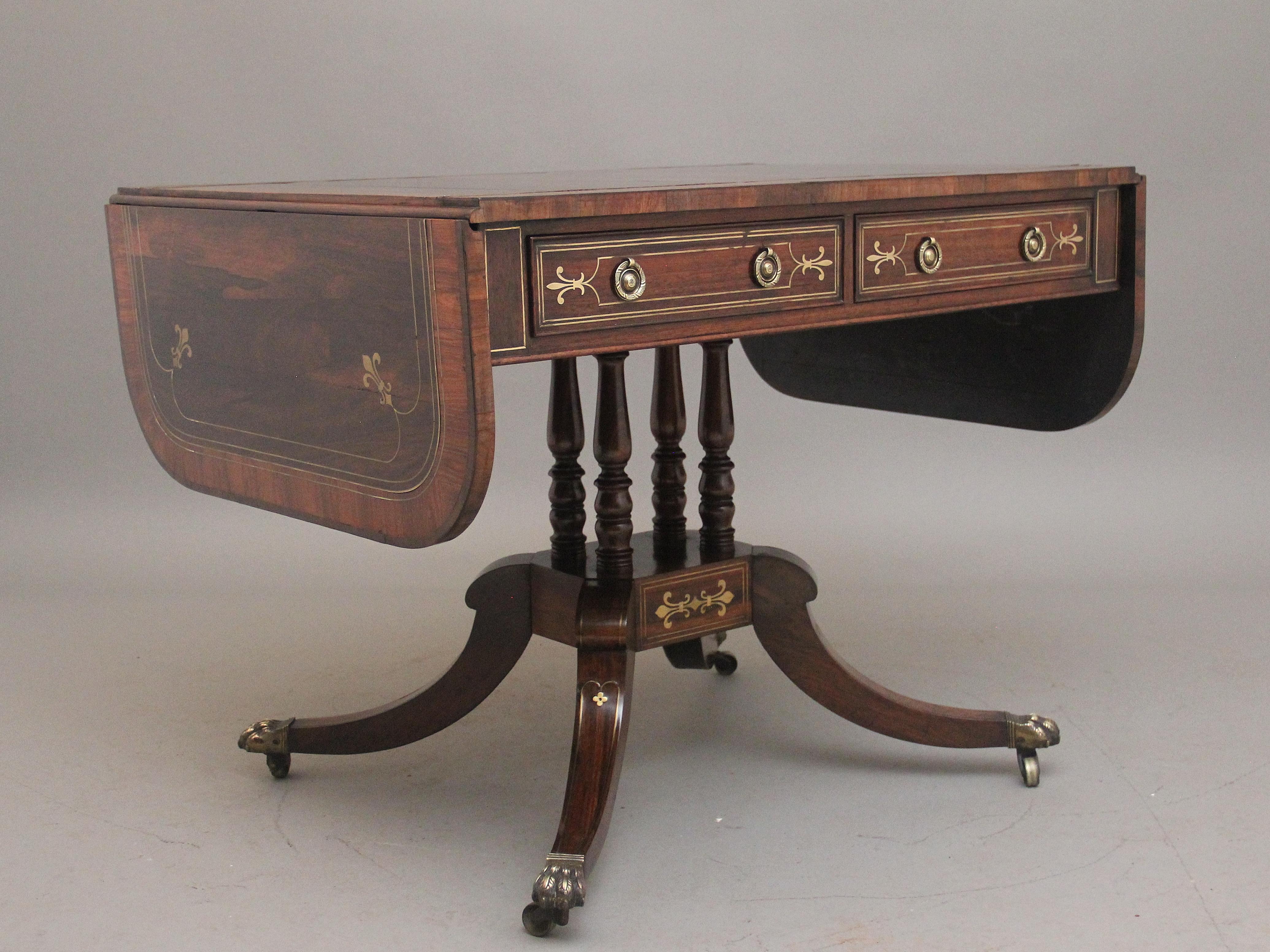
A Regency rosewood sofa table with cut-brass inlay, England, c. 1815. Sofa tables were made to stand in front of or behind a sofa. They're still good at that today!
4. America: The Parlor and the Piano
By the middle of the nineteenth century, rosewood had become the American signal that a family had arrived. The fashionable parlor of the 1850s was furnished in Rococo Revival style, and the most celebrated maker of it, the New York cabinetmaker John Henry Belter, built his famous pierced and carved chairs and sofas from thin layers of rosewood laminated together and steamed into curves, a technique he patented in the 1850s. That lamination let him carve lace-like openwork that solid timber could never have survived.
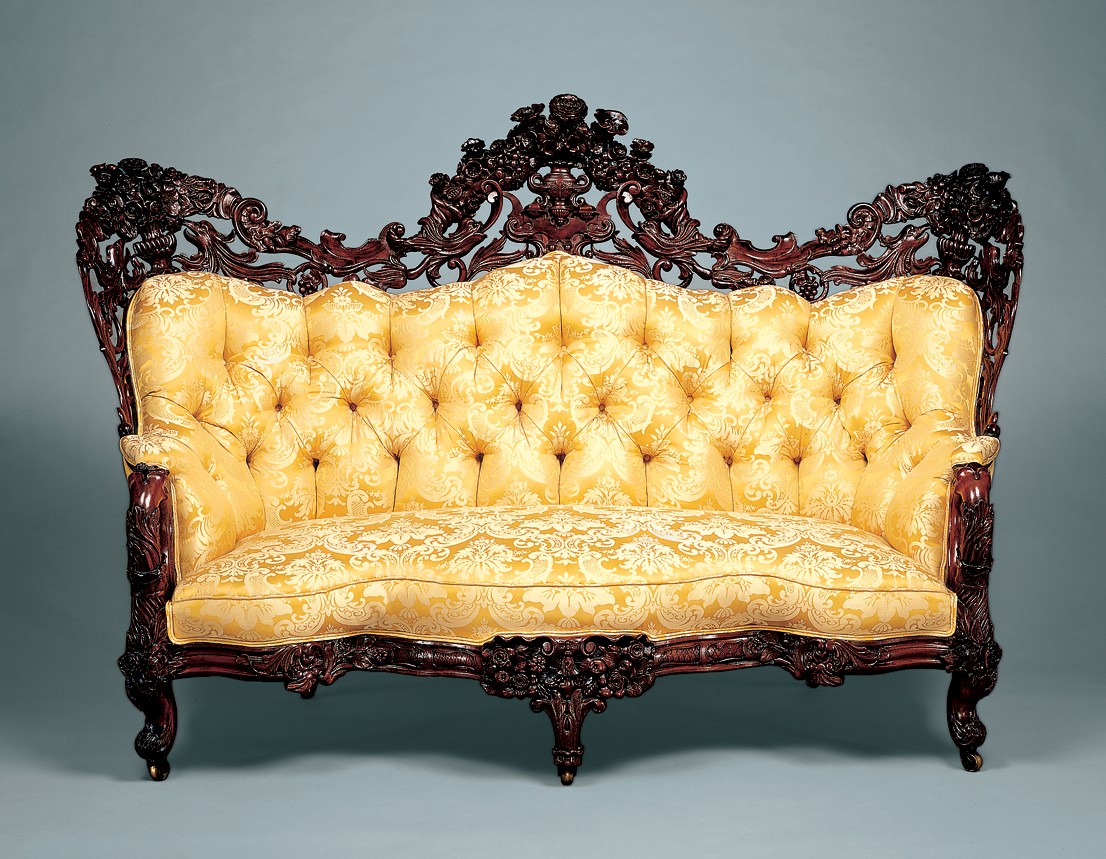
A laminated rosewood sofa by John Henry Belter, New York, c. 1855. The pierced, lace-like carving of the crest was only possible because the frame was built from thin layers of rosewood glued together and bent under steam. The Metropolitan Museum of Art.
The other status object of the American parlor was the piano, and through the middle of the century rosewood was the case wood of choice for a fashionable square or grand. If someone in your family inherited a heavy, dark Victorian piano or a carved parlor sofa with a dramatic crest, there's a good chance it's rosewood, or at least wearing it as veneer.

A Steinway & Sons square piano, patented 1858, with a rosewood case. These square pianos were in style before upright pianos took over.
5. Mid-Century Modern: Rosewood at Its Most Visible
Then came the period most people picture when they hear the word. In our Mid-Century Modern guide, teak was the everyday Danish timber. Rosewood was the upgrade.
Danish factories of the 1950s and 1960s used Brazilian rosewood for their best sideboards, wall units, desks and dining tables, and the designs suited it perfectly. A mid-century case piece is mostly flat planes: long doors, broad tops, clean sides. Those planes are exactly where a sheet of bookmatched rosewood veneer can show off, and makers chose sheets with the wildest figure they could get. Designers including Arne Vodder, Kai Kristiansen, Gunni Omann, Ib Kofod-Larsen and Poul Hundevad all worked in rosewood, and the same model often came in teak and in rosewood, with the rosewood version priced higher then and now.
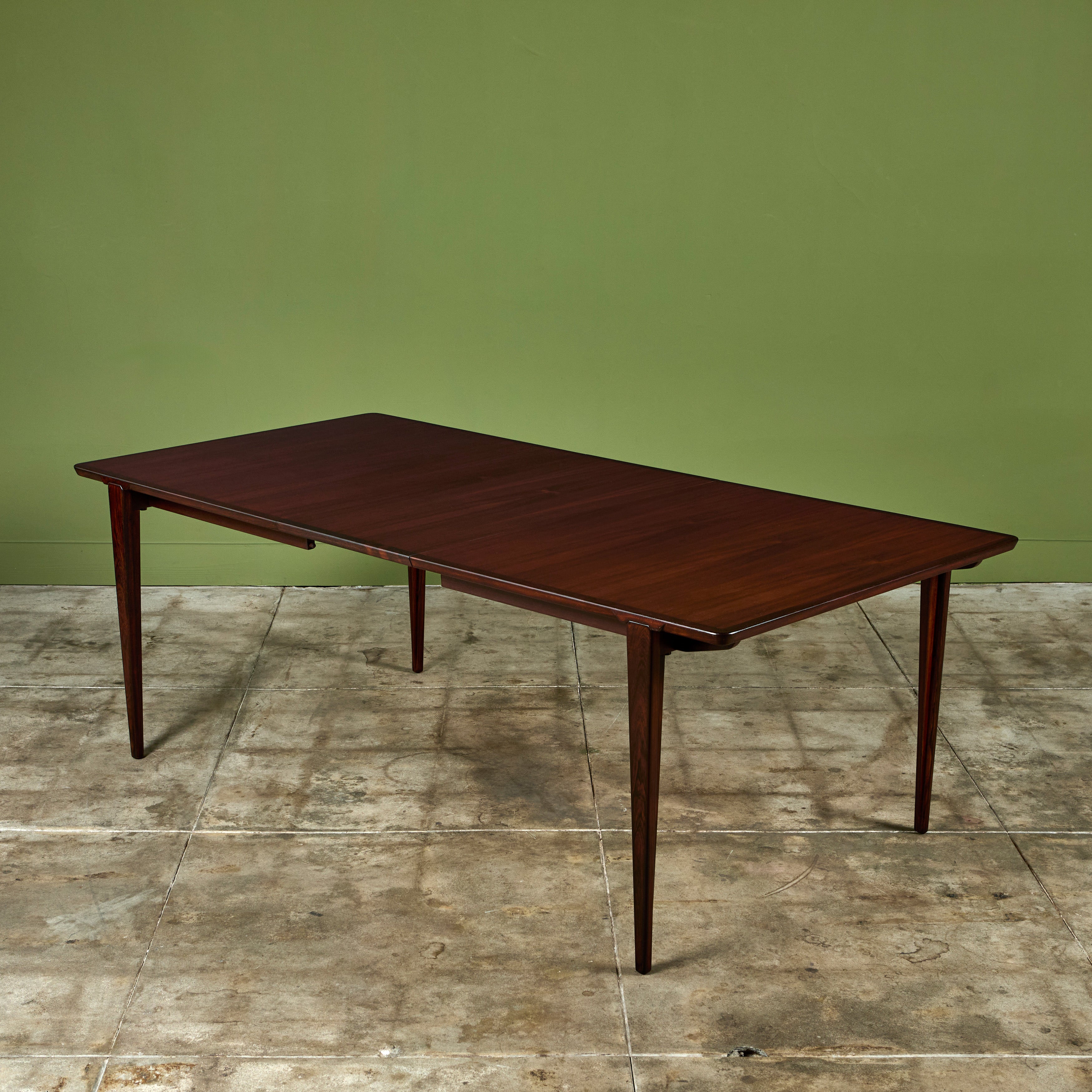
This sleek Henry Rosengren Hansen rosewood dining table was manufactured for Brande Møbelindustri, c.1960s, Denmark.
America had its own landmark. When Charles and Ray Eames released the Lounge Chair and Ottoman with Herman Miller in 1956, its molded plywood shells were faced in Brazilian rosewood veneer. Herman Miller kept rosewood as the classic option until around 1990, when it switched to more sustainable woods. Original rosewood Eames Lounges are now a collecting category of their own.
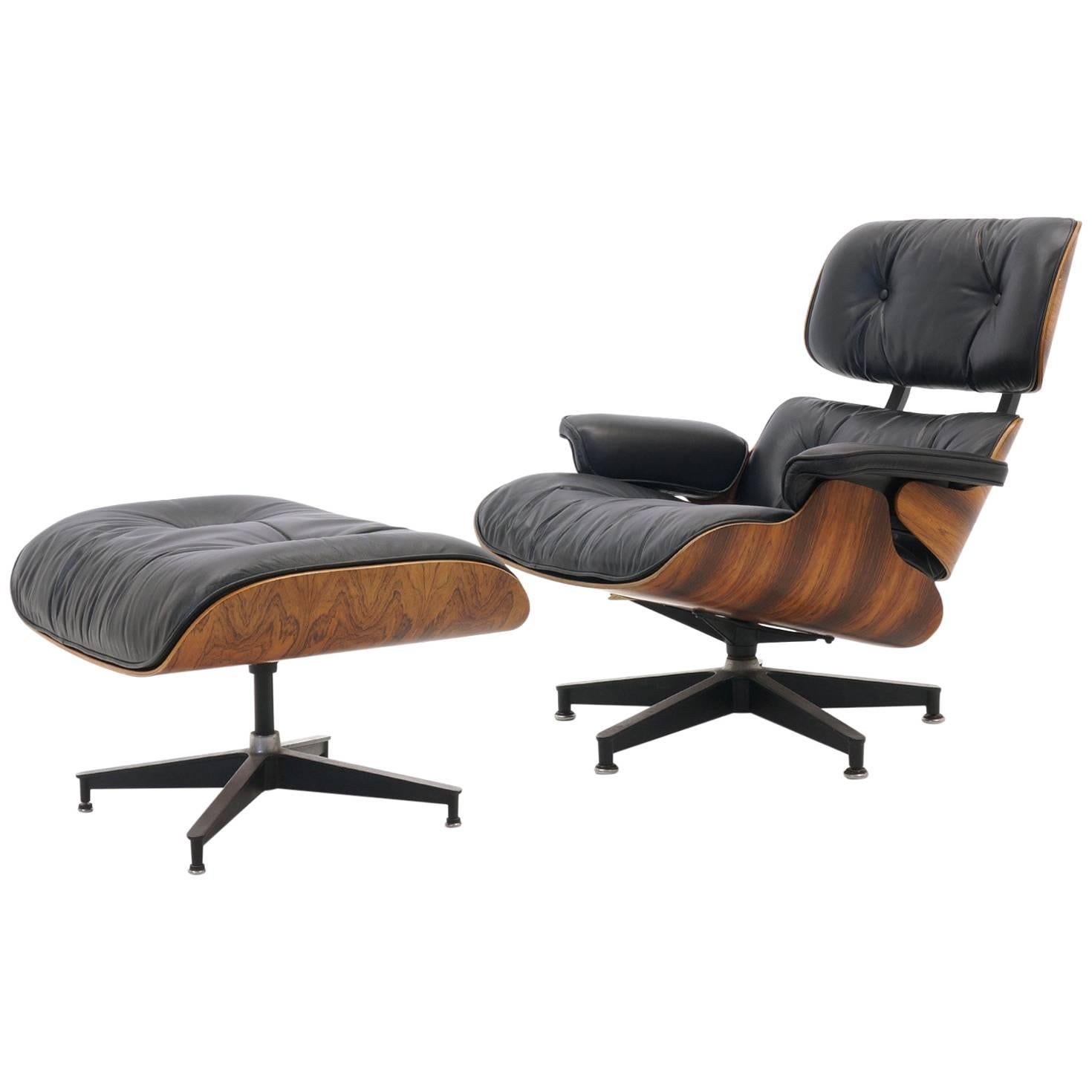
An Eames Lounge Chair (670) and Ottoman (671) by Herman Miller, with molded plywood shells in Brazilian rosewood veneer. Herman Miller ceased usage of rosewood in the early 90s, so original rosewood examples are even more expensive than their teak counterparts.
6. The End of the Supply
Rosewood's story in the twentieth century is also a story of running out. Brazilian rosewood grows slowly in the Atlantic Forest, one of the most heavily cleared forests on earth. In 1969 Brazil restricted the export of unprocessed rosewood logs, and Danish factories gradually turned to East Indian rosewood from India and Southeast Asia, which is more plentiful but plainer. That shift is why late 1960s and 1970s Danish rosewood often has a straighter, more purple-brown look than pieces from a decade earlier.
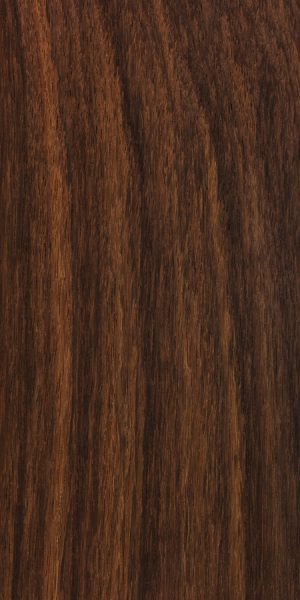
East Indian rosewood has a less dramatic grain, a cooler color, and much less contrast than Brazilian rosewood.
In 1992 Brazilian rosewood went onto Appendix I of CITES, the international treaty on trade in endangered species, its strictest category. In 2017 every other Dalbergia species followed onto Appendix II after the hongmu boom put pressure on rosewood forests across Asia, Africa and Central America. The practical result is simple: rosewood furniture is essentially no longer made in volume, and what exists is what we already have.

On March 11, 2014, Singapore's port authority seized some 30,000 smuggled rosewood logs, worth at least $50 million. It was the single biggest seizure of an illegally trafficked species in history.
The Characteristics: What Makes Rosewood Look Like Rosewood
Color That Runs All the Way Through
Rosewood's color isn't a stain. Brazilian rosewood ranges from chocolate to brick red to almost purple-black, with darker streaks running through it, and that color goes right through the timber. Where an edge has been chipped or worn, you should see the same rich brown underneath, not a pale wood with a dark skin.
Figure, Figure, Figure
This is the reason anyone paid for it. Good Brazilian rosewood has bold, irregular black lines that loop and swirl across the surface, sometimes called "spiderweb" figure, set against a warm ground. When it's cut into veneer and bookmatched (two consecutive sheets opened like the pages of a book), it produces mirrored arches and flames, often called cathedral figure. You can see it plainly on the door of our Hundevad wall unit below.
Density and Oil
Rosewoods are heavy, hard and naturally oily. That oil lets the wood take a deep, almost glassy polish with very little finish, and gives old rosewood its soft glow. It also makes the timber notoriously difficult to glue and finish, which is one reason it was so often used as veneer by specialists.
Pores and Streaks
Look closely at the surface in raking light. Rosewood is open-grained, with visible pores that often look like fine dark dashes running with the grain. Those small, irregular marks are a good sign you're looking at the real thing rather than a print.
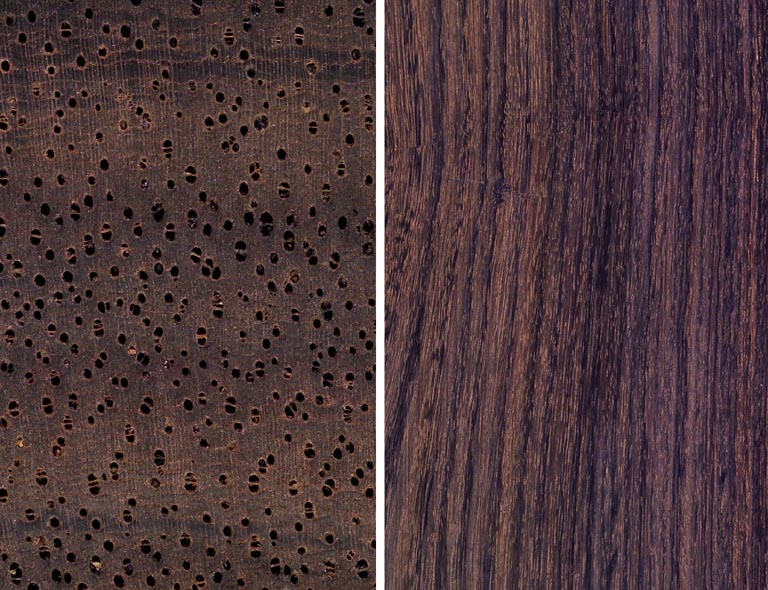
Pores and streaks characteristic of East Indian rosewood.
The Species You'll Actually Meet
|
Timber |
Botanical name |
Where it shows up |
How to recognise it |
|---|---|---|---|
|
Brazilian rosewood |
Dalbergia nigra |
Regency and Victorian work, 1950s and 1960s Danish and American modern |
Chocolate to red-brown with bold black swirls and high contrast; the most dramatic and the most valuable |
|
East Indian rosewood |
Dalbergia latifolia |
Later Danish modern, c. 1968 onward; also Indian and colonial furniture |
Purple-brown, straighter and more even grain, less contrast; handsome but calmer |
|
Honduran rosewood |
Dalbergia stevensonii |
Small objects, instruments, occasional furniture |
Pinkish to purplish brown, fine grain, less figure |
|
Kingwood |
Dalbergia cearensis |
French and later Continental marquetry |
Dark violet-brown with fine, tight stripes |
|
Tulipwood |
Dalbergia decipularis |
French marquetry and crossbanding |
Pale pink or cream with red-orange stripes |
|
Huanghuali |
Dalbergia odorifera |
Ming and Qing Chinese furniture |
Golden to amber brown, translucent luster, swirling figure |
|
Santos rosewood or "Bolivian rosewood" |
Machaerium scleroxylon |
Later reissues and modern furniture |
Not a true rosewood; lighter, more orange-brown, more variable |
|
Palisander |
Varies |
European listings of all periods |
The French word for rosewood; can mean a true rosewood or a substitute, so ask which |
Brazilian or East Indian? A Quick Test
This matters to price, so it's worth practicing. Stand back and look at the whole surface. Brazilian reads warm and busy, with reds and oranges in the ground and strong black lines that change direction across the board. East Indian reads cooler and calmer, more purple-grey brown, with grain that runs fairly straight and contrast that stays moderate. Fading complicates things, since both lighten toward honey and orange in sunlight, so look inside a door or under a top, where light hasn't reached.
East Indian rosewood isn't "fake", but don't pay Brazilian rosewood prices for it.
On Our Floor: Mid-Century Rosewood at Evolution Home
We have three rosewood case pieces in the shop right now, and they make a pretty good field guide to everything above.
Poul Hundevad Wall Units

Poul Hundevad was a Danish designer and manufacturer best known for modular shelving and wall systems, the kind of practical, well-proportioned storage that Danish homes of the 1960s were built around. We have two of his Brazilian rosewood units, each with a birch interior:
The pale birch interior is a classic Danish move. It keeps the inside of the cabinet bright (which makes finding things much easier) and it helps the rosewood outside look darker and richer by contrast.
Because the two units share the same 77-inch height and 17-inch depth, they line up neatly side by side. Together they make a wall of storage a little over 82 inches wide, just how Hundevad intended.
Rosewood Sideboard with Sliding Doors

32.5"H × 79"W × 18.25"D, $2,205. Link
Sideboards like these are what most people picture when they hear "mid-century rosewood." It's long and low, lifted on slim, round tapered legs set in from the ends, so it seems to hover. The sliding doors run uninterrupted across the front, with no hardware at all: the pulls are carved directly into the door edges, which leaves the veneer to do all the work. A softly molded edge frames the top, and a matching molding runs along the base.
Notice how the figure changes across the face, with tight dark streaks and broad orange flames. Stain can't imitate that signature Brazilian rosewood grain.
Rosewood Coffee Table and Side Table

- Coffee table, 19.75"H × 50.75"W × 31.5"D, $840. Link
- Side table, 18"H × 17.75"W × 25.5"D, $393.75. Link
These low rosewood tables feature broad, uninterrupted planes featuring a dramatic rosewood figure that runs in long dark streaks over a warm red-brown ground. These are incredible pieces well-suited for displaying the pattern of rosewood, not just the color.
How to Tell the Real Thing
With rosewood you're answering three separate questions: is it wood at all, is that wood rosewood, and which rosewood is it? One thing to set aside first is veneer. Almost all mid-century rosewood, and most Regency and Victorian rosewood, is veneer laid over a plainer core. On a Danish piece that core is often plywood, blockboard or particleboard. That's how the furniture was designed, and it isn't a mark against it.
- Rule out a print. From the 1970s onward, plenty of furniture was covered in paper or vinyl laminate printed to look like rosewood. Look for a pattern that repeats exactly across two doors, a flat, slightly plasticky sheen, and edges where a thin skin is peeling away from the core. Real veneer has depth when you tilt it toward the light, and no two areas match.
- Rule out a stain. Walnut, mahogany and even birch were sometimes stained dark and sold as "rosewood finish." Check worn edges, chips and the underside of a top. Stained wood shows a lighter color underneath; rosewood stays dark all the way through.
- Look for the pores. In raking light, rosewood shows fine, dark, dash-like pores running with the grain. Teak and walnut have pores too, but rosewood's are darker and sit in a much more dramatic figure.
- Feel the weight. On solid parts like legs, pulls and edge moldings, rosewood is surprisingly heavy for its size. A "rosewood" leg that feels light deserves a closer look.
- Check for figure variation. Every sheet of veneer is different. On a genuine piece, the figure changes from panel to panel, as on our sideboard. Perfect matching across a whole cabinet suggests a print.
- Decide Brazilian or East Indian. Use the test in the section above: warm, busy and high-contrast leans Brazilian; cool, purple-brown and straight-grained leans East Indian. Check in a spot sunlight hasn't reached.
- Find the maker's mark. Danish pieces often carry a maker's stamp, a paper label, or a Danish Furniture Makers' Control badge on the back or inside a drawer. Like the rest of these clues, a label supports a case but doesn't settle it alone.
- Read the condition honestly. Rosewood veneer is prone to fine surface checking (hairline cracks running with the grain), lifting at the edges, and fading. Patched areas often show figure that doesn't quite match its neighbors. None of these are dealbreakers, but they belong in the price.
No single test settles it. As always, you're building agreement between independent clues, the surface, the color under the wear, the pores, the weight, the figure and the marks, and staying skeptical when one of them disagrees.
A Note on the Rules
Rosewood is one of the few furniture woods that comes with paperwork attached, so it's worth a plain explanation.
CITES, the Convention on International Trade in Endangered Species, sorts protected plants and animals into tiers. Brazilian rosewood has been on Appendix I, the strictest tier, since 1992. All other true rosewoods were added to Appendix II in 2017. A 2019 revision exempted musical instruments and their parts, which is why you may remember a period when guitar players were very worried about crossing borders.
What this means for you:
- Buying and selling within the US: a vintage rosewood piece that was made and imported long ago can generally be bought, sold and moved around the country without special permits.
- Crossing a border: taking or shipping rosewood furniture out of the country, or bringing it in, can require CITES permits, and for Brazilian rosewood you may need to document that the wood predates the 1992 listing. Rules differ by country and change over time.
- Practical advice: if a rosewood piece is going overseas, talk to an experienced international shipper before you buy, not after. Receipts, dated labels and any provenance you have are worth keeping with the piece.
None of this should stop anyone buying rosewood to use at home, but it is the reason vintage is now the only realistic source. Enjoying rosewood furniture means the trees weren't cut down for nothing.
Living with Rosewood Now
The case for rosewood is easy to make. Nobody is cutting old-growth Brazilian rosewood for furniture anymore, so every good piece in circulation is part of a fixed supply. Mid-century rosewood still turns up at prices close to new mass-market furniture, while named-designer pieces in good condition sit well above their teak equivalents. Regency boxes and small tables remain some of the most affordable genuinely old rosewood around.
A few practical notes:
- Buy the useful forms. Sideboards, wall units, bookcases, desks and dining tables all work hard in a modern home. A rosewood credenza under a television or a wall unit full of books will earn its space every day.
- Let it be the dark note. Rosewood is visually heavy. It looks best against pale walls, light rugs and plain textiles like linen, wool and bouclé, which give the figure room to show.
- Mix, don't theme. One rosewood sideboard with a modern sofa reads as confident. A whole room of it starts to feel like a 1964 showroom.
- Keep it out of the sun. Rosewood fades noticeably in direct light, drifting from deep brown toward honey and orange. Rotate objects on top now and then so you don't end up with pale rings and dark squares.
- Mind the humidity. Thin veneer over a manufactured core reacts badly to dry heat. Keep pieces off radiators and away from heating vents, and consider a humidifier in winter. That's the best defense against checking and lifting.
- Go easy on the oil. Most Danish rosewood has an oil or lacquer finish. Dust with a soft, dry cloth, and if the surface looks thirsty, a very light coat of a furniture oil or wax suited to the original finish is plenty. Skip silicone sprays entirely.
- Refinish with care, or not at all. A sympathetic professional refresh of a tired mid-century surface is common and widely accepted. The risk is the veneer itself, which is thin enough that aggressive sanding can go straight through it. On Regency and Victorian rosewood, original surface matters a great deal more, and the usual rule applies: leave it alone.
Frequently Asked Questions
What is rosewood? A trade name for a group of dense, dark, figured tropical hardwoods. The true rosewoods are species of Dalbergia, including Brazilian, East Indian, Honduran and Madagascar rosewood. Several unrelated timbers are also sold as rosewood, so the name alone doesn't tell you much.
Why is it called rosewood? Freshly cut Brazilian rosewood gives off a sweet, faintly rose-like scent. The name has nothing to do with the color.
What's the difference between Brazilian and East Indian rosewood? Brazilian is warmer, redder and much more dramatic, with bold black swirling figure. East Indian is cooler and more purple-brown, with straighter grain and less contrast. Brazilian is rarer and more valuable, and Danish factories shifted toward East Indian from the late 1960s onward.
Is rosewood better than teak? They suit different rooms. Teak is lighter, golden and very durable. Rosewood is darker, denser and far more dramatic in figure. On mid-century pieces offered in both woods, the rosewood version has always cost more.
Is it legal to buy rosewood furniture? Within the US, buying and selling vintage rosewood furniture is generally fine. Taking it across international borders can require CITES permits, especially for Brazilian rosewood. Check with a shipper before sending a piece abroad.
Is my rosewood furniture solid or veneer? Almost certainly veneer, at least on the large flat surfaces. That's normal for both Regency and mid-century work. Legs, edges, pulls and moldings are more often solid.
How do I care for rosewood? Keep it out of direct sun and away from heat sources, dust with a dry soft cloth, and use oil or wax sparingly. No silicone sprays, and no aggressive sanding.
Is rosewood furniture a good investment? Treat it as a good purchase rather than a speculation. Named-designer mid-century pieces in Brazilian rosewood have held value well, and the supply can only shrink. Condition, maker and species drive price more than anything else.
A Short Glossary
Bookmatching: opening two consecutive sheets of veneer like the pages of a book so the figure mirrors across a seam. Cathedral figure: stacked, arching grain that rises up a board or panel, produced by cutting through the growth rings at an angle. CITES: the Convention on International Trade in Endangered Species, the treaty that regulates rosewood across borders. Dalbergia: the botanical genus of the true rosewoods. Hongmu: "red wood," the Chinese category of dense hardwoods approved for traditional furniture, mostly rosewoods. Huanghuali: Dalbergia odorifera, the golden rosewood of Ming furniture. Kingwood: a dark violet-brown rosewood relative used in French marquetry. Palisander (palissandre): the French and broader European term for rosewood, sometimes applied to substitutes. Santos rosewood: Machaerium scleroxylon, a South American hardwood sold as a rosewood substitute; not a true rosewood. Surface checking: fine hairline cracks in a veneer surface, usually from dryness. Tulipwood: a pale pink, red-striped rosewood relative used in French marquetry and crossbanding. Veneer: a thin sheet of decorative wood glued over a plainer core.
Evolution Home Insider publishes guides to period furniture, materials, and the craft of living with old things. If you're weighing up a rosewood piece and want a second opinion, send us photographs of the largest veneered panel in good light, a worn edge or chip, the back panel, and any labels or stamps. That's where the answers are.
Sources and further reading: CITES Appendices and annotations for Dalbergia nigra and the genus Dalbergia (1992, 2017, 2019); Eric Meier, The Wood Database entries for Brazilian, East Indian and Honduran rosewood; Craig Clunas, Chinese Furniture (Victoria and Albert Museum); Metropolitan Museum of Art collection records for John Henry Belter and American Rococo Revival furniture; Herman Miller company history of the Eames Lounge Chair and Ottoman; Victoria and Albert Museum collection records for Regency furniture.
