
The Evolution Home Insider #1: Georgian


Georgian Furniture: History, Characteristics, and How to Spot the Real Thing
Georgian furniture is the furniture made in Britain (and its colonies) between 1714 and 1830, during the reigns of George I, George II, George III, and George IV. It is defined by classical proportion, restrained symmetry, and superb cabinetmaking in walnut and then mahogany. Over those 116 years the style moves through four distinct phases — early Georgian, rococo-era Chippendale, Adam-influenced neoclassicism, and Regency — but the underlying logic never changes: a piece of Georgian furniture is built like a small building, with a base, a shaft, and a cornice, and every proportion answers to every other one.
That single idea is why a Georgian chest of drawers still looks correct in a room with a Belgian linen sofa and a Noguchi lamp. It was never designed to shout.
Key Takeaways
- Dates: 1714–1830, sometimes stretched to 1837 to include William IV.
- Signature woods: walnut first, then mahogany from roughly the 1730s, with satinwood and rosewood joining later.
- Design DNA: classical symmetry, architectural mouldings, controlled ornament, honest joinery.
- Four phases: Early Georgian → Chippendale/rococo → Neoclassical (Adam, Hepplewhite, Sheraton) → Regency.
- Best tells of authenticity: hand-cut dovetails, oak or pine secondary timbers, uneven shrinkage, oxidised brasses, and hand-tool marks on surfaces nobody was meant to see.
- Market note: so-called "brown furniture" has been unfashionable and cheap for over a decade, and is now moving back into favour — which makes this an unusually good moment to buy.
A Quick Timeline of the Georgian Period
| Reign / Phase | Dates | Dominant timber | What it looks like |
|---|---|---|---|
| George I | 1714–1727 | Walnut | Restrained curves inherited from Queen Anne; cabriole legs, shell carving, veneered burr walnut |
| George II | 1727–1760 | Mahogany | Palladian grandeur, then rococo exuberance; carved acanthus, claw-and-ball feet, Chippendale's pattern books |
| George III | 1760–1820 | Mahogany, satinwood | Neoclassical restraint; straight tapered legs, inlay and marquetry, Adam / Hepplewhite / Sheraton |
| Regency (within George III & IV) | c. 1800–1830 | Rosewood, mahogany | Archaeological Greek and Egyptian sources; sabre legs, brass inlay, lion masks, bold flat surfaces |
| George IV | 1820–1830 | Rosewood | Heavier, richer, more theatrical than the 1790s |
The History: How Georgian Furniture Actually Happened
1. Early Georgian (1714–c. 1740): Walnut, and the Beginning of Architecture in Miniature
The first Georgian furniture is essentially Queen Anne furniture with better tailoring. Cabinetmakers were working in walnut — usually as a veneer laid over a pine or oak carcase, so the figure of the wood could do the decorating — and the vocabulary was curves: the cabriole leg, the pad or claw foot, the scallop shell carved on the knee, the vase-shaped chair splat that supported the back without a rail cutting across it.
Two supply shocks changed the material. A brutal winter early in the century damaged European walnut stands, and France banned the export of walnut in 1720, which tightened supplies across the trade. Then, in 1721, Parliament passed the Naval Stores Act, which abolished import duties on timber coming from British colonies in North America and the West Indies. The Act's purpose was to secure masts, pitch and tar for the Navy. Its side effect was to make mahogany from Jamaica, Cuba and Honduras commercially viable in London workshops.
Alongside this, the Palladian movement in architecture — William Kent, Lord Burlington and the cult of Inigo Jones — pushed furniture toward the monumental. Kent designed side tables that are essentially fragments of building: massive marble tops, gilded eagles, swags, masks, broken pediments. Very few of us will ever own one. But Kent established the habit of thinking about furniture as architecture, and that habit runs through everything that follows.
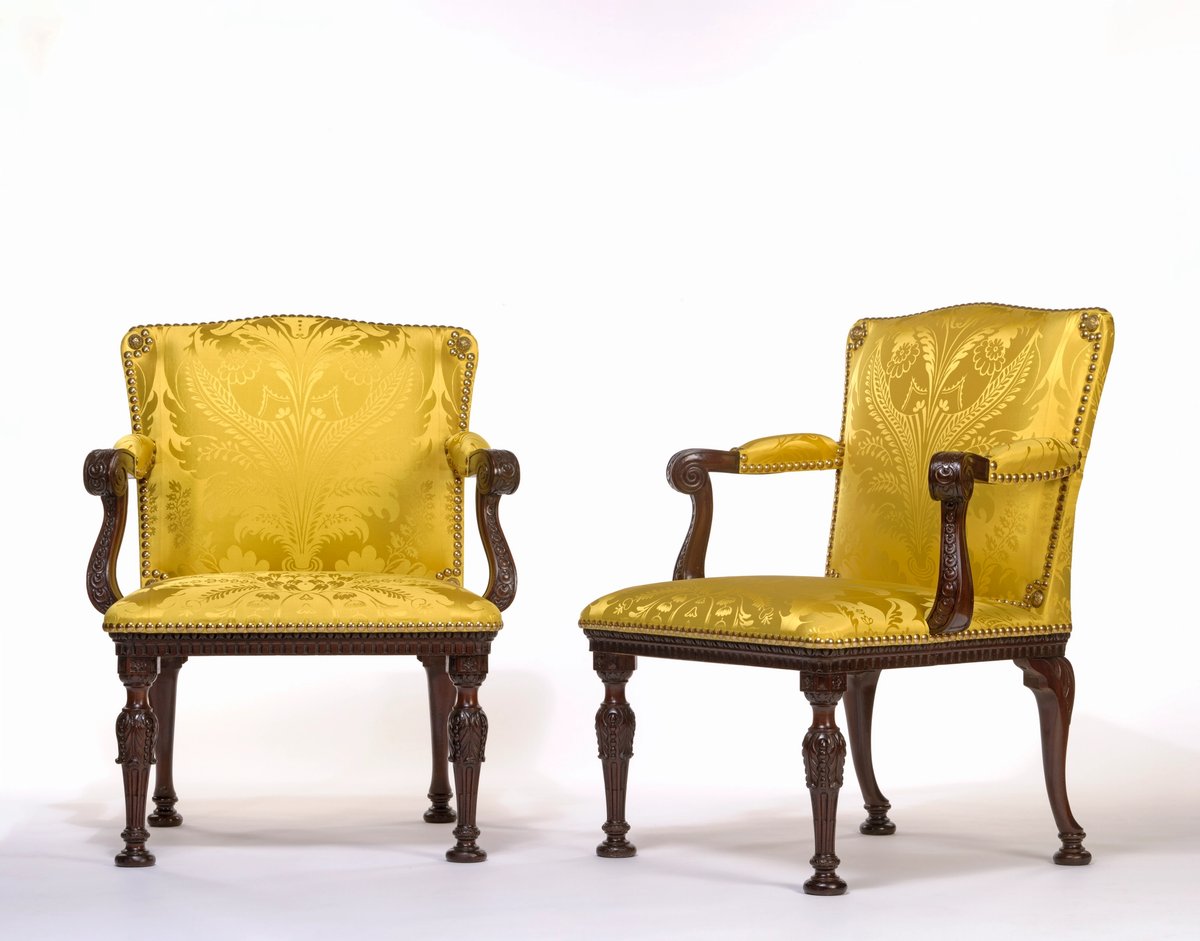
The Great Bedwyn chairs designed by Kent, rediscovered in 2019.
2. The Age of Mahogany and Chippendale (c. 1740–1765)
Mahogany did to English furniture what steel did to buildings. It is dense, dimensionally stable, resists worm, comes in enormous widths, and — critically — holds a fine carved edge without crumbling. A chair back pierced into ribbons and scrolls would have snapped in walnut. In Cuban mahogany it survives 250 years of people leaning back in it.
Into this arrived Thomas Chippendale (1718–1779), a Yorkshire joiner's son with a workshop on St Martin's Lane in London and an unusually good sense of publicity. In 1754 he published The Gentleman and Cabinet-Maker's Director, a folio of engraved designs that any competent provincial cabinetmaker could work from. It ran to a second edition in 1755 and a substantially enlarged third in 1762, and it reached America, where it was read hungrily in Philadelphia, Newport, Charleston and New York.
The Director is why "Chippendale" now means a style rather than a man. It bundled three fashionable modes into one book:
- Rococo ("the modern taste"): asymmetric C-scrolls, foliage, ribbon-back chairs, carved cabriole legs ending in a claw-and-ball foot.
- Chinese: latticework and fretted galleries, pagoda cresting, blind fret carving on square legs.
- Gothick: pointed arches, cusped tracery, cluster-column legs.
Chippendale was not alone. Ince and Mayhew published The Universal System of Household Furniture in 1762, and dozens of unrecorded workshops turned out the same forms. Most surviving "Chippendale" furniture was never touched by Chippendale.
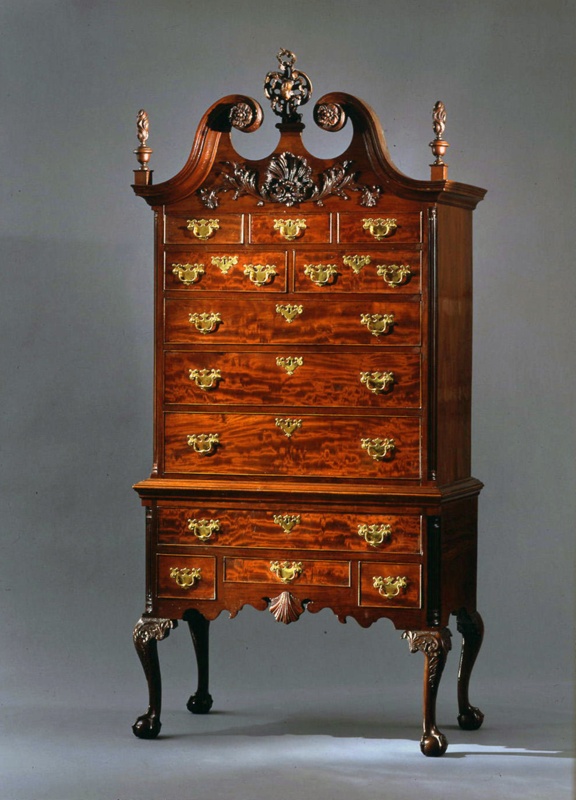
Philadelphia high chests like this are usually considered the peak of American Chippendale carving. The broken-scroll pediment with the carved rosette or urn finial is a signature of the style.
3. Neoclassicism (c. 1765–1795): Adam, Hepplewhite, Sheraton
Excavations at Herculaneum and Pompeii, plus the Grand Tour, produced a hard swing away from rococo curl. The architect Robert Adam (1728–1792) returned from Italy with a light, linear, archaeologically-flavoured vocabulary — urns, paterae, husk chains, anthemion, ram's heads, fluting — and applied it to entire interiors, furniture included, at houses like Syon, Osterley and Kenwood.
Furniture got thinner, straighter, and more decorated on the surface rather than in the round. Carving gave way to inlay, stringing, crossbanding and marquetry. Satinwood, harewood, tulipwood and boxwood arrived as contrast timbers. Legs went straight and tapered, often square in section, sometimes finishing in a small spade foot.
Two pattern books carried the look to every workshop in the English-speaking world:
- The Cabinet-Maker and Upholsterer's Guide, 1788. Published by A. Hepplewhite & Co. two years after George Hepplewhite's death, by his widow Alice, with further editions in 1789 and 1794. Nearly 300 designs. Nothing survives that can be securely documented to the Hepplewhite workshop, so the book is the style: shield-back, heart-back and oval-back chairs, serpentine settees, delicate tapered legs, French splay feet, and — a genuinely new invention — the sideboard with flanking drawers and cellaret.
- The Cabinet-Maker and Upholsterer's Drawing-Book, issued in parts from 1791. Thomas Sheraton (1751–1806) was a working cabinetmaker, drawing master and Baptist preacher who probably never ran a workshop of his own. His designs are squarer, lighter, and more mechanically inventive than Hepplewhite's: rectangular chair backs with vertical bars and small carved panels, reeded legs, painted decoration, and an obsession with dressing tables and desks full of springs, ratchets and secret drawers.

The Diana and Minerva commode at Harewood House is probably the single most celebrated piece to come out of Chippendale's later neoclassical period.
4. Regency (c. 1800–1830): The Hard Turn
The Regency proper — the years George, Prince of Wales, ruled in place of his incapacitated father — ran from 1811 to 1820, but the style begins around 1800 and continues past his accession as George IV.
Where the 1780s were graceful, the Regency is muscular and archaeological. Thomas Hope's Household Furniture and Interior Decoration (1807) and George Smith's Collection of Designs (1808) laid out a vocabulary drawn from Greek vases, Roman bronzes and Napoleon's Egyptian campaign: sabre legs copied from the Greek klismos chair, lion monopodia, paw feet, sphinxes, lotus and palmette motifs, ebonised surfaces with gilt-brass inlay and mounts. Rosewood, calamander and zebrawood joined mahogany. Ornament flattened onto the surface, and volumes got blockier.
This is the era of the sofa table, the drum table, the davenport, the canterbury and the chiffonier — small, sociable, extremely usable pieces that are, not coincidentally, the Georgian forms most likely to work in a modern house.

A signature of Thomas Hope was the klismos chair, adapted straight off Greek vase paintings.
The Characteristics: What Makes Furniture Look Georgian
Proportion Before Everything
A Georgian case piece reads as a base (bracket feet, plinth, or splay feet), a body (drawers, doors, veneered surfaces), and a top (cornice, pediment, or a simple moulded edge). The mouldings — ogee, cavetto, dentil, gadroon, egg-and-dart — come straight out of classical architecture. Ornament is applied at the joints and edges, exactly where a building carries its cornices and string courses. When a piece feels "Georgian" without your being able to say why, this is usually the reason.
The Woods
| Timber | Period | How to recognise it |
|---|---|---|
| Walnut | c. 1690–1740 | Warm mid-brown, swirling burr and feather figure, usually veneered; often faded to a honey tone |
| Cuban / "Spanish" mahogany | c. 1730–1790 | Very dense, dark reddish-brown, tight grain, takes crisp carving; often solid rather than veneered |
| Honduras mahogany ("baywood") | c. 1760 onward | Lighter, softer, straighter-grained; common in later carcase work and drawer linings on good pieces |
| Satinwood | c. 1765–1800 | Pale yellow-gold with a shimmering, satiny chatoyance; almost always a veneer on show surfaces |
| Rosewood | c. 1800–1840 | Dark chocolate-purple with dramatic black streaks; a Regency signature |
| Oak / deal (pine) | Throughout | Secondary timbers — drawer linings, backboards, dust boards, carcase framing |
Flame or "feather" mahogany, where the veneer is cut through a crotch to produce a tall arched figure, is one of the most reliably beautiful things in English furniture, and it turns up on drawer fronts, bureau falls and tallboy panels from roughly 1750 onward.
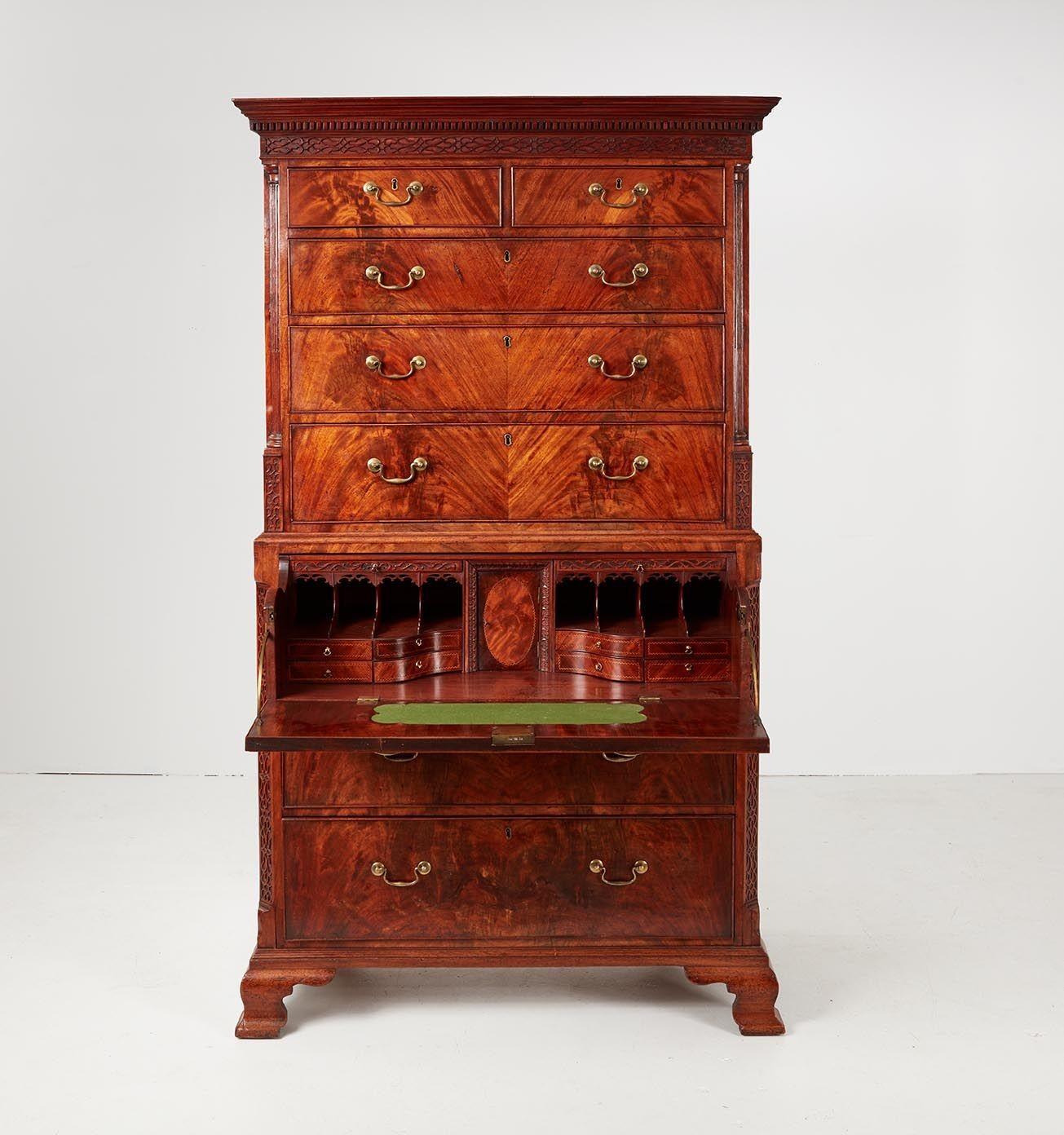
Chest-on-chests are where you see the figure at its most dramatic, since each of those long drawers gives a wide, uninterrupted panel to book-match the veneer across. This one sold for $17,900!
Legs and Feet: A Cheat Sheet
- Cabriole leg with pad, claw-and-ball, or hairy paw foot — early to mid Georgian
- Straight square (Marlborough) leg, sometimes blind-fret carved — Chippendale, 1750s–60s
- Straight tapered leg, square in section, often with spade foot — Hepplewhite, 1780s
- Turned and reeded leg — Sheraton, 1790s
- Sabre leg, curving outward like a scimitar — Regency
- On case pieces: bracket feet, then ogee bracket feet, then splayed French feet by the 1790s
Chair Backs: A Cheat Sheet
- Solid vase-shaped splat — early Georgian
- Pierced and carved splat, ribbon-back, ladder-back, Gothic tracery, Chinese fret — Chippendale
- Shield, heart, oval, wheel — Hepplewhite
- Square back with vertical bars or a central panel — Sheraton
- Broad curved top rail with a horizontal splat, on sabre legs — Regency
Hardware
Early Georgian brasses tend to be solid backplates with bail (swing) handles. By mid-century they open up into pierced rococo shapes. Neoclassical pieces favour oval or round backplates stamped with urns, wheat sheaves or shells. Regency brings lion-mask ring pulls, turned wooden knobs, and brass inlay. Original brasses are a bonus, not a requirement — they were routinely replaced as fashions changed, and the ghost marks and filled holes behind them tell that story honestly.
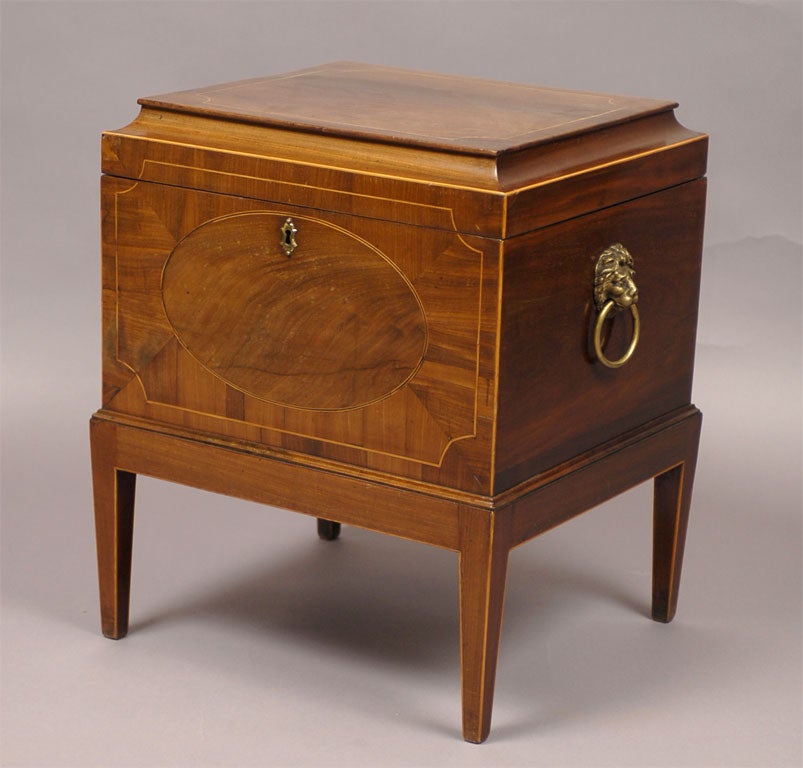
This late George III cellarette features lion-mask ring handles.
Georgian Furniture in America
Colonial cabinetmakers worked from the same pattern books, with a lag of five to fifteen years and a distinctly local accent. American "Queen Anne" and "Chippendale" furniture is Georgian furniture made in Boston, Newport, Philadelphia, New York and Charleston, in mahogany, cherry, maple and walnut, with tulip poplar or white pine as secondary woods rather than English oak and deal.
The great regional signatures are worth knowing: the blockfront-and-shell case furniture of the Goddard and Townsend families in Newport; the exuberantly carved highboys and easy chairs of Philadelphia; the restrained, tall-proportioned Boston school. After the Revolution, the neoclassical wave arrived as the Federal style, essentially Hepplewhite and Sheraton with an eagle inlaid on it. If you inherited a shield-back chair or a bow-front chest with satinwood banding from an East Coast family, this is the tradition it belongs to.
This desk and bookcase exhibits the shell-carved Newport style.
How to Tell a Period Piece from a Later Copy
The Edwardians made enormous quantities of accurate, well-built Georgian revival furniture, and the 20th century made more. These are not frauds; they are honest reproductions that now sell for a fraction of period prices. Telling them apart is a matter of looking at the parts nobody bothered to fake.
- Pull a drawer out and look at the dovetails. Hand-cut dovetails are few in number, unevenly spaced, and have narrow pins and wide tails, with faint scribe lines and chisel marks. Perfectly uniform dovetails indicate machine cutting, which dominates from the later 19th century.
- Look at the drawer sides and back. English pieces use oak linings on good work and deal (pine) on the backboards. American pieces use poplar, pine or chestnut. Mahogany all the way through, or any plywood at all, is a warning.
- Look for saw marks on hidden surfaces. Straight, slightly wandering marks come from a hand or pit saw. Arced circular-saw marks belong to the 1830s and after, and are common from the mid-19th century.
- Check the shrinkage. Wood moves across the grain for centuries. A "round" Georgian tabletop, measured carefully, is usually a little oval. A perfectly round one deserves questions.
- Read the patina in three dimensions. Oxidation should be uneven and logical: darker where light and hands reached, paler underneath, sticky-dark in the corners of drawer interiors. Uniform staining is a decorator's trick.
- Look at the feet and the base of the legs. Two hundred years of scrubbed floors, damp and moving leave feet worn, chipped and often restored. Pristine feet on a "1760" chest usually mean later replacement, which is common and forgivable, or a later piece, which is not the same thing.
- Check the screws and nails. Hand-wrought and early machine-cut screws have off-centre slots and blunt tips. Phillips-head screws are a 20th-century intrusion and mark a repair at best.
- Weigh the timber, literally. Cuban mahogany is startlingly heavy. If a "period" chair feels light in the hand, look harder.
None of these tests is decisive alone. Dating furniture is about accumulating agreement between several independent clues — style, primary wood, secondary wood, joinery, fasteners, wear — and being sceptical when one of them dissents.
Living with Georgian Furniture Now
For roughly a decade, the trade wrote off period mahogany as "brown furniture," and prices fell hard: dealers and auctioneers have described high-end antiques trading far below their turn-of-the-century peaks, with everyday pieces down more dramatically still. That correction is now reversing. The move away from all-white minimalism toward layered, personal, "inherited" interiors has put Georgian pieces back on designers' lists, along with an argument that is difficult to rebut: a 1780 mahogany chest has already lasted 240 years, was made from old-growth timber that no longer exists, and costs less than a new one from a chain store.
A few practical notes if you are buying to use rather than to curate:
- Buy the useful forms. Chests of drawers, bow-front and serpentine chests, sideboards, Pembroke and sofa tables, bureau bookcases, and sets of dining chairs all do real work in a modern house.
- Sets of chairs carry a premium. Singles and pairs are one of the last genuine bargains in the antiques trade.
- Don't strip it. Refinishing a period surface in modern materials can remove a substantial share of the value along with the patina. Wax, sparingly, once or twice a year, and skip aerosol polishes with silicone.
- Watch the environment. Central heating and direct sun are harder on 18th-century glue and veneer than two centuries of ordinary use were. Keep pieces off radiators and out of the sun's path.
- Use one as a hero. A single mahogany chest against a plain wall, or a Regency sofa table behind a contemporary sofa, does more for a room than a whole suite of period furniture ever did.
Frequently Asked Questions
What years are Georgian furniture?
1714 to 1830, covering the reigns of George I through George IV. Some dealers extend the term to 1837 to include William IV, and the Regency (c. 1800–1830) sits inside the Georgian period as its final phase.
What is the difference between Georgian and Victorian furniture?
Georgian furniture is classical, restrained and proportion-driven, and was made largely by hand in walnut, mahogany, satinwood and rosewood. Victorian furniture (1837–1901) is heavier, more eclectic and more ornamented, draws on Gothic, Rococo and Renaissance revivals, and increasingly reflects machine production — deep buttoned upholstery, coil springs, machine-cut joinery.
Is Chippendale furniture Georgian?
Yes. Thomas Chippendale worked in the middle of the Georgian period, and his Director (1754) is the defining pattern book of the mid-Georgian rococo. "Chippendale" describes a style found across Britain and colonial America, and most of it was made by other workshops.
What wood is Georgian furniture made from?
Walnut dominates until about 1740, then mahogany becomes the primary furniture wood after import duties on colonial timber were abolished by the Naval Stores Act of 1721. Satinwood appears in neoclassical work from the 1760s, and rosewood is characteristic of the Regency. Oak and pine are the secondary woods used inside drawers and carcases.
Is Georgian furniture a good investment?
Treat it as a good purchase rather than a speculation. Prices for period furniture fell sharply during the "brown furniture" slump and remain low by historical standards, and demand is now recovering. The pieces most likely to hold value are those with quality of construction, good original surface, useful form and, where possible, documented provenance.
How can I tell if my Georgian furniture is real?
Check the hidden surfaces before you look at the style. Hand-cut, irregular dovetails; oak or pine drawer linings; hand-saw or plane marks; asymmetrical shrinkage; oxidised brasses with honest ghost marks; and worn feet all point to a period piece. Machine-cut dovetails, circular saw marks, plywood, or modern screws point to a later reproduction.
A Short Glossary
Cabriole leg — an S-curved leg, swelling at the knee and tapering to the foot. Crossbanding — a border of veneer laid with the grain running across a panel's edge. Cellaret — a lidded, often lead-lined container for wine bottles, sometimes fitted into a sideboard. Fretwork — pierced or applied geometric lattice, especially in the Chinese taste. Marquetry — a picture or pattern built from shaped pieces of contrasting veneer. Patera — a small flat, round or oval classical ornament, carved or inlaid. Pembroke table — a small table with two hinged drop leaves supported on swing brackets. Splat — the central vertical element of a chair back. Stringing — a hairline inlaid line of contrasting wood or brass. Tallboy / chest-on-chest — two stacked chests of drawers, the upper slightly narrower.

Pembroke tables get their name from a Countess of Pembroke who's said to have commissioned the first one around the mid-1700s as a light breakfast table.
Evolution Home Insider publishes guides to period furniture, materials and the craft of living with old things. If you are weighing up a particular piece and want a second opinion on it, send us photographs of the drawer joints, the underside and the back — that is where the answers are.
Sources and further reading: Adam Bowett, "The 1721 Naval Stores Act and the Commercial Introduction of Mahogany," Furniture History XXX (1994); Thomas Chippendale, The Gentleman and Cabinet-Maker's Director (1754); A. Hepplewhite & Co., The Cabinet-Maker and Upholsterer's Guide (1788); Thomas Sheraton, The Cabinet-Maker and Upholsterer's Drawing-Book (1791–94); Thomas Hope, Household Furniture and Interior Decoration (1807); collection records of the Victoria and Albert Museum and the Metropolitan Museum of Art.
