
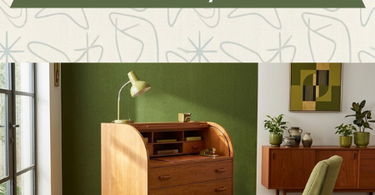
The Evolution Home Insider #2: Mid-Century Modern


Mid-Century Modern Furniture: History, Characteristics, and How to Spot the Real Thing
Mid-Century Modern furniture is the furniture designed roughly between 1945 and 1969, defined by clean lines, organic curves, honest use of new materials, and a conviction that good design should be affordable to ordinary people. It grew out of pre-war European modernism — the Bauhaus, the International Style, Scandinavian craft — and was reshaped by the optimism, new technology and mass housing of the postwar boom, mostly in the United States and Northern Europe.
The name itself is younger than the furniture. The art historian Cara Greenberg coined "Mid-Century Modern" as the title of her 1984 book Mid-Century Modern: Furniture of the 1950s, and it stuck so completely that it now covers everything from a 1946 Eames chair to a 1965 Danish teak sideboard. The phrase had drifted through print earlier — Merriam-Webster dates its first appearance to 1953 — but Greenberg gave it a framework, and collectors have used that framework ever since.
What makes a piece read as mid-century is not a single motif but an attitude: strip away anything that isn't doing work, let the material and the structure be the decoration, and build it so a factory can make thousands of them.

A 1946 "LCW" lounge chair by Charles and Ray Eames.
Key Takeaways
- Dates: roughly 1945–1969, with a golden age from about 1947 to 1965; roots reach back to the 1930s Bauhaus and International Style.
- Signature materials: teak, walnut and rosewood, plus molded plywood, fiberglass, bent tubular steel, cast aluminium and, later, molded plastic.
- Design DNA: clean lines, organic and geometric forms, tapered legs, minimal ornament, "form follows function," honest materials.
- Two great streams: American modernism (Eames, Nelson, Saarinen, Herman Miller, Knoll) and Scandinavian / Danish Modern (Wegner, Juhl, Jacobsen, Mogensen).
- Best tells of authenticity: manufacturer labels and marks, correct materials and proportions, period-appropriate construction, and honest, consistent wear.
- Market note: prices for genuine designer pieces have never been higher, even as the shops selling "mid-century inspired" lookalikes have multiplied — which makes knowing the difference worth real money.
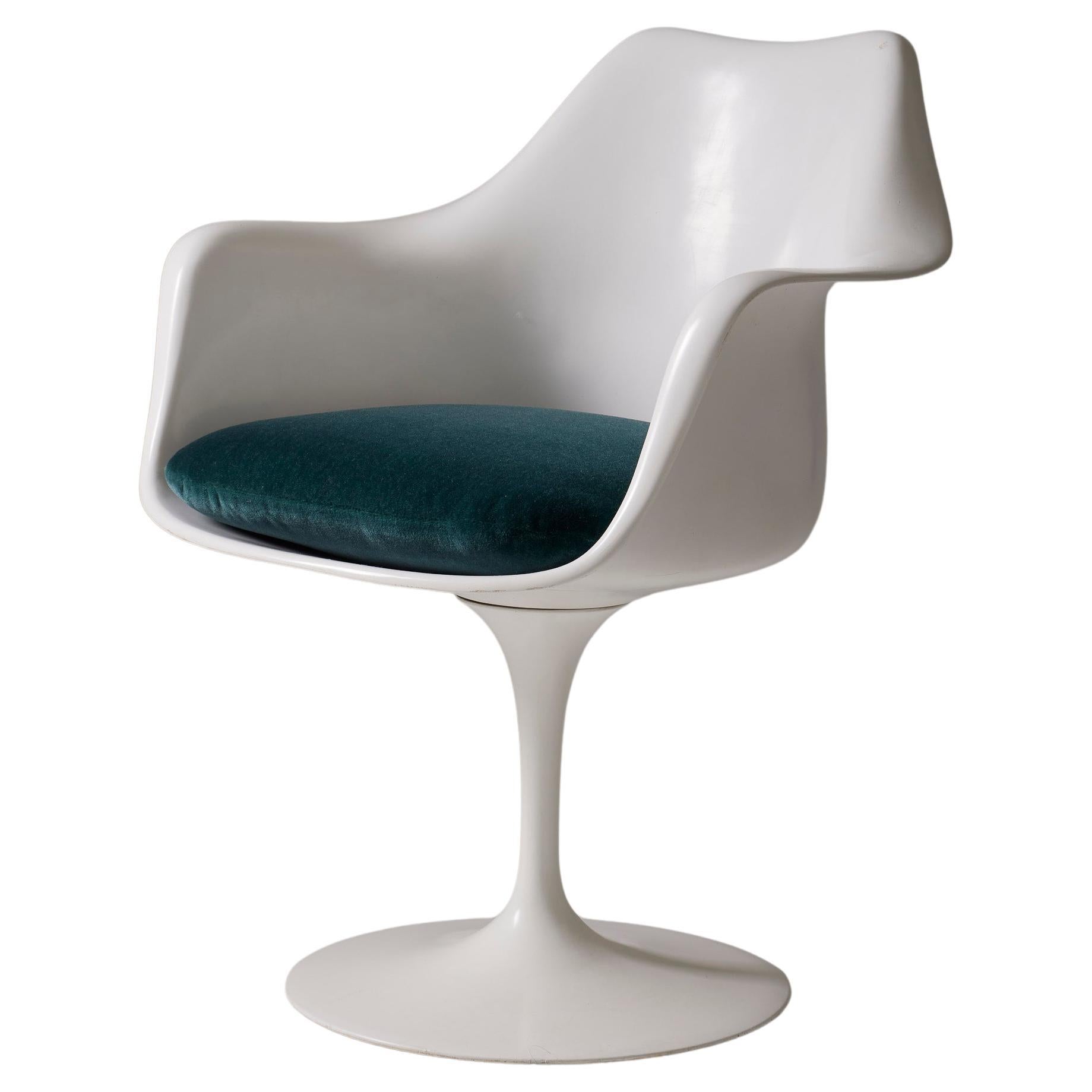
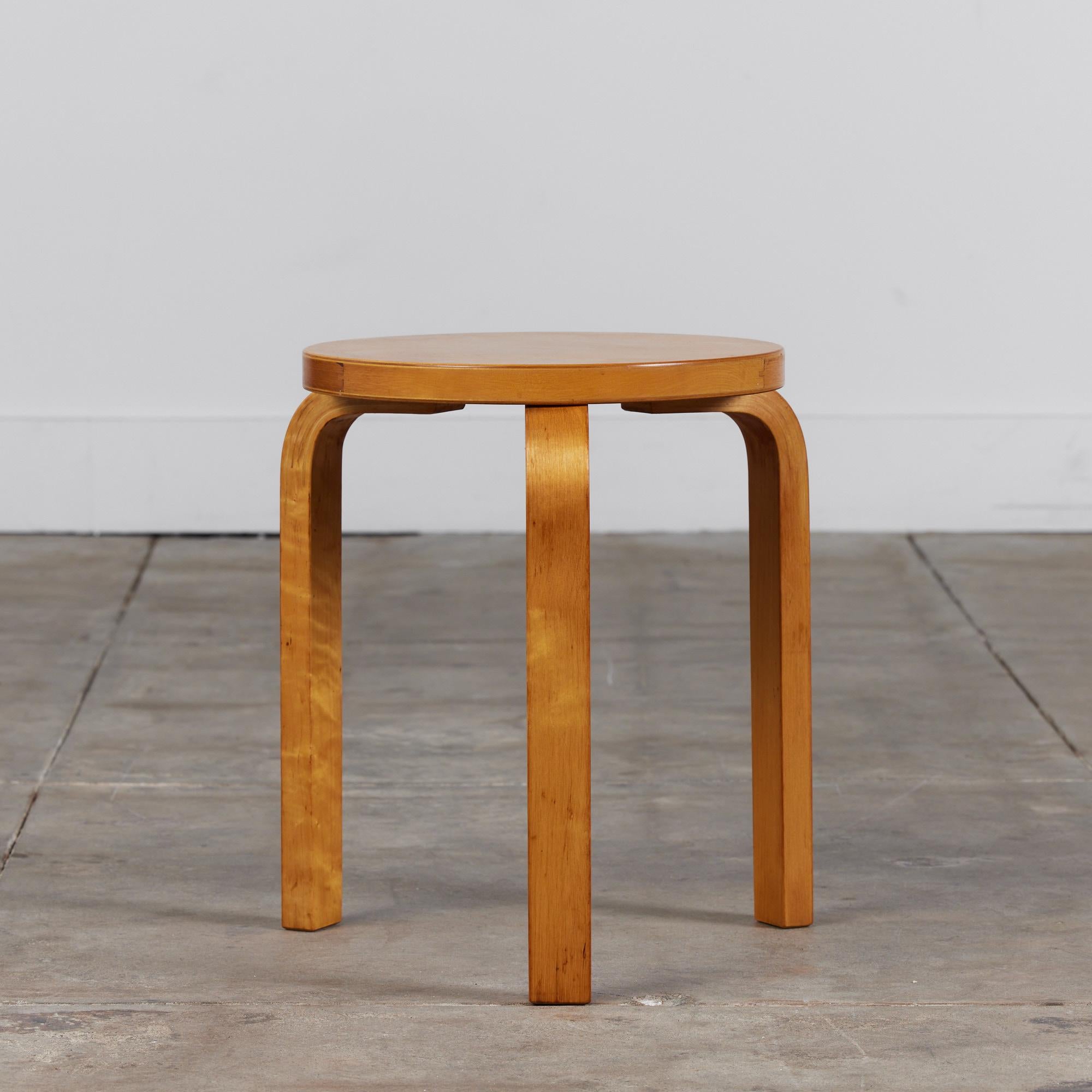
Left: A staple of American MCM, Eero Saarinen's Tulip chair, 1956. Right: A staple of Scandinavian MCM, Alvar Aalto's Stool 60, 1933. In general, American design invents new materials for the style, whereas Scandinavian design adapts traditional materials to it.
A Quick Timeline
| Year | Moment | Why it matters |
|---|---|---|
| 1919–1933 | The Bauhaus in Germany | Establishes the modernist creed — function, honesty, no ornament — that mid-century inherits |
| 1940 | MoMA's Organic Design in Home Furnishings competition | Charles Eames and Eero Saarinen win with molded plywood; a generation of careers begins |
| 1945–46 | Eames plywood group released | Molded-plywood chairs and tables reach the public; postwar modernism goes commercial |
| 1946 | George Nelson becomes design director at Herman Miller | Turns a small Michigan firm into modernism's most influential manufacturer |
| 1948–50 | Eames fiberglass shell chair; Wegner's Wishbone | New materials and Danish craft mature at the same moment |
| 1956 | Eames Lounge Chair and Ottoman | The luxury statement piece of the movement |
| 1957–58 | Saarinen Tulip; Jacobsen Egg and Swan | Sculptural, single-pedestal and enveloping forms peak |
| 1984 | Cara Greenberg names the style | "Mid-Century Modern" enters the language |
The History: How Mid-Century Modern Happened
1. Before the War: The Modernist Inheritance
Mid-century did not appear from nowhere in 1945. Its parents were the European avant-garde of the 1920s and 30s: the Bauhaus in Germany, with its belief that art, craft and industry should be one thing and that good design belonged to everyone; Le Corbusier's line that "a house is a machine for living in"; and the tubular-steel experiments of Marcel Breuer and Mies van der Rohe. When the Bauhaus was closed under political pressure in 1933, many of its figures emigrated to the United States, carrying the creed with them into American universities and workshops.
Two events set the American stage. The 1939 New York World's Fair sold the public on a streamlined, optimistic future in the home. Then, in 1940, the Museum of Modern Art ran a competition called Organic Design in Home Furnishings, and a young Charles Eames and Eero Saarinen won first prize for chairs built from molded plywood. MoMA had appointed itself a tastemaker in design, and it had found its designers.
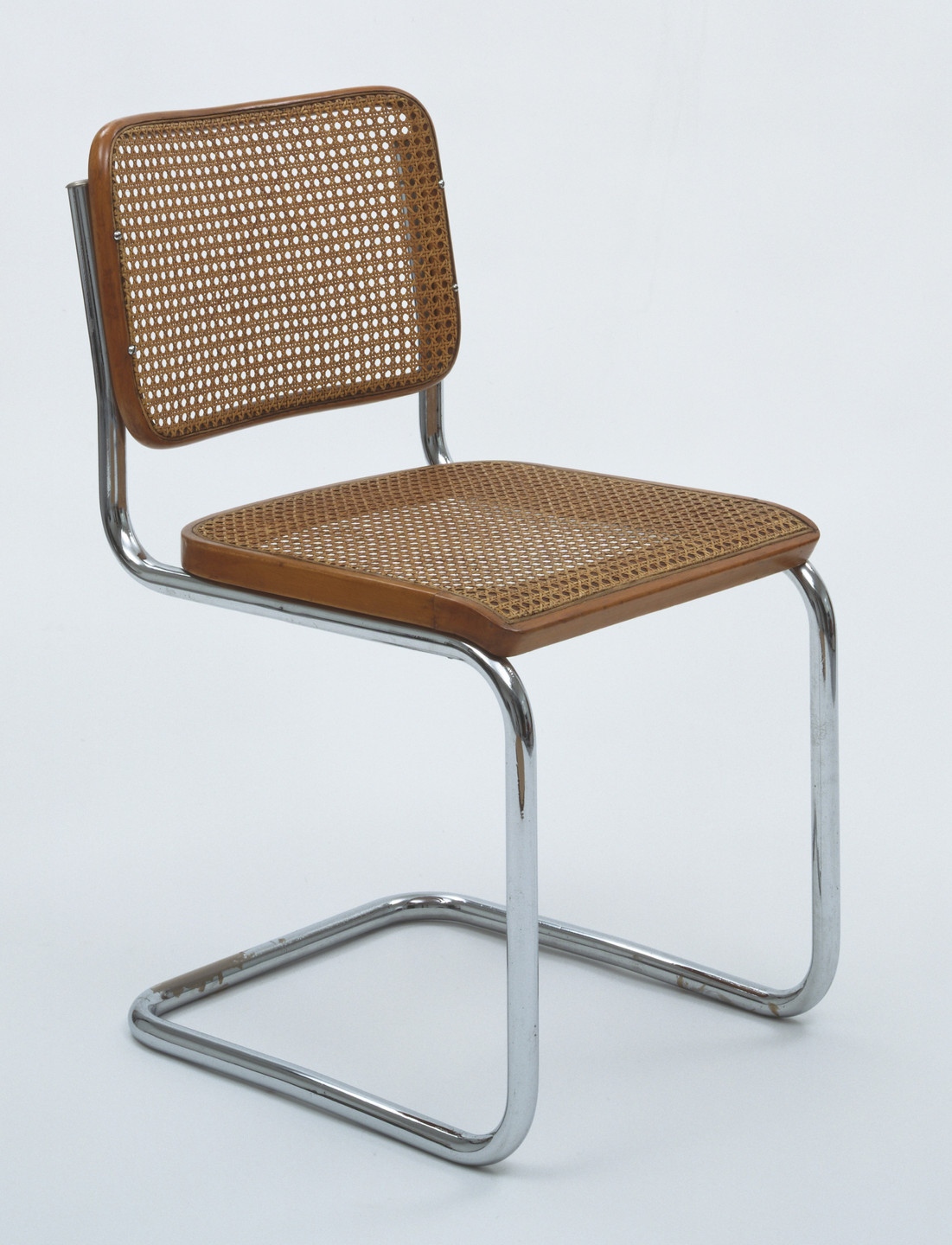
Breuer's Cesca chair, designed in 1928, using cantilevered tubular steel with a caned seat and back.
2. The Postwar Engine
The style became a mass phenomenon because the postwar conditions demanded it. Soldiers came home, families grew, and the country needed enormous quantities of new, smaller, cheaper houses. Ornate, heavy, formal furniture made no sense in a compact tract home with a young family and no live-in help. What was needed was light, practical, easy-to-clean furniture that a factory could turn out affordably — and the war had just perfected the technologies to do it.
Wartime research into molding plywood for aircraft parts and leg splints, and into fiberglass and new plastics, translated directly into furniture. Charles and Ray Eames had spent the war molding plywood; in 1945–46 they released the plywood group — the LCW and DCW chairs, plus matching tables — first through the Evans Products Company and then through Herman Miller, which bought the manufacturing rights and took over production by 1949–50. Time later called the LCW the best design of the twentieth century.
The Eames credo captures the whole movement: "the best, for the most, for the least." A single molded shell could be dropped onto a wood base, a metal base, or wire legs, so one form generated a whole family of products — an efficiency the Eameses pushed even further with their fiberglass shell chairs from the late 1940s.

These molded fiberglass shell chairs are comfortable without upholstery, making them quicker and easier to produce.
3. The American Powerhouse: Herman Miller and Knoll
Two manufacturers turned individual genius into a movement. When George Nelson joined Herman Miller as design director in 1946, he assembled a roster that included the Eameses, Isamu Noguchi and the textile designer Alexander Girard, and made the Michigan company synonymous with modern design. Nelson's own Platform Bench (1946), Ball Clock and Marshmallow Sofa became icons in their own right.
Knoll, guided by Florence Knoll, did the same on a more architectural, corporate axis. Florence Knoll's own restrained cabinets and sofas furnished the postwar American office, and she famously challenged Saarinen to design "a chair that was like a basket full of pillows — something I could curl up in," which produced the Womb Chair (1948). Saarinen followed with the Tulip series (1957), whose single fiberglass-and-aluminum pedestal was his answer to what he called the "slum of legs" under a typical table.
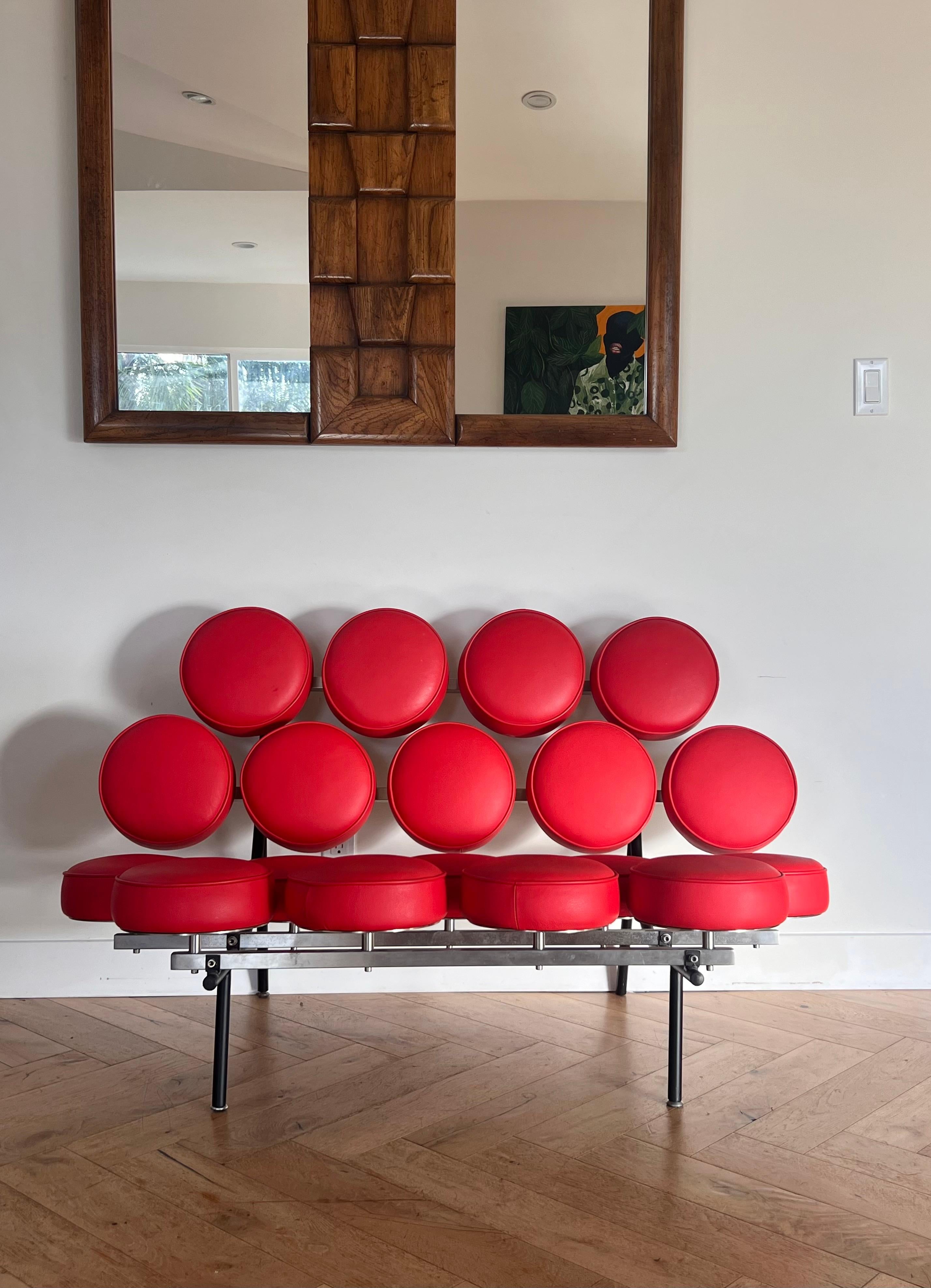
George Nelson's Marshmallow Sofa, 1956, is a classic of American MCM. Each standardized foam disc is easier to manufacture than upholstering a continuous seat.
4. The Scandinavian Stream: Danish Modern
While Americans engineered new materials, the Scandinavians perfected wood. Danish Modern ran on a different engine — centuries of cabinetmaking tradition, an annual system of Copenhagen Cabinetmakers' Guild exhibitions, and designers who trained as craftsmen first.
Hans Wegner (1914–2007), often called the master of the chair, designed close to 500 of them. He apprenticed to a cabinetmaker at fourteen and considered himself a carpenter before a designer. His Wishbone Chair (designed 1949, in continuous production since 1950 with Carl Hansen & Søn) took its Y-shaped back splat and light frame from portraits of Danish merchants in Ming-dynasty chairs; his Round Chair (1949) was so photogenic it appeared on the set of the first Kennedy–Nixon television debate in 1960.
Finn Juhl brought a sculptor's eye, floating upholstered seats and backs away from their frames as if they were art objects, and helped introduce Danish design to America around 1949–51. Arne Jacobsen, an architect, designed the stacking Ant chair, then in 1958 produced the Egg and Swan chairs for the lobby of the Radisson SAS (now Royal) Hotel in Copenhagen — enveloping, sculptural forms molded over a foam-covered shell. Børge Mogensen pushed the plainer, more democratic side of the same tradition.
The common thread was teak — later oak and rosewood — and joinery of a standard that made "Danish Modern" a byword for furniture that was beautiful, sturdy and made to last, rather than merely fashionable.
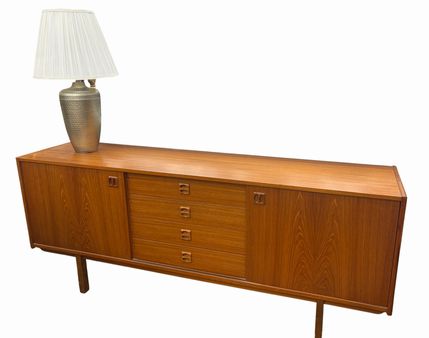
This 1960s Danish Modern teak sideboard is for sale at Evolution Home!
The Characteristics: What Makes Furniture Look Mid-Century
Form Before Ornament
The single rule underneath everything is form follows function: if the shape does its job well, decoration adds nothing. So mid-century pieces have almost no applied ornament — no carving, no moulding, no inlay. The interest comes from the silhouette, the grain of the wood, the contrast of materials, and the structure left visible.
Clean Lines and Organic Curves, Together
Mid-century holds two impulses in balance. One is geometric and rectilinear — the crisp cabinets, the low horizontal sideboard, the boxy sofa. The other is organic and biomorphic — the kidney-shaped Noguchi table, the scooped Tulip shell, the curved back of a molded chair. A good mid-century room usually plays a hard straight line against a soft curve.
Tapered Legs and Raised Bodies
Perhaps the most recognisable single feature: slim legs, often round in section, frequently splayed slightly outward, sometimes tipped with brass or bound to the frame with an angled bracket. Case pieces sit up on these legs rather than down on a plinth, so the furniture looks light and the floor stays visible beneath it. This raised, airy stance is the fastest way to read a room as mid-century.
The Materials
| Material | Where it shows up | Notes |
|---|---|---|
| Teak | Danish sideboards, tables, chairs | The hallmark of Scandinavian modern; warm, oily, golden-brown, ages beautifully |
| Walnut | American case goods, Nelson and Nakashima pieces | Deep warm brown; the signature American MCM hardwood |
| Rosewood | High-end Danish and American pieces | Dramatic dark streaks; Brazilian rosewood is now endangered and heavily regulated |
| Molded plywood | Eames chairs and tables | Curved in compound shapes wartime technology made possible |
| Fiberglass | Eames shell chairs, Tulip chairs | Molded in one piece; later reissues often switch to safer plastics |
| Tubular / bent steel | Legs, frames, bases | Inherited from Bauhaus; chromed or enamelled |
| Cast aluminium | Eames Aluminum Group, Tulip bases | Strong, light, sculptural |
A quick material tell: solid teak, walnut or rosewood points toward an authentic vintage piece. Rubberwood, pine, or low-grade plywood with a printed grain points toward a modern lookalike.
Colour and Upholstery
Against the warm woods, mid-century leans on a particular palette: neutral grounds — white, grey, oatmeal — punctuated by saturated accent colours drawn from the era's optimism, mustard, avocado, burnt orange, teal, tomato red. Upholstery runs to wool tweeds, textured weaves and, on the higher-end pieces, leather. (Bouclé, everywhere again today, is a period-correct choice on Womb and shell chairs.)
Multi-Function and Modularity
Because the target was the smaller postwar home, mid-century prized pieces that earned their space: modular shelving and storage walls, sofas that converted, nesting tables, room dividers that stored things while separating spaces. The furniture was designed to flow with open-plan living rather than fill closed formal rooms.

Pictured, the Stahl House - Case Study House #22. Located in Los Angeles and designed by Pierre Koenig in 1959, it's considered one of the more successful Case Study Houses and certainly a definitive icon of American Modernist architecture.
Iconic Pieces Worth Knowing
- Eames Molded Plywood Chair (LCW/DCW), 1945–46 — the breakthrough that made the Eames name; one seat form, many bases.
- Eames Lounge Chair and Ottoman, 1956 — molded plywood shells and leather cushions; the movement's luxury statement.
- Eames Fiberglass Shell Chair, from 1948–50 — the "best for the most for the least" made literal; the ubiquitous molded seat.
- Noguchi Coffee Table, 1948 (Herman Miller) — two interlocking wood supports under a heavy free-form glass top; treated as sculpture as much as furniture, with rare early examples reaching six figures at auction.
- Saarinen Tulip Table and Chairs, 1957 (Knoll) — a single sculptural pedestal that cleared the legs out from underfoot.
- Saarinen Womb Chair, 1948 (Knoll) — Florence Knoll's "basket full of pillows."
- Wegner Wishbone Chair (CH24), 1949 (Carl Hansen & Søn) — the most reproduced Danish chair, still made on the original line.
- Jacobsen Egg and Swan Chairs, 1958 — sculptural, enveloping shells designed for a single Copenhagen hotel.
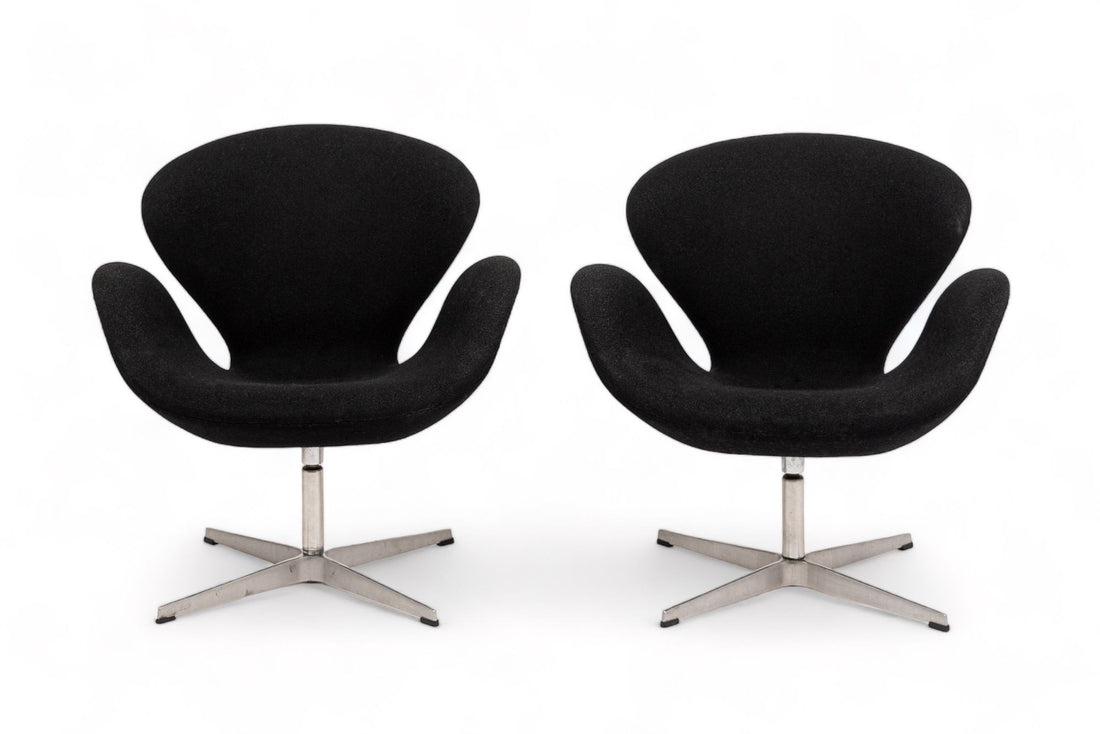
Jacobsen's swan chairs are a Mid-Century Modern staple.
How to Tell a Genuine Piece from a Reproduction
Mid-century's popularity is exactly its authentication problem. The market is layered: authentic vintage originals (roughly 1945–1975) made by the original manufacturers; licensed reissues still made by Herman Miller, Knoll, Carl Hansen and Vitra; honest "inspired-by" pieces from retailers like West Elm that never claim to be the real thing; and outright fakes. Telling them apart is a matter of looking past the silhouette, which is easy to copy, to the things that are hard to fake.
- Find the label or mark first. Most original pieces carry a manufacturer's label, stamp, medallion or branding — Herman Miller, Knoll, Carl Hansen & Søn, a Danish "Made in Denmark" control mark, a designer's signature. Learn what the correct mark looks like for the specific model and era, and photograph it. Labels can be removed or faked, so treat them as one clue, not a verdict.
- Check the material against the claim. Solid teak, walnut and rosewood are right; a piece "in the mid-century style" made of rubberwood, particle board, or plywood with a printed wood-grain photo finish is a modern reproduction.
- Measure the proportions. Reproductions frequently get dimensions subtly wrong — a leg splayed at the wrong angle, a shell a centimetre too deep, a back too upright. Compare against verified images of the authentic model.
- Look at the construction. Genuine pieces show real joinery and quality fixings appropriate to their maker and date. Sloppy joints, staples where there should be screws, or a suspiciously perfect factory finish are warnings.
- Read the wear. Age-appropriate patina — softened edges, honest wear where hands and feet actually land, mellowed teak — should be consistent across the piece. Wear in odd places, or a "vintage" piece with no wear at all, deserves suspicion.
- Weigh the price and the seller. A genuine Wegner or Eames priced far below the market usually isn't genuine. Reputable dealers and auction houses provide provenance and label images; sellers who can't or won't warrant caution.
None of these tests is decisive alone. Authentication is about agreement between several independent clues — mark, material, proportion, construction, wear, provenance — and walking away when they don't line up.
A note on reissues: a licensed reissue is not a fake. A new Wishbone Chair from Carl Hansen & Søn or an Eames Lounge from Herman Miller is the real design, made to the original standard, and perfectly honest to buy and own. It simply won't carry the collector value or the patina of a 1950s original, and it shouldn't be sold as vintage.
Living with Mid-Century Modern Now
The style never really left, and prices for genuine designer pieces are at record highs even as the market floods with lookalikes. That combination rewards knowing what you're looking at. A few practical notes:
- Buy the useful forms. Sideboards, low storage, dining chairs, coffee and side tables, and lounge chairs all do daily work and suit open-plan rooms.
- Vintage originals hold value best. If you're buying as an investment as much as for use, an authenticated original from a known maker is the piece that appreciates; a "mid-century inspired" lookalike is furniture, not an asset.
- Consider a licensed reissue for pieces you'll use hard. Getting the design without the fragility or the collector premium is a legitimate choice for a dining chair a family will actually sit in.
- Respect the material. Teak and walnut want oil or wax, not silicone sprays. Keep pieces out of direct sun, which fades wood and cracks old finishes, and off radiators.
- Mix, don't theme. Mid-century looks best as a few strong pieces against plainer surroundings, layered with texture — a wool rug, linen or bouclé, a plant, warm light — rather than a wall-to-wall recreation of a 1959 showroom.
Frequently Asked Questions
What years are Mid-Century Modern furniture?
Roughly 1945 to 1969, with a widely cited golden age from about 1947 to 1965. The style's roots reach back to the 1930s Bauhaus and International Style, and some pieces made into the early 1970s still count. The term itself was popularised by Cara Greenberg's 1984 book.
What is the difference between Mid-Century Modern and modern furniture?
"Modern" refers to the broad early-twentieth-century modernist movement (Bauhaus, International Style) that rejected historical ornament. "Mid-Century Modern" is the specific postwar chapter of that movement, roughly 1945–1969, which softened modernism's hard edges with organic curves, warm woods and new materials, and aimed it at the ordinary consumer home.
What wood is Mid-Century Modern furniture made from?
Teak is the hallmark of Scandinavian and Danish Modern; walnut is the signature American hardwood; rosewood appears on higher-end pieces (Brazilian rosewood is now endangered and regulated). Molded plywood, fiberglass, bent steel and cast aluminium are the other defining materials.
Is Mid-Century Modern furniture a good investment?
Authenticated vintage originals from known makers — Herman Miller, Knoll, Carl Hansen, and named designers like Eames, Wegner, Juhl and Jacobsen — have appreciated strongly and command record prices. "Inspired-by" reproductions are not investments; they're inexpensive furniture. Provenance, condition, maker and correct materials drive value.
How can I tell if my Mid-Century Modern furniture is authentic?
Start with the maker's label or mark and confirm it's correct for that model and era. Then check that the material matches the claim (solid teak or walnut, not printed-grain plywood), that the proportions match verified examples, that the construction and joinery are quality, and that the wear looks honest and consistent. No single test is conclusive; look for several clues to agree.
Are Eames chairs still made?
Yes. Herman Miller (and Vitra in Europe) produce licensed authorised versions of Eames designs to this day, and Carl Hansen & Søn still makes Wegner's Wishbone Chair on its original line. These reissues are genuine designs made to original standards, distinct from both 1950s vintage originals and unlicensed fakes.
A Short Glossary
Biomorphic — a free, organic form inspired by natural shapes, like the Noguchi table. Danish Modern — the Scandinavian, craft-based, teak-and-oak stream of mid-century design. Fiberglass shell — a seat molded in one piece from glass-reinforced plastic; an Eames signature. Form follows function — the modernist principle that a design's shape should be dictated by its purpose. International Style — the pre-war modernist architecture and design movement that fed mid-century. Molded plywood — thin wood layers glued and bent under heat and pressure into compound curves. Organic modernism — the softer, curved wing of the style, as opposed to strict geometry. Pedestal base — a single central support replacing four legs, as in Saarinen's Tulip series. Reissue — an authorised, currently produced version of an original design. Tapered leg — a slim leg narrowing toward the floor, often splayed; the movement's most recognisable feature.
Evolution Home Insider publishes guides to period furniture, materials and the craft of living with old things. If you're weighing up a specific mid-century piece and want a second opinion, send us photographs of the label or maker's mark, the joinery, and the underside — that's where authenticity is decided.
Sources and further reading: Cara Greenberg, Mid-Century Modern: Furniture of the 1950s (1984); Museum of Modern Art, Organic Design in Home Furnishings competition (1940) and New Furniture Designed by Charles Eames (1946); manufacturer histories and archives from Herman Miller, Knoll and Carl Hansen & Søn; collection records of the Victoria and Albert Museum and the Museum of Modern Art; Britannica, "What Is Mid-Century Modern Design?"
