
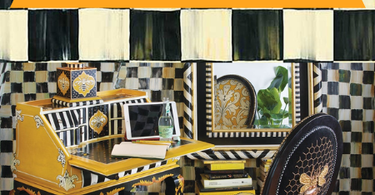
The Evolution Home Insider #6: MacKenzie-Childs


MacKenzie-Childs: History, Characteristics, and How to Spot the Real Thing
Most of the makers we cover spent their careers perfecting the art of good manners. MacKenzie-Childs went the other way entirely.
Since 1983, the company has been hand-painting majolica, enamelware, glass, and furniture on a converted dairy farm above Cayuga Lake in Aurora, New York, working from one governing belief: a plain surface is a wasted opportunity. Checks against florals against stripes against dots, all of it brushed by hand, all of it finished with a gold edge that wanders a little because a person put it there. You either fall for it immediately or you don't, and there isn't much middle ground.
Here's the part that makes it fun to collect. MacKenzie-Childs is still in business, still on the same farm, and still stamping the initials of the artisan who decorated each piece into the glaze. Forty-three years of retired patterns sit in a documented archive, and the marking system has changed often enough that a stamp on the foot can date a piece to within a couple of years. Turn a bowl over and it will usually tell you where it was made, roughly when, and who painted it. Very few living brands hand you that much.

The Courtly Check kettle is MacKenzie-Childs' signature piece. The hand-painted checks, the darkened bronze rim, and the bright finial are all hallmarks of the brand.
Key Takeaways
Founded: 1983 in Aurora, New York. Still producing, still headquartered on the same farm.
Founders: Victoria MacKenzie-Childs (1948 to 2026) and Richard MacKenzie-Childs, both trained in ceramics at Alfred University.
Design DNA: pattern stacked on pattern, hand-brushed checks, gold and copper luster edges, applied beading and bumps, hot color anchored by a black-and-white armature, and forms exaggerated a step past the practical. English country house meets traveling carnival, without ever quite tipping into camp.
Signature materials: terracotta majolica for the Aurora-made ceramics, heavy-gauge enameled steel for the tableware, plus wood, glass, and textiles across the rest of the line.
Best tells of authenticity: the artisan's initial stamp and exactly where it sits, a ring of exposed terracotta at the foot of majolica, honest variation in the brushwork, weight and rim finish on enamelware, and a pattern name that actually appears in the archive.
Market note: the gap between retail and resale is wide and runs in both directions. Retired majolica and early studio work from the 1980s are what collectors chase. Recent enamelware is everywhere and priced like it, which is good news if you just want a great kettle.
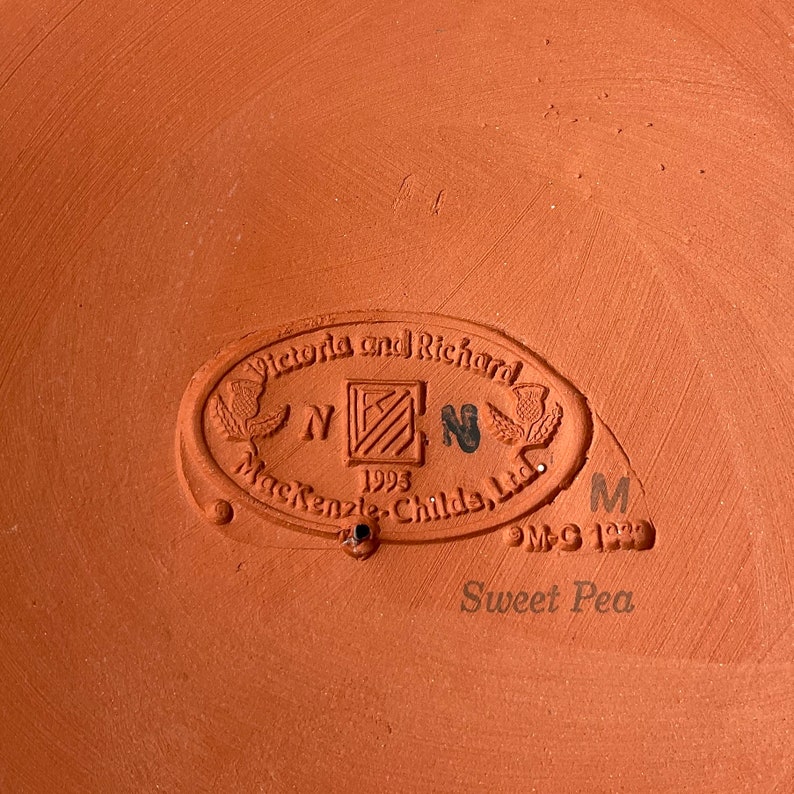
An example of a founder-era MacKenzie-Childs artisan stamp, which proves the piece was handmade in Aurora before 1997, after which "Victoria and Richard" was dropped from the brand name. This piece is also initialed by the artisan with two letters rather than one, which means the artisan had graduated from being a trainee to a full decorator.
A Quick Timeline
| Year | Moment | Why it matters |
|---|---|---|
| 1970s | Victoria and Richard meet in the ceramics program at Alfred University | Both take an MFA under the potter Wayne Higby, a lifelong mentor |
| Late 1970s | The couple teach and make work in Devon, England | The English country-house palette and the folk-art looseness both start here |
| 1983 | The company is founded in the basement of Wallcourt Hall, Aurora | A 1909 prep-school dormitory becomes a pottery studio |
| 1988 | The studio moves a mile up Route 90 to the present farm | Artisan stamping pauses, then restarts under a new system |
| Early 1990s | Bergdorf Goodman and Neiman Marcus pick up the line | National recognition, and the beginning of serious collecting |
| 1993 | The Madison Avenue flagship opens | The brand becomes a New York luxury fixture |
| 1996 | The first Barn Sale, held under a single tent | Now one of the biggest annual retail draws in Cayuga County |
| 2000 | Chapter 11 | Debt, an expensive ad campaign, and leases on two stores that never opened |
| 2001 | Pleasant Rowland buys the company out of bankruptcy court | The farm is restored, the company stays in Aurora, the founders leave |
| 2008 | Rowland sells to Twin Lakes Capital | Ownership passes to private equity, where it remains |
| 2014 | Castanea Partners invests in parent company Aurora Brands | The current corporate structure takes shape |
| 2018 | Patience Brewster Inc. is acquired | The ornament and illustration line joins the house |
| 2026 | Victoria MacKenzie-Childs dies at 77 | Renewed collector attention on early, founder-era work |
The History: How MacKenzie-Childs Happened
1. Two Potters, a Farmhouse, and a Check
Victoria and Richard met over clay at Alfred University, took their MFAs under their mentor Wayne Higby, and then spent a stretch in Devon teaching art and, of all things, making stage clothing. They came home with an unusual pair of skills in one household: serious technical command of glaze chemistry, and a theatrical instinct about surface that most studio potters of the era would have considered slightly embarrassing.
They started in 1983 in the basement of Wallcourt Hall, a 1909 dormitory built for an all-girls prep school. The early output was tile, then hollowware, made in small runs and decorated with a density that made it impossible to mistake for anybody else's work. In 1988 the whole operation moved a mile up Route 90 to a nineteenth-century dairy farm overlooking Cayuga Lake, and the dairy barn became the production studio it still is today.
The Courtly Check came out of that first decade and has never gone away. It's a black-and-ivory check, hand-brushed so the squares wander, edged in gold luster applied by hand and therefore never quite even. Victoria pulled the idea from chessboards and from the black-and-white tiled floors of English cathedrals and abbeys, which explains the odd double register of the thing. It reads as playful and grand at the same time, and it has been holding that trick for four decades.

Victoria and Richard MacKenzie-Childs pose in Aurora.
2. The 1990s: Bergdorf, Madison Avenue, and Full Volume
The nineties made the brand. Bergdorf Goodman and Neiman Marcus took the line, the Madison Avenue flagship opened in 1993, and the aesthetic found precisely the audience it needed: people furnishing rooms who had grown bored of behaving themselves. Press coverage reached constantly for storybook comparisons, and the shops were merchandised to earn them, floor to ceiling, pattern arguing with pattern.
This is also the decade that produced most of what collectors now hunt. The Taylor line of hand-painted majolica tableware carried dozens of patterns, plenty of them retired after a season or two, and surviving examples from the early and middle nineties show a looser, more painterly hand than later production. Names from these years come up constantly on the resale market: Aalsmeer, King Ferry, Sherwood Gardens, Odd Fellows, and Piccadilly. They also get misapplied roughly as often as they get used correctly, which is a theme we'll return to.

Examples of Taylor patterns. The ruffled rims are a giveaway.
3. The Bankruptcy, and How the Founders Lost the Brand
By 2000 the company had outrun its balance sheet. There was substantial bank debt, a steep round of price increases, an expensive advertising campaign, and long-term leases signed on two flagship locations, one on Rodeo Drive and one on Madison Avenue, neither of which ever opened. With insolvency closing in, the company filed Chapter 11.
What happened next is the part most people don't know. Pleasant Rowland, founder of American Girl and a Wells College alumna with deep roots in Aurora, bought the company out of bankruptcy court in 2001 for $5.5 million as part of a much larger investment in the village. The purchase kept the business on the farm, and the farm itself was restored over the following two years.
It also ended the founders' relationship with the company that carried their name. Rowland offered Victoria and Richard a settlement contingent on a non-compete. They declined, filed personal bankruptcy, and the trademarks built on their own surname passed out of their hands. The couple spent much of the next two decades aboard the Yankee Ferry, the last surviving Ellis Island ferry, moored in New York, where Victoria kept designing and, from 2020, ran a YouTube channel about life on the boat. She died in March 2026.
None of this changes whether a given piece is worth buying. It does explain why "founder-era" carries weight with collectors, and why anything documented to the studio before 2001 sits in its own category.
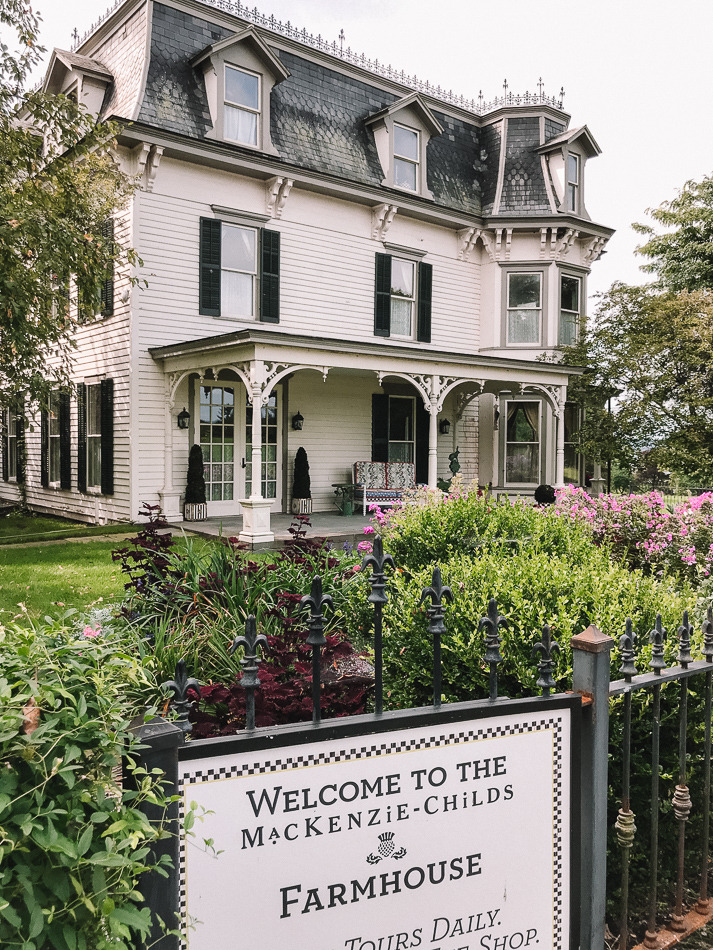

The Victorian farmhouse was restored during the Rowland years and remains open to visitors! Every room is decorated without restraint. Ceramics production occurs in the converted dairy barn nearby.
4. The Company Since
The company has changed hands a few times and picked up satellite studios along the way. The Barn Sale, which began as one tent in 1996, now pulls tens of thousands of people to the farm across four days each summer. It went online-only during the pandemic and came back in person in 2023.
Production today is split. Majolica ceramics, furniture, and upholstery are still made and decorated by artisans on the Aurora farm. Enamelware, glassware, and much of the accessory line are produced overseas to the company's specification and then hand-decorated. Both are genuine MacKenzie-Childs. Collectors care about the difference anyway, and the Aurora-made ceramics carry the premium.

A contemporary showcase of MacKenzie-Childs' decor today.
The Characteristics: What Makes a Piece Look MacKenzie-Childs
Pattern Against Pattern
The organizing principle is accumulation. One piece might carry checks, stripes, florals, a band of dots, and a luster edge, and the patterns are chosen to argue with each other rather than harmonize. Nothing stays plain if it can be decorated instead.
There's real discipline underneath the noise, though, and it lives in value and scale. The checks do the structural work, holding everything in position, while the florals and stripes supply the color. Take the checks away and the whole thing would slide off the table.
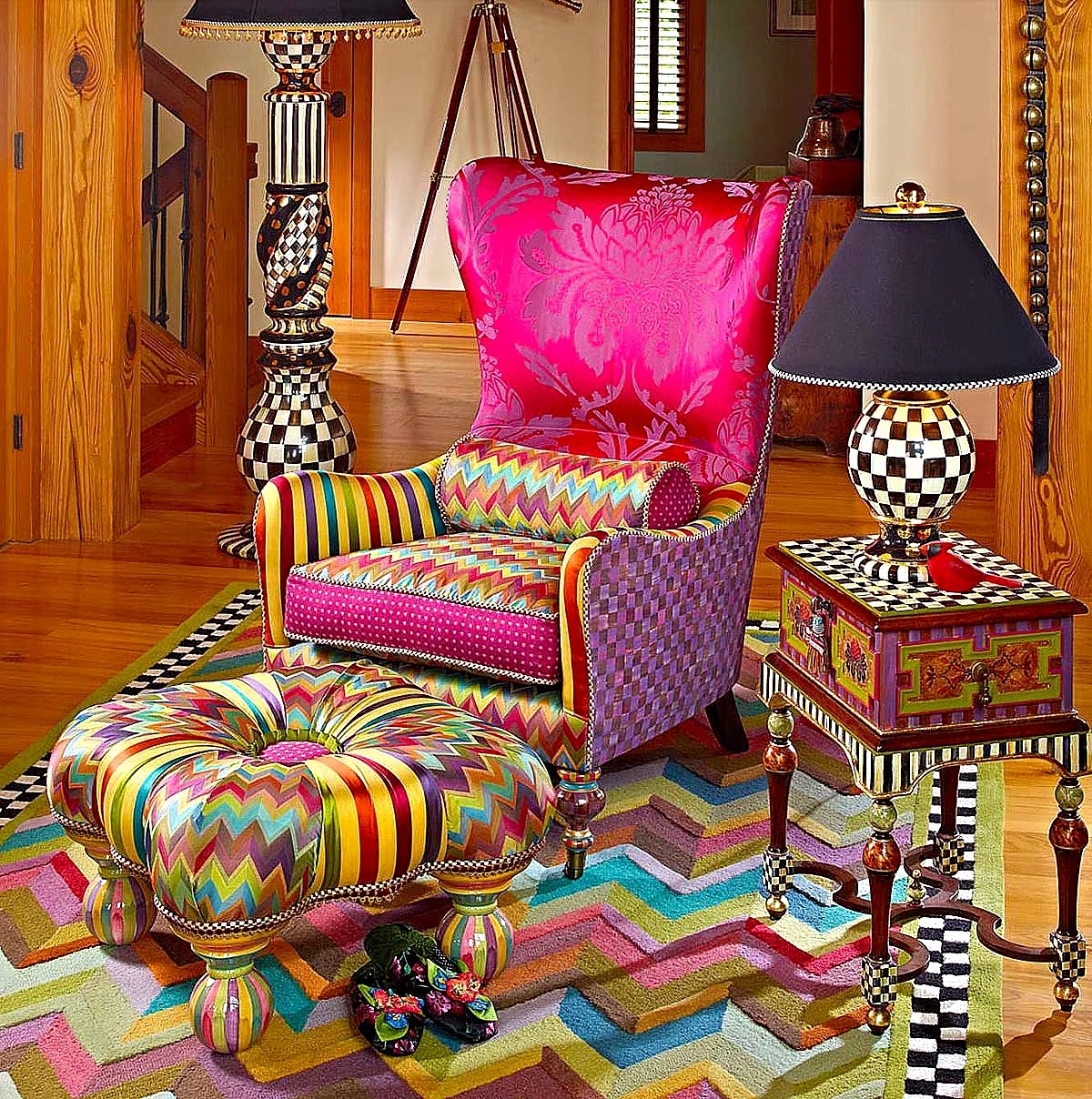
The contrasting colors and patterns are held together by the stabilizing effect of the checks in this showcase.
The Checks
A few main colorways run the house. Courtly is black and ivory with gold luster, Royal is blue, Sterling is gray, Rosy is pink, Emerald is green, and Parchment is a warmer ivory and gold. On enamelware these are painted by hand using colored frits that fuse into the base glaze during firing, which is why the squares vary in size and the edges of each square go slightly soft. Printed or woven checks, by contrast, are flat and repeat perfectly. That difference is doing a lot of work for you later in this article.
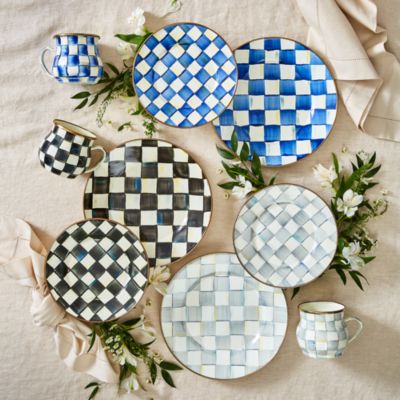
From the top down: Royal, Courtly Check, and Sterling.
The Wandering Gold Edge
Luster goes on by hand and fires last. On a genuine piece the gold band changes width, thins where the brush lifted, and follows the rim rather than sitting perfectly concentric with it.
It also wears, enthusiastically. Luster is the first casualty of a dishwasher, so worn gold on an otherwise sound piece is a condition issue and not evidence of a fake. If you own anything with a luster edge, keep it out of the machine and you'll keep the gold.
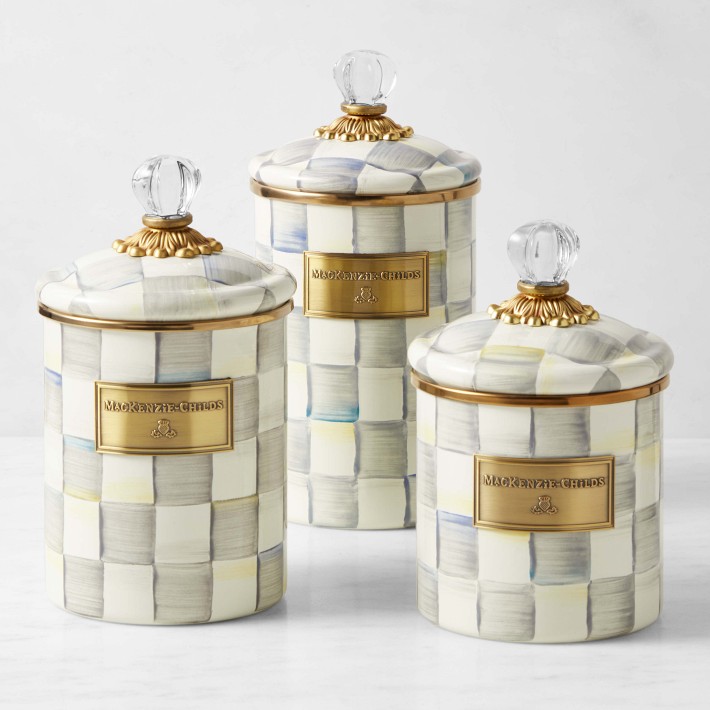
These canisters have prominent gold edging.
Beading, Bumps, and Applied Ornament
Small raised elements turn up everywhere: rows of beads along a rim, dots of contrasting slip, rick-rack borders, finials scaled up past reason, feet that curl further than they need to, and handles built for a much larger hand. The underlying forms come from eighteenth and nineteenth century European design, then get pushed about fifteen percent past where a period maker would have stopped. That fifteen percent is the whole personality of the brand.
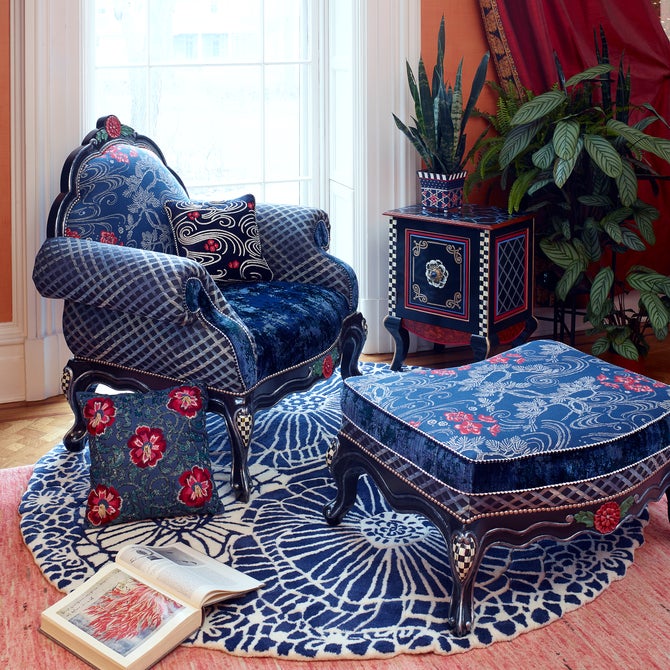
This set in Royal blue shows the brand's love for ornament applied heavily to 18th and 19th century European designs.
Color
The palette runs hot. Jewel greens, tomato red, ultramarine, chartreuse, and pink, all of it sitting on or beside black and white that keeps the arrangement from dissolving into a puddle. The monochrome ground is what earns the color its volume, and it's the reason Courtly Check somehow behaves itself in rooms that should reject it outright.
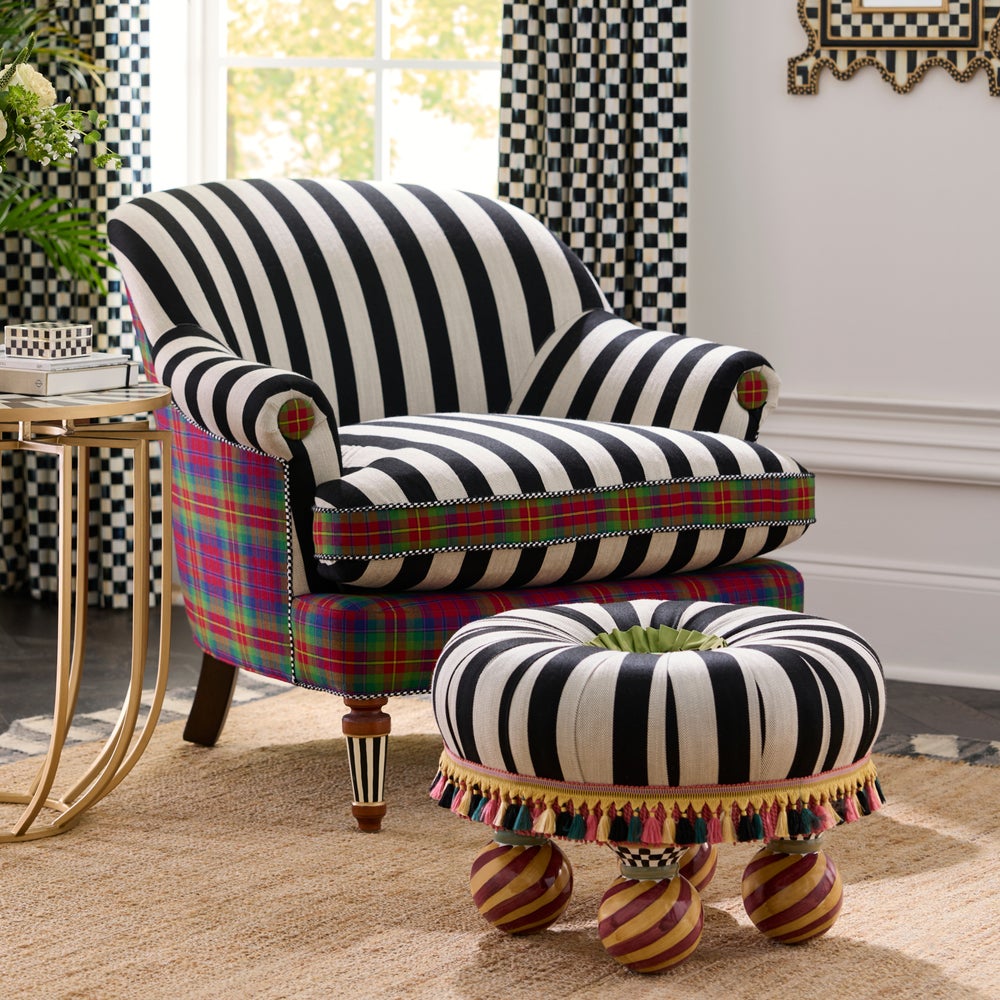
The bright jewel-toned tartan on this club chair is balanced against the black and white upholstery and legs.
The Materials
| Material | Where it shows up | Notes |
|---|---|---|
| Majolica (terracotta) | Aurora-made ceramics, tableware, vases, lamp bases | Red-brown clay body under an opaque white glaze; the clay shows at the unglazed foot |
| Enameled steel | Kettles, canisters, mugs, plates, cookware | Heavy-gauge steel, glazed and fired above 1,380°F, then decorated and refired |
| Bronzed stainless steel | Rims, handles, knobs on enamelware | A darkened rim rather than a bright chrome one; a great quick tell |
| Gold and copper luster | Edges, bands, accents | Fired last, applied by hand, always a little irregular, always the first thing to wear |
| Hardwood | Furniture, tables, chairs, case pieces | Painted and decorated in Aurora; production stages marked with colored dots rather than initials |
| Blown and painted glass | Stemware, ornaments, barware | Hand-painted decoration over blown forms |
| Decals and transfers | Non-check patterns on enamelware | Applied by hand after the second glaze firing, then fired again so they become permanent |
One clarification on the word majolica, since it trips people constantly. Here it means the traditional technique: a porous earthenware body under an opaque white glaze, with decoration painted on top of that glaze. It does not mean the Victorian relief-molded majolica of Minton and Wedgwood. Same word, different animal.
Patterns Worth Knowing
Courtly Check. The signature. Black and ivory with a gold luster edge, in production since the 1980s and applied to essentially everything the company makes.
Royal Check, Sterling Check, and Parchment Check. The same idea in blue, gray, and warm ivory. Royal has the largest following after Courtly.
Flower Market. Loosely painted blooms on white, usually with a check or stripe border. The most collected of the florals, and a standard partner for Courtly in mixed settings.
Taylor. Not a single pattern but the name of the hand-painted majolica tableware program, under which individual patterns rotate in and out. That rotation is exactly what makes the archive worth studying. Odd Fellows, deliberately mismatched, is among the best known.
Aalsmeer, King Ferry, Sherwood Gardens, Piccadilly, Wildflowers, and Field Study. A representative slice of the retired and rotating patterns you'll meet on the secondary market. Some ran for years, some for a single season.
Pattern names are the currency of resale listings, and sellers throw them around like confetti. A name attached to the wrong piece is usually carelessness rather than fraud, but it's a reason to look harder at everything else in that listing.

Flower Market patterns use bright, organic shapes to accent the checks. The gold rims harmonize the pieces across patterns.
How to Tell the Real Thing
You're really answering three questions: is it genuine, when was it made, and is it Aurora ceramic or imported enamelware? One thing to set aside first is machine involvement. Ram-pressed and slip-cast bodies are exactly what a genuine piece should show, so that's not a red flag here.
Turn it over and find the initials. Nearly every ceramic piece carries stamped artisan initials, applied with a potter's ink made from the same stuff as the glazes, so the mark fires in permanently. Two letters means a trained decorator. A single letter usually means a decorator in training. Small pieces like finials often go unstamped because the mark would swallow the decoration.
Use the marking system to date it. The company's practice has changed several times, and each change hands you a usable date range:
- Spring 1988 onward, briefly: stamping stopped altogether around the move to the new studio.
- 1989 to 1991: stylized single-letter stamps pressed into the soft clay during finishing.
- 1991 to 1992: a single block letter pressed into the soft clay.
- 1992 to 1994: a small dot of color on the glaze near the exposed terracotta foot, a different color for each decorator.
- 1994 to 1995: a single initial hand-painted in black stain next to the exposed terracotta.
- 1995 to the present: rubber stamps carrying two initials.
Check where the mark sits. Pottery decorators stamp onto the glaze, right where the glaze meets the clay at the foot. Everybody else in the process, meaning finishing, glazing, luster, and quality control, stamps onto the bare terracotta. Finishing stamps often include the year alongside the initials, which is as close to a date mark as this company gets.
Look at the foot. Aurora majolica shows a ring of unglazed red-brown terracotta. If the underside is white all the way across, uniformly glazed and unmarked, you're looking at something else. That something else may well be a genuine imported product, but it isn't studio ceramic and shouldn't be priced like one.
Read the brushwork. Hand-painted checks vary. Squares differ in size, the black differs in density, corners aren't square, and the luster edge changes width. Flawless repetition points to printed or transferred decoration. The company does use decals legitimately on some patterns, applied by hand and fired in, so a transfer isn't automatically a problem. A transfer sold to you as hand-painted absolutely is.
Weigh the enamelware. The real thing is built on heavy-gauge steel and feels like it. The rim should be bronzed stainless, darkened rather than bright, and firmly seated. Light, tinny bodies with shiny chrome rims and a printed check are the most common lookalikes, and they usually surface under vague listing language about "checkered enamelware" rather than any actual brand claim.
Treat "in the style of" as the warning it is. There's a busy trade in unbranded black-and-white check housewares. Most of it isn't pretending to be MacKenzie-Childs outright, but plenty of resellers misidentify what they have, and a few are borrowing the brand name to justify the price.
Know what a second is. The Barn Sale and the outlet move factory seconds, genuine pieces with cosmetic flaws, usually marked as such. Seconds are collectible in their own right. What you want to avoid is a reseller quietly passing one off at full mainline pricing.
Assess condition properly. On majolica, hold the piece up and tap the rim. A ring means you're fine; a dull thud means there's a hairline somewhere. On enamelware, any chip through to the steel matters, and a chip on a food surface means that piece retires from serving duty. On anything with luster, dishwasher damage shows up as dull, patchy gold.
No single test settles it. You're building a case out of independent clues: the mark, its position, the foot, the brushwork, the weight, the hardware, and the pattern name. When they agree, relax. When one dissents, keep asking questions.

Some MacKenzie-Childs is made in China and lacks the maker stamp you'd see in a New York original.
Living with MacKenzie-Childs Now
The market splits cleanly. Current retail is broad and runs from cheerful stocking stuffers to pieces that cost thousands. The secondary market is where you go for specificity: retired patterns, early studio work, a replacement plate to finish a set, discontinued forms, and anything documented to the founder era before 2001. Victoria's death in March 2026 has pulled fresh attention toward the earlier material, so expect more competition than usual on it right now.
A few notes if you're buying to use rather than to store:
Buy the forms you'll actually reach for. Kettles, canisters, mugs, serving bowls, cake stands, lamps, and side tables stay in circulation, which means you keep collecting the enjoyment long after you've stopped thinking about the price.
One piece is a statement, twelve is a theme. A single checked kettle on a plain stove, or one majolica lamp on a bare console, reads as confidence with a sense of humor. A fully committed kitchen starts to read as a showroom, and showrooms are somebody else's project.
Hand-wash anything with luster. Gold and copper edges do not survive dishwashers. Metallic decoration never goes in a microwave under any circumstances. Enamelware is more forgiving, but washing by hand and drying it right away is still the habit worth building.
Retire chipped enamel from food service. If you can see steel, don't eat off it. That goes for this brand and every other piece of enamelware in your cabinet.
Buy retired patterns from sellers who photograph the underside. A listing that shows the foot, the stamps, and the rim comes from someone who understands what they're selling. Trust those over the ones offering three glamour shots and no marks.
Consider the Barn Sale. Four days each summer on the Aurora farm, with the restored Victorian farmhouse, the gardens, and the studio all open. It's a real drive from the DMV rather than a day trip, so make a weekend of it. The prices are excellent, and the property alone justifies the gas.

A shot from the barn sale.
Closer to Home: The Del Ray Outlet!
Not everybody has a free weekend and a tank of gas for upstate New York, which is why local shoppers should know about the MacKenzie-Childs outlet tucked inside Del Ray Monograms at 2005 Mount Vernon Avenue in Del Ray! Same brand, and only minutes away if you live around the area.
It's a monogram and tabletop shop first, so you can browse hand-painted trays, French glassware, and stacks of monogrammed linens along with the MacKenzie-Childs inventory. What's on the shelf today may not be there next month, so remember that the best pieces leave with whoever showed up first! Go in open to possibility rather than with a list.

Del Ray Monograms is a great place to look for MacKenzie-Childs!
Frequently Asked Questions
What years is MacKenzie-Childs furniture and pottery from? The company was founded in 1983 and is still producing today. "Vintage" here generally means work from the 1980s and 1990s. "Founder-era" means anything made before Victoria and Richard left the company in 2001.
Who owns MacKenzie-Childs now? Aurora Brands, following investment from Castanea Partners in 2014. The company was bought out of bankruptcy by Pleasant Rowland in 2001 and sold to Twin Lakes Capital in 2008. The founders have had no involvement since 2001.
Where is MacKenzie-Childs made? Majolica ceramics, furniture, and upholstery are made and decorated by artisans on the Aurora, New York farm. Enamelware, glassware, and much of the accessory line are produced overseas and hand-decorated, and the company lists these as imported.
What is Courtly Check? The house signature: a hand-painted black-and-ivory check with a gold luster edge, drawn from chessboards and the black-and-white tiled floors of English abbey interiors. It appears across every material the company works in.
Is MacKenzie-Childs dishwasher safe? Some enamelware is rated dishwasher safe, but hand-washing treats everything better. Anything with gold or copper luster should always be washed by hand, and nothing with metallic decoration should ever go in a microwave.
Is MacKenzie-Childs a good investment? Treat most of it as tableware and furniture rather than as an asset. The pieces that hold or gain value are retired majolica patterns, early studio work, complete undamaged sets, and unusual forms, all in good condition with the luster intact. Common recent enamelware is inexpensive on the secondary market and likely to stay that way.
How can I tell if my MacKenzie-Childs is genuine? Turn it over. Look for stamped artisan initials, a ring of exposed terracotta at the foot on ceramics, real variation in the painted check, and a bronzed stainless rim with genuine weight behind it on enamelware. Then use the marking timeline above to pin down a date range. Several clues in agreement is the standard, and one clue on its own isn't.
Did Victoria and Richard design everything sold under the name? No. They founded the company and led its design until 2001, and everything since has come from the company's design team. That distinction was one of the points of contention in the litigation that followed the bankruptcy.
A Short Glossary
Bisque: clay fired once, before glazing. Check: the house pattern family, in four main colorways, Courtly (black and ivory), Royal (blue), Sterling (gray), and Parchment (ivory and gold). Decal: a printed transfer applied by hand and fired in, becoming a permanent layer of the design. Enamelware: a glass-based glaze fused to a steel body at high temperature. Frit: ground glass, the base of both the glazes and the painted decoration. Luster: a thin metallic film, gold or copper, applied and fired last. Majolica: an earthenware body under an opaque white glaze, decorated on top of that glaze. Ram press: a mechanical process that forms clay between two dies, standard for plates and shallow forms. Second: a genuine piece with a cosmetic flaw, sold at a discount through the outlet or Barn Sale. Slip casting: forming hollow shapes by pouring liquid clay into plaster molds. Taylor: the name of the hand-painted majolica tableware program, under which individual patterns rotate in and out.
Evolution Home Insider publishes guides to period furniture, materials, and the craft of living with old things. If you're weighing up a particular MacKenzie-Childs piece and want a second opinion, send us photographs of the underside showing any stamped initials, the foot where glaze meets clay, and the rim in raking light. That's where the answers are.
Sources and further reading: MacKenzie-Childs, Ltd. company materials on care, use, and production; artisan stamp and dating chronology as published by authorized dealers; Victoria MacKenzie-Childs obituaries and reporting, March 2026; contemporaneous coverage of the 2000 Chapter 11 filing, the 2001 acquisition, and the subsequent trademark litigation in the Syracuse Post-Standard, Rochester Business Journal, and The New York Times; Life in the Finger Lakes and Auburn Citizen reporting on the Aurora farm and the annual Barn Sale.
