

Insider #7: Hardstone Trees
Chinese Hardstone and Glass Trees: History, Characteristics, and How to Spot the Real Thing
Somebody in a Qing palace workshop during China's final imperial dynasty looked at a flowering plum branch, wondered how to keep it in bloom, and found a solution in gemstones.
That's the whole idea behind these hardstone trees. A Chinese hardstone tree is a miniature flowering tree built out of carved semiprecious stone and glass, wired petal by petal onto a metal armature and planted in a pot of plaster, then set into a cloisonné, porcelain, or carved stone jardinière. It's a bouquet that never wilts, a garden with no season, and a genuinely absurd amount of handwork disguised as a versatile decorative object that has escaped its natural habitat in imperial palaces to spread throughout the world.
They come in an enormous range of quality. The very best can be found in the Palace Museum's Treasure Gallery, tribute objects made from gold, jade, coral, and rare gemstones. At the bottom sit tourist trees glued together from cheap wire and dyed quartzite. In between, and this is where almost everything you'll actually encounter lives, sits a century of Chinese export production that ranges from lovely to lazy, often in the same shop, frequently at the same price.
Learning to tell them apart takes about ten minutes and a good light. Here's the ten minutes!

Key Takeaways
What they are: miniature flowering trees made from carved hardstone, glass, and wire, descended from the Chinese tray-landscape tradition called penjing.
Dates you'll meet: imperial court examples from the eighteenth and nineteenth centuries, a big export wave from roughly 1900 to 1940, a second wave from the 1950s through the 1980s, and continuous production today.
Design DNA: an armature of copper or brass wire, branches bound in silk or coated to read as bark, individually drilled and threaded petals, gilt or glass bead stamens, and a base packed hard with plaster and stone chips.
Signature materials: nephrite and jadeite, carnelian and agate, rose quartz, amethyst, aventurine, lapis, malachite, turquoise, coral, mother of pearl, and Peking glass, which is a period material and not a cheat.
Best tells of authenticity: carved petals with drill holes and natural color variation, oxidized wire under frayed silk, a plaster base with real weight, and a jardinière whose quality matches the tree standing in it.
Market note: ordinary mid-century examples are startlingly affordable for the labor involved, and the fastest way to overpay is to buy a modern tree wearing an old pot.

A Quick Timeline
| Year | Moment | Why it matters |
|---|---|---|
| 706 AD | Tomb murals at the Qianling mausoleum | Attendants carry miniature landscapes on trays, the earliest picture we have of penjing |
| Song through Ming | Penjing matures as a scholar's art | Rocks and living trees in shallow pots, arranged like a painting in three dimensions |
| 18th century | The Qing court goes big on jeweled versions | Palace workshops and provincial tribute produce permanent trees in gold, jade, and gemstone |
| 19th century | Tribute production peaks | Trees arrive at court for New Year and imperial birthdays, usually in matched pairs |
| c. 1900–1940 | The export era | Republic-period workshops sell hardstone trees to Western buyers, often in cloisonné pots |
| 1950s–1980s | The second wave | State workshops and Friendship Store production put a tree on a lot of American mantels |
| 1980s–present | Everything at once | Fine handwork, tourist output, and outright junk share a market and a vocabulary |
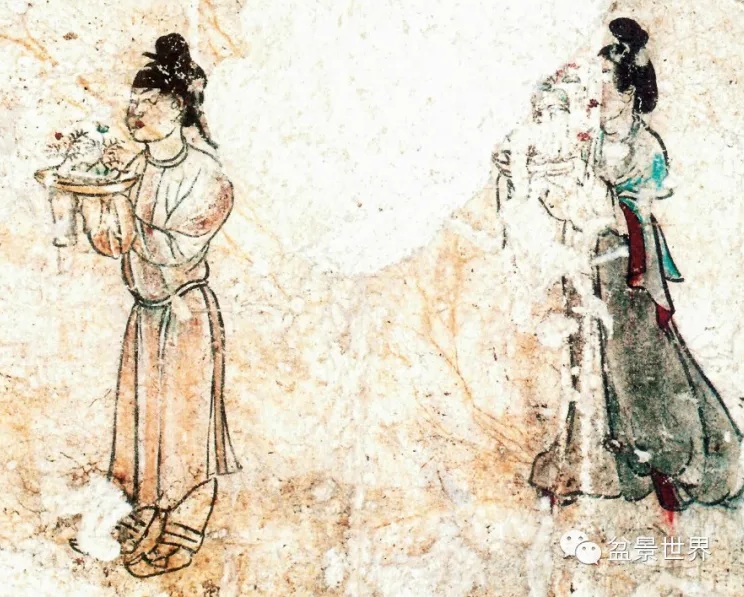
This Wangdu Han tomb mural displays proto-penjing, the artistic practice that would produce hardstone trees.
The History: How These Trees Happened
1. The Living Ancestor
Long before anybody thought to carve a flower out of agate, the Chinese were putting small trees in shallow dishes and calling it art. The word is penjing, meaning roughly "tray scenery," and it's the parent of Japanese bonsai rather than a variation on it. The earliest picture of one turns up in murals at the Qianling mausoleum outside Xi'an, painted around 706 for the tomb of the Tang crown prince Zhanghuai, where attendants are shown carrying miniature rock-and-plant arrangements on trays.
By the Song dynasty the practice had become fully scholarly. A penjing was a landscape painting you could walk around, a way of getting a mountain gorge onto a desk. Rocks did as much work as plants, and a good arrangement was supposed to suggest a place, a season, and a mood all at once. The artist had to prove themselves capable of understanding a moment in time and space well enough to reproduce it in miniature.
Everything about the jeweled trees flows from that tradition. The asymmetry, the exposed root, the branch that pushes way out past the edge of the pot, the emphasis on the pot itself as part of the composition, all of it is inherited from the original medium. The only real innovation was replacing the plant with something that doesn't need water.

Penjing in root-over-rock style on display at the Chinese Penjing Collection of the National Bonsai and Penjing Museum in Washington, D.C.
2. The Court Discovers Permanent Flowers
The Qing court had a serious appetite for objects that pretend to be other objects. Jade carved to look like cabbage, jasper carved to look like braised pork, enamel painted to look like woodgrain. A gemstone tree fits that appetite perfectly, and it adds a bonus the emperor could genuinely appreciate: a plum tree that blooms in July.
The Palace Museum's Treasure Gallery in Beijing has a room dedicated to these, roughly 220 square meters of artificial potted landscapes made from gems, gold, silver, pearls, coral, ivory, enamel, and lacquered wood. The museum describes them as indispensable court decoration for festivals and ceremonies, and notes that many arrived as tribute. One of the star pieces, dated to the century between 1662 and 1795, is a plum tree whose blossoms are cut from 284 rubies, with jade leaves, sapphire centers, and gold stamens, growing out of a gilded basin engraved with longevity characters. Underneath it, lapis, white jade, agate camellias, and coral beads fill in the ground cover.
That's the ceiling; it's worth knowing about so you understand what the export trees are quoting.
The auspicious logic mattered as much as the sparkle. These were gifts, presented at New Year and at imperial birthdays, so every element carried a wish. Plum blossom meant endurance and renewal, since the plum flowers on bare wood in the cold. Peach meant long life. Pomegranate meant many sons. Pine, bamboo, and plum together are the Three Friends of Winter, a set that survives every hardship and stays green. Nobody sent the emperor a tree just because it was pretty.
.jpg?mode=max)
This pair of hardstone trees sold at Christie's for $100,800.
3. The Export Era
Around the turn of the twentieth century, the workshops that had been supplying the court found themselves supplying department stores instead. Western buyers loved these trees, and the format scaled beautifully. Substitute carnelian for ruby, aventurine for emerald, glass for jade in the cheaper seats, keep the technique exactly the same, and you have an object that still requires hundreds of hours of skilled hand labor but costs a fraction of the imperial version.
The Republic period, roughly 1912 to 1949, produced quantities of very good ones. Cloisonné jardinières became the standard pot, partly because the same export houses were already selling cloisonné and partly because turquoise enamel makes pink quartz look terrific. Carved celadon, famille rose porcelain, spinach jade bowls, and gilt-metal planters all show up too.
American decorators of the 1940s and 1950s took to calling them "Ming trees," a trade name with no historical basis whatsoever. You'll still see it in listings. It doesn't mean the tree is from the Ming dynasty, and if a seller uses the phrase as though it does, that tells you something useful about the rest of the description.

A mid-century hardstone "Ming" tree.
4. The Second Wave and the Flood
Production restarted in earnest through the state-run workshops of the 1950s onward, and picked up serious volume in the 1970s and 1980s as tourism and export both opened up. A great deal of what turns up in American estates today comes from this window. Quality is variable but often genuinely good, with real stone, real wire construction, and pots that range from decent cloisonné to stamped brass.
Then came the flood. Modern mass production discovered that you can dye ordinary quartzite any color you want, cut petals by machine, glue them to a plastic stem, and stick the whole thing in a resin pot for a few dollars. These are sold honestly as decor most of the time. They also get resold dishonestly as antiques all the time, usually by people who don't know any better.
The good news is that they're easy to catch. Machine work in this category is loud.
The Characteristics: What Makes One of These Read as Good
Composition Before Sparkle
A serious tree behaves like a tree. It has a dominant trunk with real taper, a visible root flare where it meets the ground, an asymmetric crown with layered branches and open space between them, and usually one long limb reaching well past the footprint of the pot. Blossoms appear at different stages, so you'll find tight buds, half-open flowers, and full blooms on the same branch, which is exactly what a real prunus does in March.
A weak tree is a lollipop. Uniform density, blossoms distributed like a pompom, no negative space, every flower open, branches radiating from a central point like a bottle brush. Once you've seen the difference you can spot it across a room, before you get close enough to identify a single stone.
The Ground Layer
Look down. On a good piece the surface of the "soil" is a whole small landscape: crushed stone in graded sizes, moss suggested with dyed chips or fine aventurine, sometimes a carved scholar's rock, a lingzhi fungus, or a few tiny narcissus growing at the base. Cheap trees have bare plaster, or gravel poured in and glued flat, or a disc of green felt.
The Stamens
Those little yellow clusters at the center of each blossom are a quality indicator all by themselves. Better trees use tiny gilt-metal beads or glass seed beads, threaded on individual wires and gathered into a bundle, sometimes eight or ten per flower. Cheaper trees use a single bead, a dot of yellow paint, or a blob of glue with sand in it.
The Materials
| Material | Where it shows up | Notes |
|---|---|---|
| Nephrite jade | Leaves, occasionally whole blossoms | Spinach green, celadon, or white; slightly greasy luster, tough enough to carve very thin |
| Jadeite | Better leaves and flowers | Brighter and glassier than nephrite, with more visible grain and color mottling |
| Aventurine | The everyday green leaf | Quartzite with tiny mica inclusions that throw a faint glitter in raking light |
| Carnelian and agate | Orange, red, and banded petals | Look for the banding running across the petal, a giveaway that it's cut stone |
| Rose quartz | Pink blossoms | Cloudy, slightly milky, often with internal fractures that catch light |
| Amethyst | Purple blossoms | Color usually zones from pale to deep across a single petal |
| Lapis and sodalite | Blue accents and berries | Lapis carries gold pyrite flecks; sodalite runs grayer and more veined |
| Coral | Red berries, small blossoms | Adds real value and real paperwork; see the note below on regulated materials |
| Mother of pearl | White petals with a sheen | Layered structure visible at the edges |
| Peking glass | Petals of any color | A legitimate period material, not a fake; look for bubbles and a soft edge |
| Copper and brass wire | Every stem, every petal | Oxidizes to brown, green, or black under the silk wrap |
| Silk floss | Binding on the finer branches | Frays, fades, and goes brittle, all of which are good signs |
| Plaster and composition | The trunk surface and the base fill | Built up over the armature, painted and textured to read as bark |

Some trees make use of even more exotic materials. The blue leaves on this tree are made of preserved kingfisher feathers, a practice known as tian-tsui (feather inlay).
About the Glass
Chinese glassmaking, particularly the opaque colored glass usually called Peking glass, has been a respected decorative material since the eighteenth century, and export trees have always mixed glass petals in with stone deliberately, often to get colors that stone doesn't offer cheaply. A tree that's part glass and part stone is completely normal.
What matters is whether the glass is honest period glass or modern molded plastic, and whether the seller is describing it accurately. Old glass petals are cool to the touch, have a little weight, often show a bubble or two, and were drilled and wired like everything else. Plastic feels warm, weighs nothing, and is usually glued.
The Pot
Half the object, and frequently the more valuable half. Cloisonné dominates, which means you're now evaluating two things at once. On the enamel, look for wire work that varies slightly in width and spacing, small pits and depressions in the enamel surface where gases escaped during firing, gilding worn thin on the rim and the high points of the feet, and a color palette that sits a little soft rather than electric. Mid-century and later factory cloisonné uses very regular thin wire and flat bold color, which is fine, just newer.

This mid-century cloisonné pot is a striking and valuable component of this hardstone tree display. Notice the way a polished surface is used to evoke shallow water.
Subjects Worth Knowing
Plum, or prunus. Five-petaled blossoms on dark twiggy wood, the most common subject and the most loaded. The plum blooms in late winter, so it stands for endurance and the promise of spring.
Peach. Pink blossoms, and sometimes actual carved peaches in rose quartz or carnelian. Straight-up longevity.
Cherry and apple blossom. Similar to plum, usually built with a fuller, lusher crown.
Chrysanthemum. Big multi-petal heads, often mounted on a shorter bushy form. Autumn, and a long life lived well.
Pomegranate. Split fruit showing the seeds, in carnelian or coral. A wish for lots of children.
Wisteria. Hanging clusters, usually amethyst. Harder to build and less common.
Pine. Needle clusters in green stone, often paired with rock and moss. Steadfastness.
Narcissus. Usually a low arrangement in a shallow dish rather than a tree, white petals with yellow centers, growing from carved bulbs. A New Year piece.
Fruiting trees. Mandarin orange, kumquat, and loquat all appear, with the fruit in yellow or orange stone. Mandarins in particular mean prosperity, because the word plays on the word for gold.
How to Tell Old From New
Nobody stamps these, so authentication is entirely a matter of construction and materials. The good news is that the workmanship is right there on the surface, unhidden, waiting to be looked at.
Pick it up. A real one is heavy in a way that surprises people. Stone petals, a plaster-packed base, and an enamel-on-copper pot add up fast. A tree that lifts like an empty vase is made of plastic and foam.
Touch a petal to your lip or the back of your hand. Stone and glass both feel distinctly cold and stay cold for a second. Plastic warms up instantly. This sounds silly, but it works every single time.
Find the drill hole. Every stone and glass petal on a properly made tree was drilled and threaded onto wire. Look at where a petal meets its stem and you should see a hole, often slightly conical, sometimes a little off center, occasionally with a small chip at the exit where the drill broke through. Petals glued directly to a stem with no hole at all means modern production.
Read the color for honesty. Natural stone has zoning, veining, inclusions, and cloudiness, and no two petals match exactly. Dyed quartzite comes in flat saturated candy colors, repeats exactly, and often shows the dye pooling darker in surface cracks. If a tree has forty identical fuchsia blossoms, they're dyed.
Look for banding and structure. Carnelian and agate show banding. Aventurine glitters faintly under raking light. Rose quartz has internal veils. These are the fingerprints of real material, and they're visible without a loupe if you tilt the piece toward a window.
Check the wire and the wrap. Old copper and brass wire oxidizes to a dull brown or a green crust, especially where silk has held moisture against it. Silk binding fades unevenly and frays at the branch tips. Green plastic-coated florist wire and bright unpatinated brass tube are modern.
Examine the trunk surface. Period trunks are built up in plaster or composition over the armature, then carved, painted, and sanded so the bark reads convincingly, with genuine irregularity and often a hollow or knot worked in. Some use actual gnarled wood or root. A trunk with a visible mold seam running up one side is cast resin.
Check out the ground layer. The fill should be hard, dense, and dirty, with stone chips of varying size actually set into it rather than sprinkled on top. Look for the dust of decades in the crevices, which is hard to fake and easy to see.
Count the losses. Old trees lose petals. Look for bare wire ends where a blossom used to be, replacement petals in slightly wrong material or color, and small pieces rattling loose in the pot. Losses aren't a dealbreaker on a good tree, but they belong in the price.
Interrogate the marriage. Trees and pots get separated and recombined constantly, since a broken tree leaves a perfectly good pot behind. Check that the plaster fill sits level and old inside the pot, with no fresh crumbs, no visible modern adhesive, and no gap where the fill has been dropped in as a pre-made plug. Also check that the quality levels agree. A crude tree in a superb jardinière, or the reverse, deserves a hard second look.
Judge the pot on its own terms. Evaluate the cloisonné or porcelain as though the tree weren't there, then decide whether you're buying one good object, two, or half of one.
Be careful with coral and ivory. Both show up on older trees. Elephant ivory faces strict federal and state restrictions on sale and transport in the US, and red and pink coral is regulated internationally. If a piece involves either, get the details straight before you buy, and think twice before you ship it anywhere.
No single test settles it. You're building agreement across the drill holes, the wire, the color behavior, the base, and the pot, and staying skeptical when one of them dissents.
Living with a Hardstone Tree Now
Here's the case for buying one: somebody spent weeks drilling and wiring several hundred individually carved stone petals. Prices are variable and often pretty attractive; small mid-century examples turn up in the low hundreds. A well-composed larger tree in a good cloisonné jardinière generally runs from several hundred into the low thousands, more for a matched pair, which is how they were meant to be shown and how they're increasingly hard to find. Fine early twentieth-century work climbs from there, and court-level pieces live in a different universe entirely.
They also do something in a room that very little else does; all that faceted stone catches light from every angle and never sits still, so a tree on a console changes character between morning sunlight and evening lamplight. Against a plain wall, next to a modern sofa, in a bathroom, on a stack of books, it reads as confident and a little whimsical. But beware, a shelf of twelve of them risks looking a gift shop.
A few practical notes:
Handle it by the pot, always. Two hands under the base, and never a hand on the trunk or a branch. The whole tree is cantilevered off a wire armature set in plaster, and the leverage on that joint is delicate.
Don't wash it. Water gets into the plaster, softens old adhesive, and corrodes wire from the inside. A soft brush, a bulb blower, or a hair dryer on cool and low is the entire cleaning routine.
Dust it more often than feels reasonable. Hundreds of petals means hundreds of horizontal surfaces. Five minutes with a makeup brush every few weeks keeps it looking like jewelry.
Keep it out of direct sun. Amethyst and rose quartz fade, dyed stone fades faster, and heat cycling is hard on old glue. Off the radiator, out of the window, same rules as everything else old.
Don't bend the branches. Wire fatigues. That elegant sweep has been holding its position for eighty years and doesn't want your opinion on it.
Fix losses properly or not at all. Fine wire and patience, or a conservator. Hot glue on a hardstone tree is a tragedy and it's permanent.
Buy the pair if you find one. Matched pairs were the original format and they're worth meaningfully more together than apart, so a dealer offering both is doing you a favor whether they know it or not.
Frequently Asked Questions
What are these actually called? No single term has won. Dealers use hardstone tree, gemstone tree, jeweled tree, jade tree, jeweled penjing, and the old American trade name "Ming tree," though these have nothing to do with the Ming dynasty. The tradition they come from is penjing, meaning tray scenery, which is also the ancestor of Japanese bonsai.
Is it jade? Some of it, sometimes. Green leaves are often nephrite or jadeite, but aventurine and dyed quartzite are at least as common, and blossoms are usually quartz family stones like carnelian, agate, rose quartz, and amethyst. Any listing that calls the whole tree "jade" is using the word loosely.
How old is mine? Without a mark you're dating by construction. Silk-bound branches, oxidized wire, individually drilled petals, and a hand-finished plaster base put you somewhere in the first half of the twentieth century or earlier. Glued petals, plastic-coated wire, and machine-uniform blossoms put you more recently. Most American estate examples date from the 1920s through the 1980s.
Does glass mean it's fake? No. Chinese decorative glass is a serious historical material and export trees have always mixed it with stone on purpose. Molded plastic is the actual problem, and it feels completely different in the hand.
Are they valuable? Most are affordable relative to the labor in them, running from a couple hundred dollars to a few thousand depending on size, materials, composition, condition, and the quality of the pot. Pairs, early work, unusual subjects, and fine cloisonné jardinières carry the premium. Court and imperial pieces are a separate market and turn up at auction rather than in shops.
Is the cloisonné pot original to the tree? Often, but check. Trees and pots get recombined constantly. Look at whether the plaster fill inside the pot is old and level, and whether the quality of the tree and the quality of the enamel actually match.
Can I clean it? Dry methods only. Soft brush, blower, cool air. No water, no dish soap, no ultrasonic cleaner, nothing that involves submerging any part of it.
What do the flowers mean? Plum for endurance and renewal, peach for long life, pomegranate for children, mandarin for prosperity, chrysanthemum for autumn and longevity, pine and bamboo for steadfastness. These were gifts before they were decor, and every element was a wish.
A Short Glossary
Armature: the wire skeleton that carries the whole tree, usually copper or brass, anchored in the plaster base. Aventurine: a quartzite with mica inclusions that give a faint glitter; the workhorse green leaf stone. Bogu: the "hundred antiques" motif of scholar's objects such as books, censers, and brush pots, common on cloisonné panels. Cloisonné: enamel decoration built inside cells formed by soldered metal wires, then fired, ground flat, and gilded. Jadeite and nephrite: two different minerals both correctly called jade; jadeite is glassier and brighter, nephrite tougher and softer in luster. Jardinière: the ornamental pot or planter the tree stands in. Lingzhi: the auspicious bracket fungus associated with immortality, often carved into the ground layer. Peking glass: opaque colored Chinese glass, a period decorative material used deliberately alongside stone. Penjing: "tray scenery," the Chinese art of miniature landscapes in shallow containers, ancestor of bonsai. Prunus: the plum, the most frequently depicted subject and a symbol of endurance. Stamens: the tiny bead clusters at the center of each blossom, usually gilt metal or glass, and a reliable quality tell. Three Friends of Winter: pine, bamboo, and plum together, a set standing for resilience.
Evolution Home Insider publishes guides to period furniture, materials, and the craft of living with old things. If you're weighing up a particular hardstone tree and want a second opinion, send us photographs of a blossom close enough to show the drill hole, the branch tips where the wire and binding are exposed, the surface of the plaster base, and the underside of the pot. That's where the answers are.
Sources and further reading: Palace Museum, Beijing, Treasure Gallery (Zhenbaoguan) gallery descriptions of gemstone potted landscapes and tribute objects; Qianling mausoleum mural documentation, tomb of Crown Prince Zhanghuai, 706 AD; National Palace Museum, Taipei, Qing decorative arts collection records; Metropolitan Museum of Art collection records for Chinese hardstone carving and cloisonné; auction catalogue descriptions and condition reports for Chinese hardstone trees, Republic period through late twentieth century.
