
The Evolution Home Insider #5: Eastlake


Eastlake Furniture: History, Characteristics, and How to Spot the Real Thing
Eastlake furniture is the furniture made in America between roughly 1870 and 1890, named for the English design writer Charles Locke Eastlake, and defined by straight lines, shallow incised ornament, and construction that shows you how it was put together. It arrived as a reform movement, a corrective to the swollen curves and deep carving of Rococo and Renaissance Revival, and it was then produced by American factories in such volume that the man whose name it carries quickly lost control of his influence over it.
That’s the first thing to understand about the style. Eastlake wrote a book of household advice; American manufacturers turned the book into a product line. The furniture that carries his name is the work of factories in Grand Rapids and Cincinnati applying his principles selectively, affordably, and in enormous quantities, at exactly the moment the American furniture industry learned to mass-produce.
The result is a style with a split personality, and a market to match. At the top end sit the ebonised, inlaid cabinets of Herter Brothers and Daniel Pabst, which execute Eastlake's ideas at the level he envisioned and command accordingly high prices. At the bottom sit tens of thousands of walnut side chairs and marble-top washstands, honestly made from good timber with real joinery, currently among the most accessible antique furniture in America.

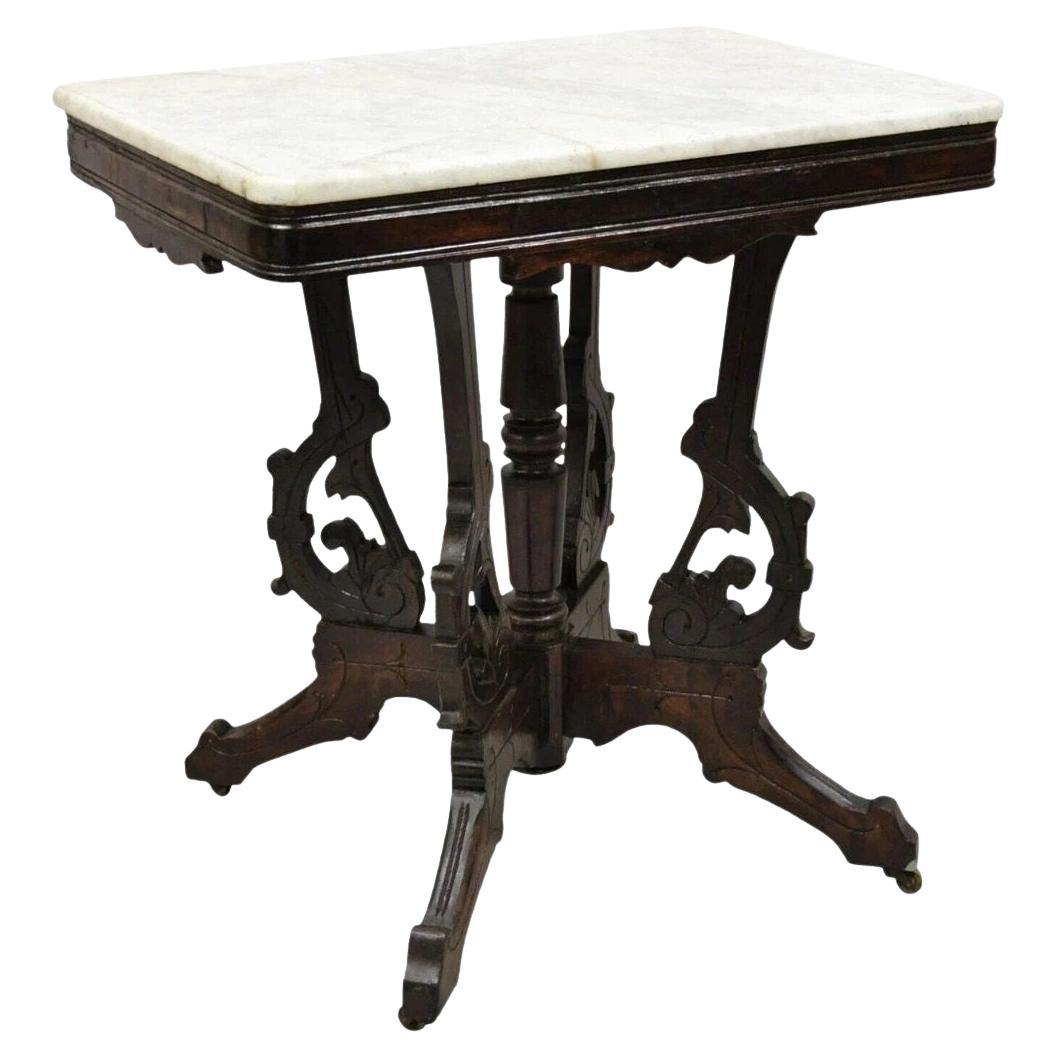
First image: An ebonized and inlaid Aesthetic Movement cabinet by Herter Brothers, circa 1875. The Aesthetic Movement blended Eastlake's theories of design with Japanese influences. Second image: a Victorian-era marble-topped parlor table, a very popular Eastlake form that shows off the carving, incising, marble top, and black walnut characteristic of the style. Both of these pieces favor straight lines and shallow, incised ornament; hallmarks of Eastlake design.
Key Takeaways
-
Dates: roughly 1870–1890 in America, with the peak of the craze from about 1875 to 1885.
-
The spark: Charles Locke Eastlake's Hints on Household Taste (London, 1868), and above all its first American edition (Boston, 1872).
-
Design DNA: rectilinear form, shallow incised lines and chip carving, visible joinery, geometric panels, spindles and galleries, flat stylized ornament.
-
Signature materials: black walnut and walnut burl above all, then ash, cherry, chestnut and oak; ebonized cherry on the high-style pieces; marble tops on case furniture.
-
The two tiers: factory Eastlake from Grand Rapids and Cincinnati, made by the trainload, and high-style "Modern Gothic" from New York and Philadelphia workshops, which is a different market entirely.
-
Best tells of authenticity: period machine work (yes, machine work), period accurate secondary woods, crisp incising cut into solid timber, original marble and mirror plate, and consistent oxidation across every element.
-
Market note: Eastlake is among the most accessible antique furniture available, purely because so much of it survives. The build quality is frequently better than the price implies.

This pair of walnut Eastlake chairs feature spindles and incised designs that were easily produced by steam-powered Victorian machinery.
A Quick Timeline
|
Year |
Moment |
Why it matters |
|
1868 |
Eastlake publishes Hints on Household Taste in London |
Ruskin and Pugin's reform arguments reach the middle-class parlour |
|
1872 |
First American edition, Boston |
The ideas land in a country with a booming furniture industry and no settled taste |
|
1870s |
Several further American printings |
Manufacturers read it as a catalogue rather than a critique |
|
c. 1870 onward |
Grand Rapids becomes the American furniture capital |
Powered routers and carving machines meet a style built on incised lines |
|
1876 |
Philadelphia Centennial Exposition |
Japanese design and reform furniture reach a mass American audience at once |
|
c. 1875–1885 |
Peak Eastlake production |
Bedroom and parlour suites shipped by the trainload |
|
Later 1870s |
Eastlake distances himself from the American furniture |
The name has fully escaped the man |
|
1880s |
Aesthetic Movement high style matures |
Herter Brothers, Kimbel and Cabus, Pabst build the luxury version |
|
c. 1890 |
Golden Oak takes over |
Oak, curves and applied machine carving displace walnut and incising |
|
c. 1900 |
Stickley and Mission |
Eastlake's original ethos returns in a new form |
Grand Rapids, Michigan, was a center of production of the Eastlake style. Black Walnut was plentiful in the region, which is why it's the wood most associated with Eastlake furniture. This photo of the factories was taken in 1911.
The History: How Eastlake Furniture Happened
1. The Reformer and His Book
Charles Locke Eastlake (1836–1906) trained as an architect, wrote A History of the Gothic Revival in 1872, and served for two decades as Keeper and Secretary of the National Gallery in London. He was the nephew of Sir Charles Lock Eastlake, the painter who ran that institution first. He was, in other words, a writer and administrator rather than a maker, and his contribution to furniture is a book of opinions.
Those opinions arrived in 1868 as Hints on Household Taste in Furniture, Upholstery and Other Details, and they were bracing. Eastlake looked at the Rococo Revival and Renaissance Revival furniture filling English and American parlours and saw cheapness and dishonesty everywhere: veneer laid over cheap carcase timber to imply solid wood, deep carving cut across the grain where it would inevitably crumble, curves sawn out of straight boards, and machine ornament dressed up as the work of a carver's hand.
His prescriptions followed from Pugin and Ruskin. Build rectilinearly, because a straight element is strong and a sawn curve wastes timber and invites breakage. Show the joint: let the peg, the tenon end and the chamfer be part of the design. Keep decoration flat and incised, worked into the surface rather than modelled out of it. Prefer solid timber. Look to medieval joinery and, increasingly through the 1870s, to Japan, for models of construction that do not pretend to be something else with cheap tricks like misleading veneer.
Eastlake was writing about taste for householders, not issuing plans for cabinetmakers. His book contains illustrations, but it is fundamentally an argument about what people should buy, not what they should make.

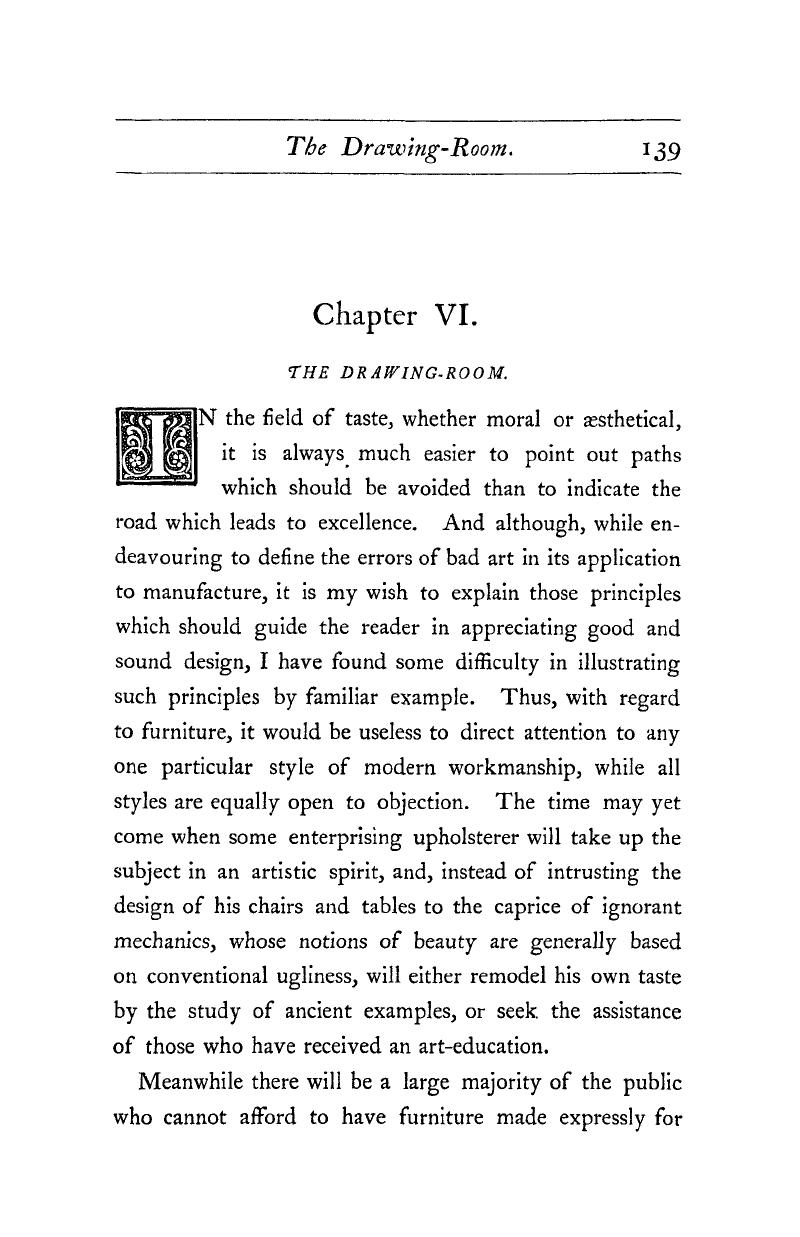
Charles Locke Eastlake and one of his tracts in "Hints on Household Taste in Furniture, Upholstery and Other Details" (1868). The book is packed with lines like "Thus, with regard to furniture, it would be useless to direct attention to any one particular style of modern workmanship, while all styles are equally open to objection." Lower on this page, he prefigures the condition that will eventually create the American Eastlake movement: "Meanwhile there will be a large majority of the public who cannot afford to have furniture made expressly..."
2. The American Edition and the Runaway Name
The Boston edition of 1872 is where the story turns. America in the early 1870s was recovering from the Civil War and had developed a rapidly industrializing furniture trade, a growing middle class furnishing new houses as the United States expanded westward, and a genuine appetite for guidance on what good taste looked like. Eastlake's book supplied a vocabulary, and the trade took it.
Within a few years, manufacturers were advertising "Eastlake" suites, and the word had come to mean any furniture that was straight-sided and decorated with incised lines. Eastlake himself, watching from London, was not flattered. In a later preface he noted that American tradesmen were selling furniture under his name that he had nothing to do with at all.
He had a point, though not the one he thought he was making. The American furniture was not a misunderstanding of his book so much as a demonstration of what happens when a reform argument meets a distribution system. The manufacturers adopted the parts that were cheap to produce and dropped the parts that were not.

An 1880's old west saloon decorated in the Eastlake style.
3. Grand Rapids, and the Machine That Made It
Here’s the mechanical fact underneath the whole style: incised decoration is fast. A powered router or a mechanical carving machine cuts a groove, a chip-carved band, or a shallow roundel in seconds, where high-relief carving of the kind Renaissance Revival demanded took a skilled carver hours. Eastlake's flat, surface-worked ornament was, entirely by accident, the most machine-friendly decorative vocabulary of the nineteenth century.
Grand Rapids, Michigan understood this quickly. Firms including Berkey and Gay, Nelson, Matter and Company, the Phoenix Furniture Company and Widdicomb built an industry on rail access to Michigan hardwood, powered machinery, and a national mail-order and wholesale market. Cincinnati, New York, Boston and Philadelphia all produced Eastlake furniture too, but Grand Rapids became the name that meant volume.
So the reform style intended to restore honesty to furniture became the most efficiently mass-produced style of its era. That’s not quite the redirection it sounds like; the machine work is competent, the timber is genuine black walnut, and the carcases are mortised, tenoned and dovetailed rather than stapled. Considering all that, it’s miles above today’s ultra-cheap particleboard factory furniture.
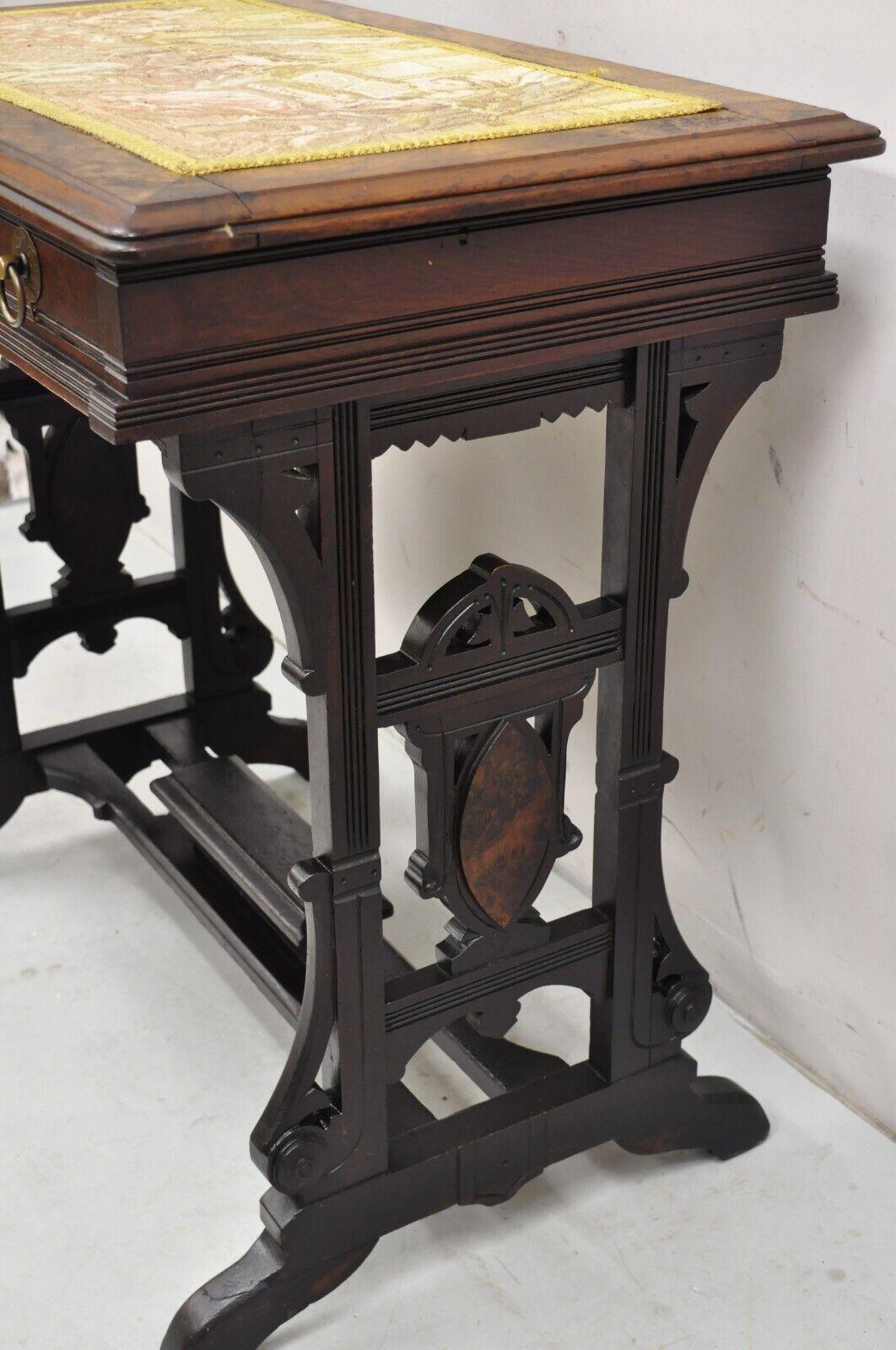
This sewing stand features the characteristic carved designs of the Eastlake look, plus a beautiful medallion made of burled walnut.
4. Japan, the Centennial, and the Aesthetic Movement
The 1876 Philadelphia Centennial Exposition did for American design roughly what the 1862 London exhibition had done for British. The Japanese pavilion was a sensation, and a generation of American designers absorbed a set of lessons: ornament can be flat, asymmetrically placed, drawn from nature but stylised nearly to a diagram, and it can be beautiful without being three-dimensional.
Those lessons fit Eastlake's programme perfectly, and the two currents merged into what is now called the Aesthetic Movement. Fans, stylised chrysanthemums and sunflowers, bamboo turning, cranes, and geometric fretwork joined the trefoils and quatrefoils Eastlake had inherited from the Gothic Revival.
At the luxury end this produced some of the finest furniture ever made in America. Herter Brothers of New York, under Christian Herter, made ebonised cherry cabinets with inlaid marquetry panels and gilt-incised detail. Kimbel and Cabus built a much-discussed "modern Gothic" interior for the Centennial. In Philadelphia, Daniel Pabst worked with the architect Frank Furness on furniture of real inventive power. These pieces are Eastlake's ideas realised by people who could actually execute them, and the market prices them in a different league from anything out of a factory.

An aesthetic movement inlaid, parcel-gilt and part-ebonized cherrywood and maple cabinet, attributed to Herter Brothers (1864-1906), New York, circa 1880. Estimated at $20,000-$40,000.
5. The End, and the Sequel
By around 1890 the fashion had turned. Golden Oak brought quartersawn oak, applied machine-stamped ornament and a return to curves, and Eastlake walnut began to read as dark and old-fashioned. Much of it was painted, broken up for lumber, or exiled to attics and rental houses over the following half-century, which is one reason surviving pieces so often carry a 1930s or 1950s refinish.
The argument did not die with the style. When Gustav Stickley began making Mission furniture around 1900, he was restating Eastlake's case with the incised ornament removed: rectilinear form, exposed joinery, honest material, no applied decoration at all. Arts and Crafts is Eastlake taken seriously.
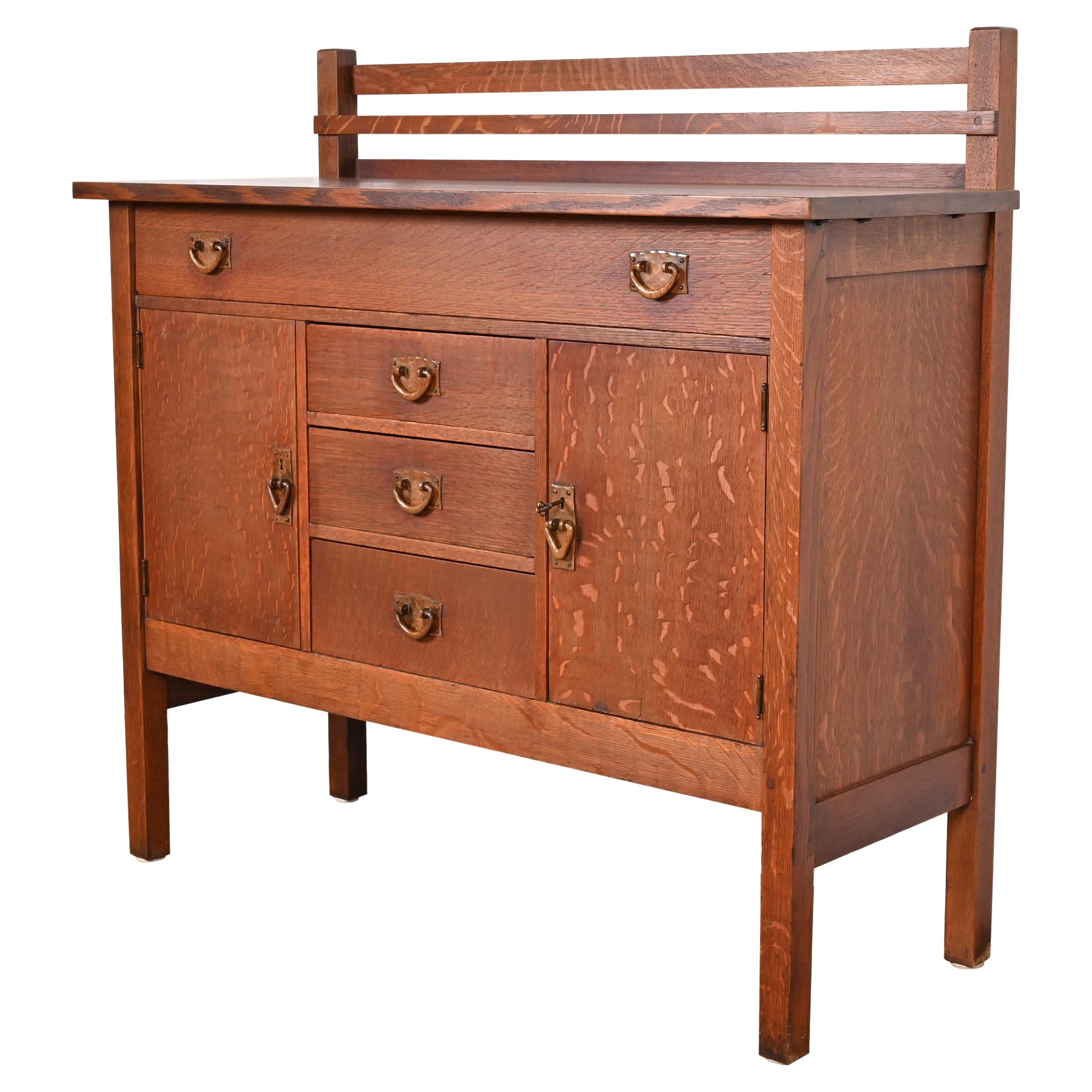
Stickley's Craftsman (also called Mission) style embraced Eastlake's original ethos of honest craftsmanship.
The Characteristics: What Makes Furniture Look Eastlake
The Straight Line, First and Last
Eastlake furniture is boxy. Case pieces are rectangular, crests are flat or stepped rather than scrolled, legs are turned or square rather than cabriole, and where there is a curve it tends to be a small arc or a chamfer rather than a sweeping S. If a Victorian piece reads as angular, that alone puts Eastlake at the top of the list.
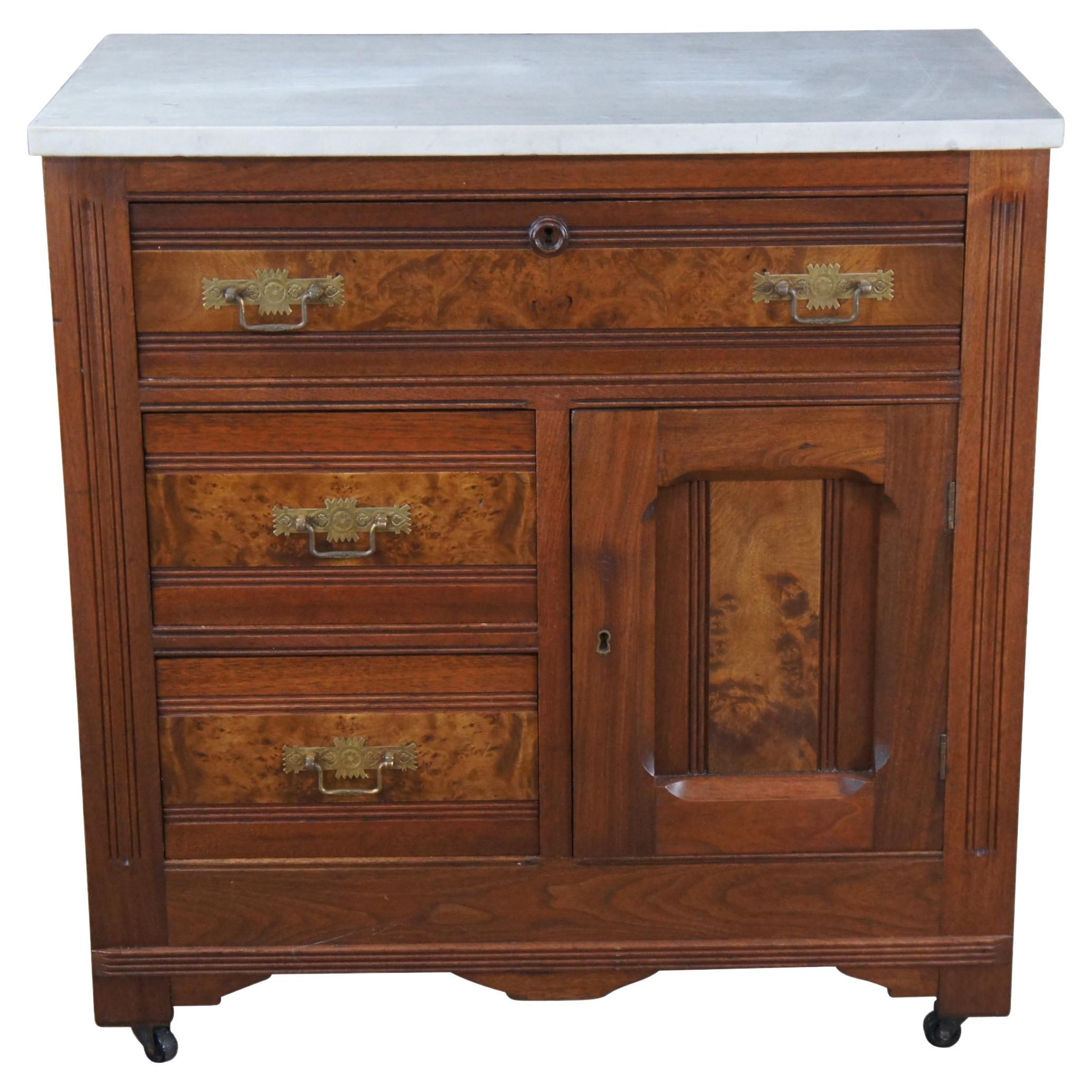
This typical Eastlake washstand is nearly all straight lines, which makes it a great anchor piece for a modern interior. The casters on the feet allowed Victorian homeowners to easily dust beneath their furniture, rearrange their rooms, or transport furniture across the country during a period of great mobility and expansion in the United States.
Incised Decoration: The Single Best Tell
Everything else on this list appears on other styles. Incising is the diagnostic feature. Look for shallow parallel grooves cut into the surface, often in bands of two or three, sometimes filled with black wax or gilding so they read as lines from across the room. Alongside them: chip-carved bands of small repeating gouges, shallow carved roundels, and flat geometric patterns worked a few millimetres deep.
The test to remember is direction. Eastlake ornament goes into the wood. Renaissance Revival and Golden Oak ornament comes out of it, carved in relief or glued on as an applied element.
Geometric Panels and Burl Reserves

Incised designs like those on this Eastlake bed frame are calling cards of the style. The designs on the central panel are bamboo shoots, inspired by Japanese arts and crafts.
Case pieces are typically divided into rectangular panels by applied mouldings, with the panel field either plain, incised, or filled with a slab of highly figured burl walnut veneer. This is a curious survival of exactly what Eastlake objected to, since the burl is decorative veneer over a plainer ground. Manufacturers liked it because a burl panel does a great deal of visual work for very little labour.
Spindles, Galleries and Applied Turnings
Small turned spindles appear constantly: in galleries along the tops of sideboards and dressers, as miniature colonnades flanking mirror plates, as friezes under shelves, and in the backs of chairs. Applied half-columns and split turnings, glued onto stiles and panel edges, do similar work.

This Eastlake apothecary cabinet displays a top gallery with small turned spindles.
The Motif Vocabulary
-
Incised parallel lines and bands, the base layer of nearly every piece
-
Roundels and rosettes, shallow-carved or incised discs
-
Chip-carved borders, rows of small gouged notches
-
Stylised sunflowers and daisies, flattened almost to geometry
-
Trefoils, quatrefoils and pointed arches, inherited from the Gothic Revival
-
Japanese fans, stylised bamboo, chrysanthemums and cranes, on Aesthetic Movement pieces
-
Chamfered edges and exposed pegs, decoration by way of construction
-
Tiles, encaustic or transfer-printed, set into washstand backsplashes and hall tree panels
The Materials
|
Material |
Where it shows up |
Notes |
|
Black walnut |
The default show wood, 1870s especially |
Warm chocolate brown, straight-grained, takes a crisp incised line |
|
Burl walnut veneer |
Panel reserves on dressers, sideboards, chair crests |
Dense swirling figure; supplies the pattern the flat panels lack |
|
Ash |
Later and cheaper suites, often as "walnut and ash" |
Pale, coarse open grain; frequently stained to imitate walnut |
|
Cherry |
Better pieces, and the ebonised high style |
Fine, even grain; darkens handsomely with age |
|
Chestnut |
Carcases and some show surfaces |
Similar figure to oak, lighter; American chestnut is effectively gone |
|
Oak |
Toward the end of the period |
Signals the coming transition to Golden Oak |
|
Ebonised cherry or maple |
Aesthetic Movement and high-style work |
Stained black, often with gilt incising and inlay |
|
Marble |
Tops of dressers, washstands, side and parlour tables |
Usually grey-veined white; also rouge and black on better pieces |
|
Poplar and pine |
Drawer linings, backboards, dust boards |
The secondary woods to expect inside an American piece |
Hardware
The hardware is genuinely useful for identification. Look for brass teardrop pulls hanging from small incised backplates, carved wooden pulls shaped as leaves, fruit or shells, brass bail handles on rectangular stamped plates with geometric or Japanesque patterns, and pressed brass keyhole escutcheons. Cast iron appears on plainer work. Original hardware adds real value here, partly because the incised backplates are themselves period ornament.
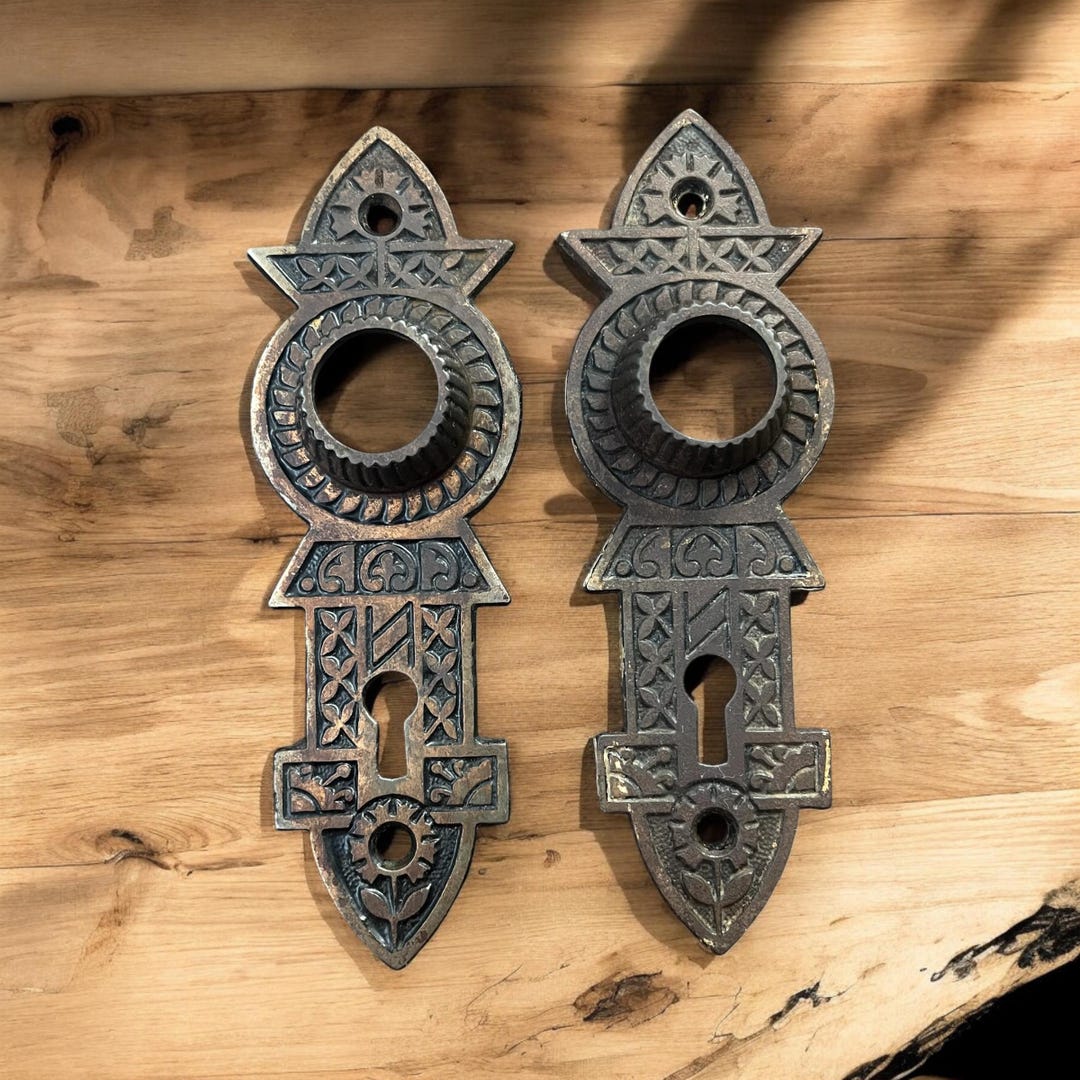
Eastlake hardware is especially beautiful and often displays classic motifs of the style, such as the sunflowers on these escutcheons.
Legs, Feet and Casters: A Cheat Sheet
-
Turned and reeded legs on chairs and tables, often with ring turnings
-
Square tapered or chamfered legs, sometimes with incised lines running down the face
-
Trumpet and spool turnings on parlour tables
-
Plinth bases on large case pieces
-
Ceramic or wooden casters on almost everything, since Victorian housekeeping meant moving furniture to sweep
-
Bracket-and-spindle stretchers joining table legs to a central finial
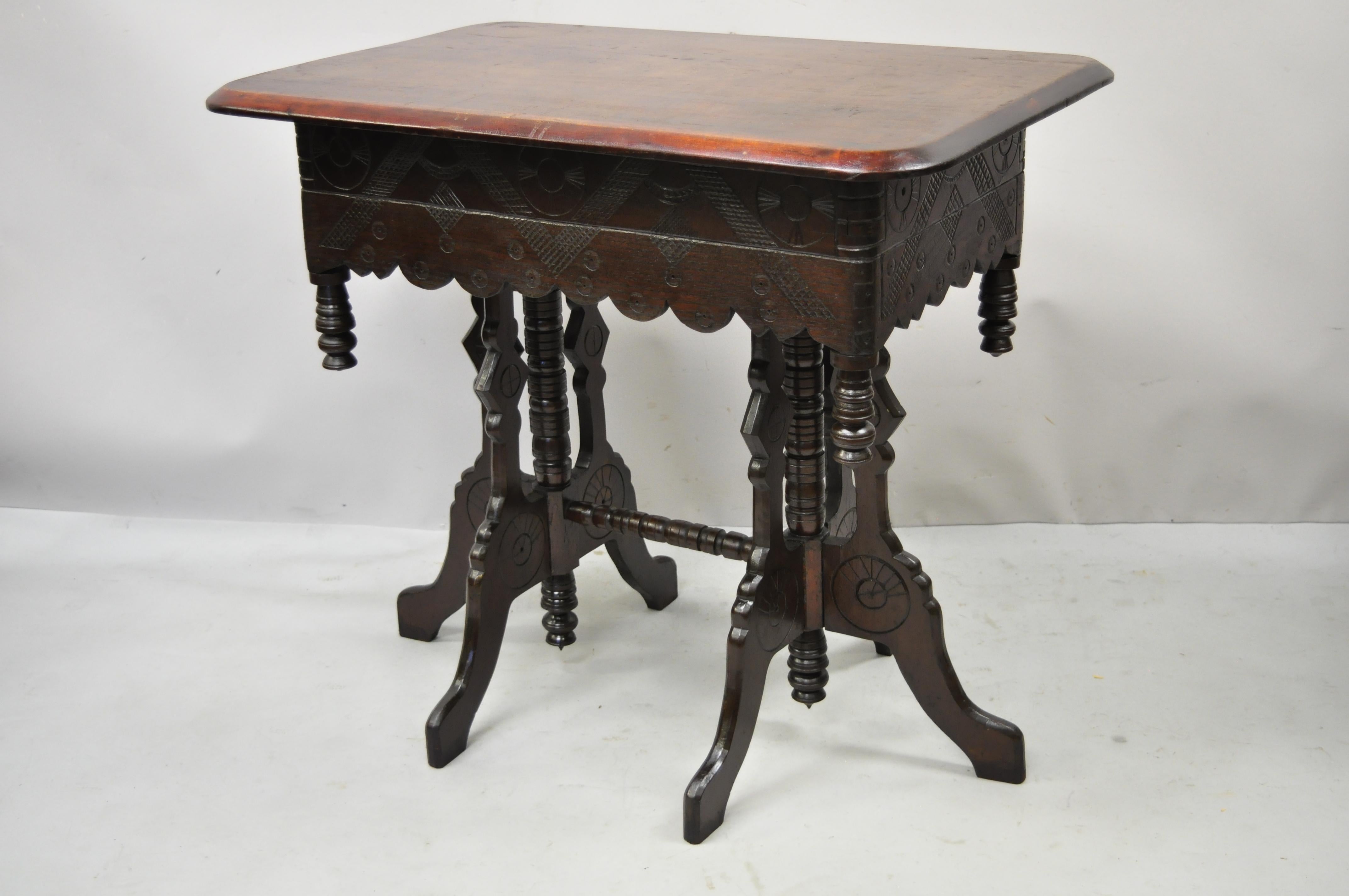
Legs can be the most dramatic part of an Eastlake piece.
Forms Worth Knowing
-
The bedroom suite, bed with a tall panelled headboard, marble-top dresser with mirror, and washstand or commode; sold as a set and now usually broken up
-
The marble-top dresser, with a fixed or tilting mirror on shaped supports
-
The washstand or commode, low, with a marble top and often a tiled or marble backsplash
-
The hall tree, a mirror, hooks, and a hinged seat over a boot box
-
The sideboard, panelled and galleried, sometimes with a marble serving surface
-
The parlour suite, gentleman's chair, lady's chair, settee and side chairs, upholstered in tufted velvet or horsehair
-
The platform rocker, rocking on a spring mechanism above a stationary base
-
The folding chair, carpet-seated and often surprisingly elegant
-
The parlour or lamp table, square or octagonal, marble-topped, on casters
-
The étagère, whatnot and secretary, for the display and paperwork the period demanded
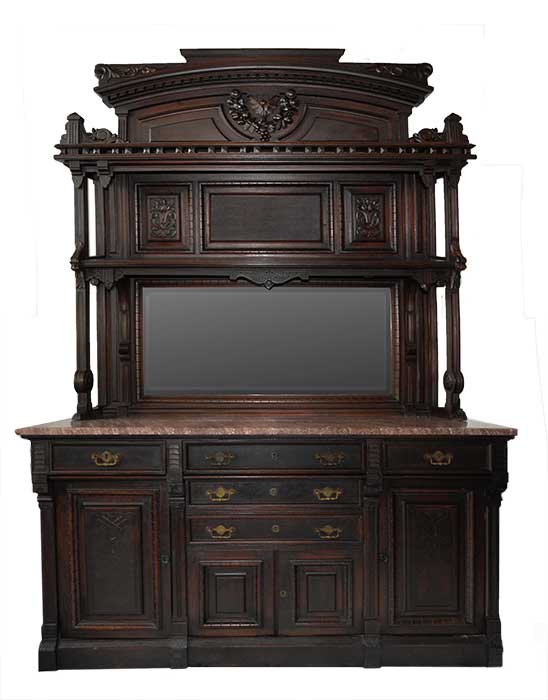
This ebonized Eastlake sideboard features panels, an inset mirror, a gallery, and a marble serving surface.
Eastlake, Renaissance Revival, Aesthetic, Golden Oak: Telling Them Apart
Sellers use "Victorian" for all of it, which helps nobody. A rough guide:
-
Renaissance Revival (c. 1860–1880): taller, heavier and more sculptural. Deep high-relief carving, applied cartouches, arched pediments, carved crests with urns, medallions or human heads. If a crest looks carved by a sculptor, this is where you are.
-
Eastlake (c. 1870–1890): rectilinear, flat-crested, decorated with incised lines and chip carving. Spindles, geometric panels, burl reserves. Ornament cut in, not modelled out.
-
Aesthetic Movement (c. 1875–1890): overlaps Eastlake so heavily that dealers use the terms interchangeably. Reach for it when the piece is ebonised, inlaid, gilt-incised, or carries clearly Japanese motifs, and when the quality suggests a named workshop rather than a factory.
-
Golden Oak (c. 1890–1915): quartersawn oak instead of walnut, applied machine-stamped ornament, and curves returning in the form of serpentine drawer fronts, claw feet and bowed glass.
The simplest test is the one above: run a finger over the ornament. Cut into the surface points to Eastlake. Standing proud of it points to the styles either side.
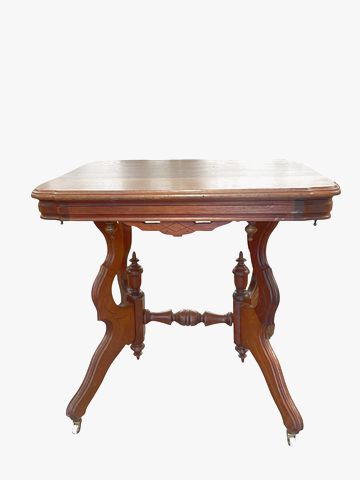
This nineteenth-century Eastlake table on its original casters is available at Evolution Home! We love this piece because it preserves the classic Eastlake look without being too dark or too heavy - perfectly suited for a modern interior.
How to Tell a Period Piece from a Later Copy
Eastlake authentication runs backwards from Georgian authentication, and that trips people up. Machine work is not a warning sign here. Uniform machine-cut dovetails, circular saw marks on secondary surfaces and machine-cut screws are all exactly what a genuine 1880 factory piece should show. What you are separating is 1880 from 1975, and 1880 original from 1880 heavily reworked.
-
Read the incising closely. Period incising is cut, so the groove has crisp severed edges and old wax, dirt and finish settled into the bottom of it. Twentieth-century reproductions often use embossed or stamped decoration, where a heated die crushes the wood fibres rather than cutting them. Look at the end of a groove under a raking light: cut lines terminate cleanly, pressed lines have a compressed, slightly glossy shoulder.
-
Check the secondary woods. Expect poplar, pine or chestnut in drawer linings, backboards and dust boards. Plywood or particleboard anywhere in the carcase means twentieth century, full stop. Thin plywood drawer bottoms are the most common giveaway on reproductions.
-
Assess the marble. Original tops are thick, often close to an inch, grey-veined rather than bright white, and finished with a hand-worked bevelled or ogee edge that is not perfectly consistent all the way round. Replacements tend to be thinner, whiter and machine-cut to a slightly different footprint. Lift the top and look for an outline of unfaded finish on the wood beneath; it should match the stone sitting on it.
-
Look hard at mirror-and-base marriages. Dresser bases and mirror frames are separated and recombined constantly, and a marriage is worth considerably less than an intact piece. Check that the incised patterns match in scale and style, that the walnut is the same colour and figure, and that the mirror supports bolt into original holes rather than fresh ones. New screw holes beside filled old ones tell the whole story.
-
Judge the mirror plate on its own terms. Period plate is thinner, slightly wavy, and losing silver at the edges. A bright modern plate in a period frame is normal and perfectly acceptable, but it should not be paid for as original.
-
Follow the hardware ghosts. Original pulls leave a shadow of unfaded finish and a wear pattern where hands landed. Filled holes, mismatched plates, or hardware that sits proud of the surface indicate replacement, which is common and forgivable but should show up in the price.
-
Look for a maker's mark. Grand Rapids firms stencilled, stamped or labelled a good deal of their output on drawer bottoms, backboards and the undersides of tops. A legible Berkey and Gay or Phoenix Furniture mark is worth finding before you negotiate.
-
Be honest about the finish. Most surviving Eastlake has been stripped and refinished at least once, and a great deal was painted at some point in the twentieth century. Original shellac is darker, softer and often finely crazed. Because condition rather than rarity drives value in this category, an intact original surface commands a genuine premium.
No single test settles it. Dating this furniture means building agreement between several independent clues, including the incising, the secondary woods, the stone, the hardware and the wear, and staying sceptical when one of them dissents.

This Eastlake piece has been refreshed with a "cottage style" coat of blue paint.
Living with Eastlake Now
This is the value proposition in the antiques trade at the moment, and it exists for an unglamorous reason: they made too much of it. Production between 1875 and 1885 was enormous, survival rates are high, and the style has been out of fashion since roughly 1890. Common walnut side chairs frequently trade for less than a hundred dollars. Dressers, hall trees, sideboards and parlour tables generally run from a few hundred into the low thousands depending on size, original marble, original mirror and finish. Attributed pieces from named workshops sit in an entirely separate market and can reach five and six figures at auction.
What you are actually buying at the low end is solid black walnut, mortise-and-tenon joinery, hand-fitted drawers and a hundred and forty years of proven service, for less than a flat-pack equivalent. A few practical notes:
-
Buy the useful forms. Marble-top side and parlour tables, dressers used as sideboards or bathroom vanities, hall trees in an actual hall, and sideboards all do daily work. Washstands make excellent small bathroom cabinets.
-
Handle marble vertically. A marble top carried flat will snap under its own weight. Always move it on edge, with two people, and never slide it across the wood.
-
Don't refinish it. Clean it, wax it sparingly, and leave the rest alone. If a surface genuinely needs work, find a restorer who will amalgamate or French-polish the existing shellac rather than sand it off.
-
Know that incising collects dust. Every one of those grooves is a dust trap. A soft brush occasionally is the whole maintenance routine, and it is worth knowing before you buy a heavily carved hall tree.
-
Mix, don't theme. One walnut Eastlake piece against a plain wall, or a marble-top table beside a modern sofa, reads as confident. A complete matching suite reads as a period room, which is a different project.
-
Watch for the high-style outliers. Ebonised, inlaid, gilt-incised pieces with real quality are Aesthetic Movement furniture wearing Eastlake clothes, and they are worth a great deal more than their factory cousins. They turn up misidentified more often than you would expect.

An Eastlake piece can add a pop of rich, natural wooden texture and color to a modern interior. It also can lend a stabilizing effect through its straight lines along with a sense of historical depth and continuity.
Frequently Asked Questions
What years is Eastlake furniture from?
Roughly 1870 to 1890 in America, with the peak between about 1875 and 1885. The source book was published in London in 1868 and in Boston in 1872, and the style faded around 1890 as Golden Oak took over.
Who was Charles Eastlake, and did he design this furniture?
He was an English architect, critic and museum official (1836–1906) who later served as Keeper of the National Gallery in London. He designed almost none of the furniture that bears his name. His 1868 book Hints on Household Taste set out design principles, American manufacturers attached his name to their products without any arrangement, and Eastlake distanced himself from the results.
What is the difference between Eastlake and Renaissance Revival furniture?
Renaissance Revival is heavier, taller and sculptural, with deep high-relief carving, applied cartouches and elaborate crests. Eastlake is rectilinear and flat, decorated with shallow incised lines, chip carving, spindles and geometric panels. The quickest test is whether the ornament is cut into the surface (Eastlake) or modelled out of it and applied to it (Renaissance Revival).
Is Eastlake the same as Aesthetic Movement furniture?
They overlap substantially and dealers often use the terms loosely. Aesthetic Movement is the broader, more Japanese-influenced current running through the 1870s and 1880s, and its finest pieces, from makers like Herter Brothers, Kimbel and Cabus, and Daniel Pabst, are ebonised, inlaid and made to a far higher standard than factory Eastlake. Reach for "Aesthetic Movement" when the quality and the Japanese motifs are both present.
What wood is Eastlake furniture made from?
Black walnut is the default, usually with panels of figured burl walnut veneer. Ash, cherry, chestnut and later oak all appear, and ash was often stained to pass as walnut on cheaper suites. High-style Aesthetic pieces use ebonised cherry or maple. Poplar and pine are the secondary woods inside drawers and carcases, and marble tops are standard on dressers, washstands and parlour tables.
Is Eastlake furniture valuable?
Most of it is inexpensive, because production was vast and demand has been soft for decades. Common chairs can be very cheap, and case pieces typically run from a few hundred dollars into the low thousands. Value concentrates in original condition (untouched finish, original marble, original mirror plate, original hardware, no marriage between base and mirror) and in attributed pieces from named workshops, which trade in a completely different market.
How can I tell if my Eastlake furniture is genuine?
Machine work is expected on a genuine piece, so don’t treat uniform dovetails or circular saw marks as warnings. Instead, confirm the incising was cut rather than stamped, check for poplar or pine secondary woods and no plywood, verify the marble is thick with a hand-worked edge and matches its unfaded outline on the wood, and make sure the mirror frame belongs to its base. Then look for a Grand Rapids maker's mark on the drawer bottoms or backboards.
A Short Glossary
Chip carving: a band of small repeating gouged notches cut into a surface. Burl: the dense swirling figure from a tree growth, sliced as veneer for panel reserves. Chamfer: a bevelled edge cut off a square corner, used decoratively as evidence of construction. Ebonised: stained black to imitate ebony, usually on cherry or maple. Escutcheon: the plate or lining around a keyhole. Étagère: an open shelved stand for displaying objects. Gallery: a low decorative railing of spindles along the top of a case piece. Hall tree: a hall stand combining mirror, hooks and a hinged seat over storage. Incising: shallow decorative lines cut into a surface, often filled with black wax or gilding; the signature Eastlake technique. Marriage: a piece assembled from parts of two others, typically a dresser base with a mirror from elsewhere. Reeding: parallel raised ridges turned or cut into a leg or post. Roundel: a small circular carved or incised ornament. Split turning: a turned element sawn lengthwise and applied to a flat surface as decoration. Washstand: a low case piece, usually marble-topped, made to hold a basin and pitcher.
Evolution Home Insider publishes guides to period furniture, materials and the craft of living with old things. If you are weighing up a particular Eastlake piece and want a second opinion, send us photographs of the incised decoration in raking light, the drawer linings, the underside of the marble and the back of the mirror supports. That is where the answers are.
Sources and further reading: Charles L. Eastlake, Hints on Household Taste in Furniture, Upholstery and Other Details (London, 1868; Boston, 1872) and A History of the Gothic Revival (1872); Mary Jean Smith Madigan, Eastlake-Influenced American Furniture, 1870–1890 (Hudson River Museum, 1973); Doreen Bolger Burke et al., In Pursuit of Beauty: Americans and the Aesthetic Movement (Metropolitan Museum of Art, 1986); collection records and Aesthetic Movement essays of the Metropolitan Museum of Art; Grand Rapids Public Museum furniture industry collections.
