
The Evolution Home Insider #3: Neoclassical


Neoclassical Furniture: History, Characteristics, and How to Spot the Real Thing
Neoclassical furniture is the furniture made across Europe and America between roughly 1760 and 1830, which turned away from the curves and frivolity of Rococo and back to the straight lines, symmetry, and ornament of ancient Greece and Rome. It is defined by architectural proportion, restrained classical decoration — urns, swags, acanthus, fluting — and an air of disciplined elegance that runs from Robert Adam's English interiors to Marie Antoinette's Versailles to Duncan Phyfe's New York workshop.
Neoclassicism is best understood not as one style but as a movement with regional accents. The same classical vocabulary produced the light, inlaid English "Adam" and Hepplewhite furniture, the refined French Louis XVI, the delicate American Federal, and, in its final and heaviest phase, the monumental Empire. What holds them together is a single conviction, borrowed straight from the ancients: that beauty comes from order, proportion, and clarity rather than from ornament for its own sake.
That conviction is why a Neoclassical console or a Federal card table still looks composed in a modern room. The style was built on the same architectural logic that governs a classical façade, and that logic does not date.
Key Takeaways
- Dates: roughly 1760–1830, overlapping the later Georgian, Regency, and Napoleonic eras.
- The spark: the excavations of Herculaneum (from 1738) and Pompeii (from 1748), which put real classical objects in front of designers for the first time.
- Design DNA: symmetry, architectural proportion, straight tapered or fluted legs, and restrained classical ornament — urns, paterae, swags, acanthus, anthemion.
- Regional phases: English (Adam, Hepplewhite, Sheraton) → French (Louis XVI) → American (Federal) → the later, heavier Empire.
- Signature materials: mahogany and satinwood, with marquetry, inlay, and — especially in France — gilt-bronze (ormolu) mounts.
- Best tells of authenticity: hand joinery, correct secondary woods, honest inlay and veneer, oxidised mounts, and consistent age-appropriate wear.
- Market note: fine Neoclassical, Louis XVI, and Federal pieces enjoy steady global demand precisely because their architectural restraint suits contemporary interiors so well.
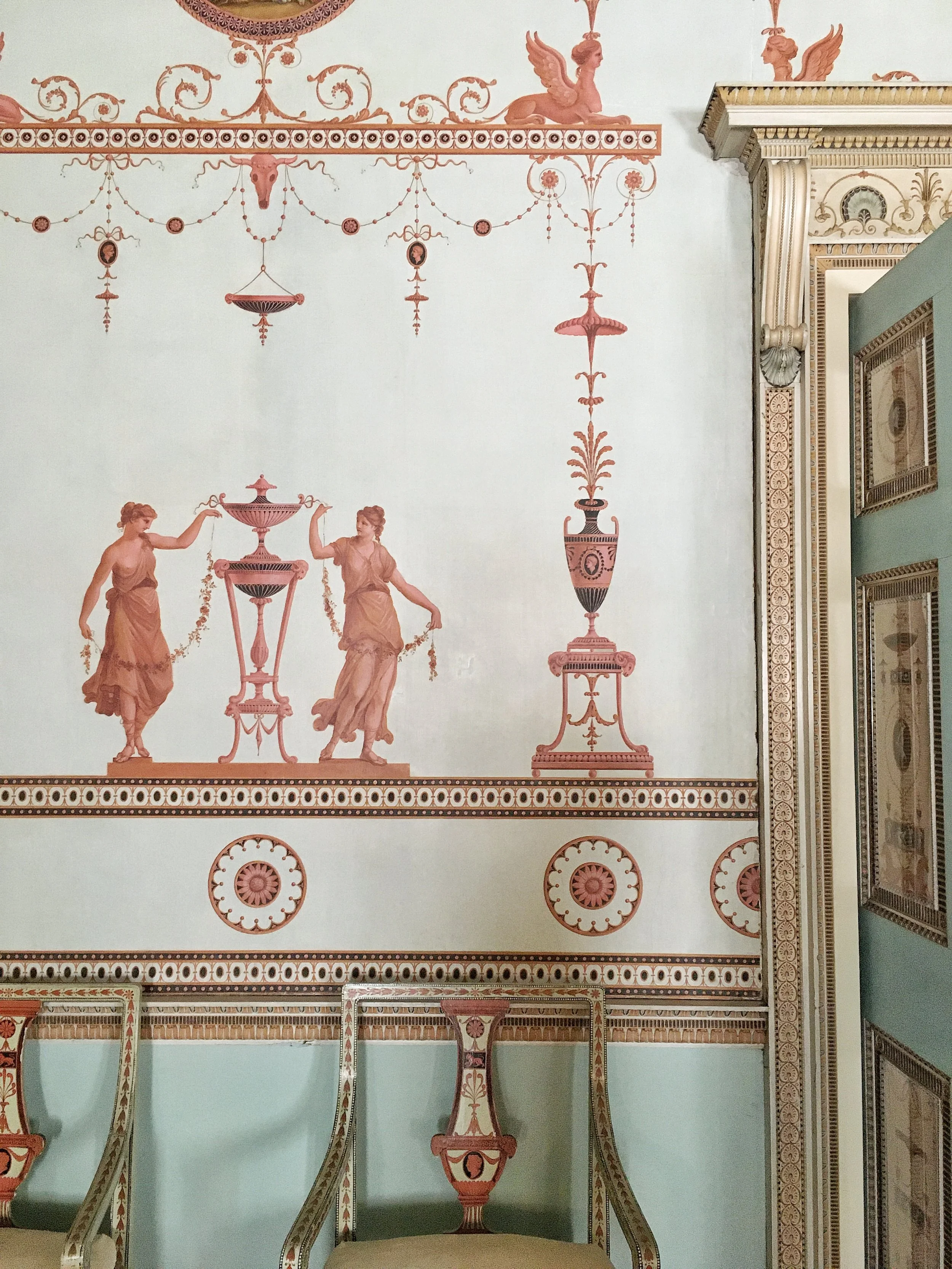
Robert Adam's Etruscan Dressing Room at Osterley Park (completed 1775–78) shows numerous neoclassical motifs working together. Adam's inspiration for this room came from Sir William Hamilton's collection of Etruscan vases and the excavation of Pompeii, and the decoration reads like it's lifted straight off pottery: urns and swags decorate the jambs of the integrated window shutters, while the wall panels carry paterae and anthemion bands throughout.
A Quick Timeline
| Year | Moment | Why it matters |
|---|---|---|
| 1738 / 1748 | Excavations begin at Herculaneum, then Pompeii | Authentic Roman objects reach designers and fuel the "taste for the antique" |
| c. 1760 | Neoclassicism emerges as a full style | The Rococo curve gives way to the straight line across Europe |
| 1767–1779 | Robert Adam furnishes Osterley Park | The English "Adam style" defines integrated classical interiors |
| 1774–1793 | Reign of Louis XVI | The French Louis Seize style matures under royal patronage |
| 1788 / 1791 | Hepplewhite's Guide and Sheraton's Drawing-Book | Pattern books carry the light English neoclassical taste worldwide |
| c. 1790–1815 | American Federal style flourishes | The young republic adopts classicism as its national look |
| c. 1804–1815 | Napoleon's Empire style | Neoclassicism turns monumental, archaeological, and imperial |
| c. 1815–1830 | American Empire (Phyfe, Lannuier) | The heavier late phase dominates fashionable American rooms |
The History: How Neoclassical Furniture Happened
1. The Spark: Digging Up Antiquity
For most of human history, ancient furniture was known only from literary descriptions and the occasional carved relief. That changed in the middle of the eighteenth century. Systematic excavation of Herculaneum began around 1738 and of Pompeii around 1748 — two Roman towns buried and preserved by the eruption of Vesuvius in AD 79 — and for the first time designers could see how the ancients actually decorated their rooms.
The effect was electric. Wealthy Europeans on the Grand Tour visited the sites; a flood of illustrated books spread the discoveries across the continent; and artists like Piranesi turned Roman ruins into objects of romance. The Enlightenment gave the enthusiasm an intellectual frame — the critic Johann Joachim Winckelmann argued that the surest path to greatness was to imitate the ancients — and against that background the swirling, asymmetric Rococo suddenly looked frivolous and exhausted. A return to classical order felt like a return to reason itself.
The change was gradual rather than abrupt. Furniture of the 1760s and 1770s is often called transitional, mixing lingering Rococo curves with the new classical straightness, before the fully developed Neoclassical style took hold.

Pompeii's frescoes preserved forms, like the curved-leg klismos chair, that didn't survive the eruption. These paintings, more than any single surviving object, gave Adam and his contemporaries a sense of how a Roman room was actually furnished and arranged.
2. England: The Adam Style
In Britain the movement is inseparable from one man. The architect Robert Adam (1728–1792) had studied the ruins of Rome and Spalato firsthand, and he returned with a light, linear, archaeologically-flavoured vocabulary that he applied to entire interiors — walls, ceilings, chimneypieces, carpets, and the furniture to match. At houses like Osterley Park, Syon, and Kenwood, he designed harmonious schemes in which, famously, even the lock plates answered to the overall classical idea.
Adam's furniture uses classical ornament with restraint: paterae (small round or oval disks), husk chains, urns, rams' heads, and fluting, applied to forms that had gone straight and slender. Where Rococo bulged, Adam's commodes and tables were rectilinear and calm.
Two pattern books then democratised the look and carried it far beyond the great houses. George Hepplewhite's Cabinet-Maker and Upholsterer's Guide (1788, published posthumously by his widow Alice) gave the world shield-back and oval-back chairs, tapered legs, and the sideboard. Thomas Sheraton's Cabinet-Maker and Upholsterer's Drawing-Book (from 1791) offered squarer, lighter designs full of inventive mechanisms. Together with Adam, these three names became the benchmark of the English neoclassical taste — and the direct source for the American Federal style that followed.
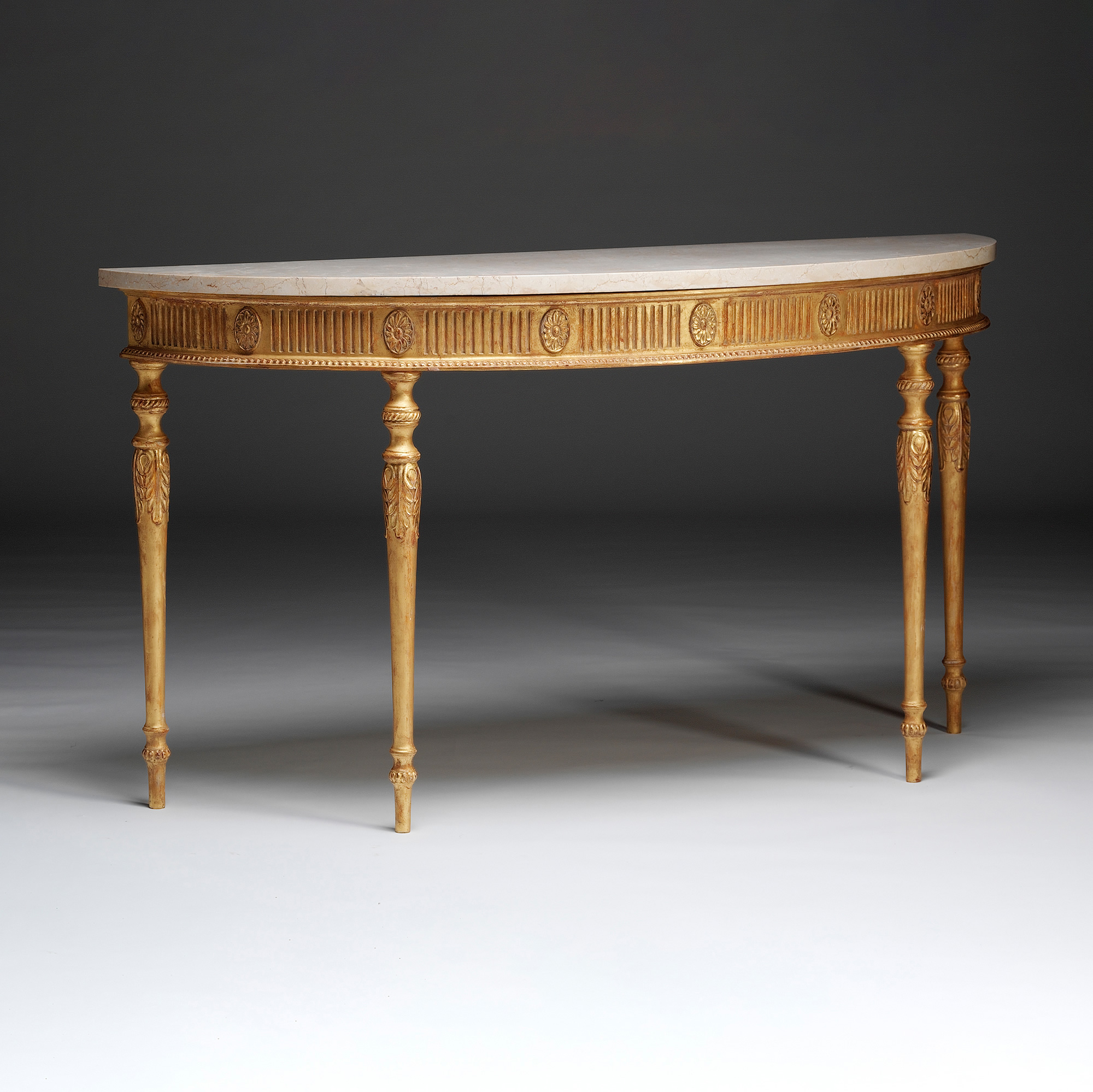
Designed by Robert Adam and carved by Sefferin Alken, this table was made for the gallery at Croome Court in Worcestershire, the country seat of the sixth Earl of Coventry, and is now in the Metropolitan Museum's collection. Pier mirrors and tables like this one generally stood against a pier, the wall space between two windows. It's a textbook example of English neoclassicism: tapering fluted legs, restrained gilt ornament, and architectural symmetry designed to work with a specific room.
3. France: Louis XVI
In France the same classical wave produced the Louis XVI style, named for the king who reigned from 1774 to 1793, though the taste was already forming under Louis XV. It was, in effect, the birth of French neoclassicism and the last phase of the old Baroque-Rococo tradition rolling to a close.
Louis Seize furniture replaced the Rococo cabriole with straight, tapered, fluted legs — often turned to resemble miniature classical columns — and squared, symmetrical case pieces. But the French kept their love of luxury: marquetry of exotic woods, panels of lacquer, and above all finely chased gilt-bronze mounts (ormolu) that framed drawers and capped legs. Marie Antoinette was a devoted patron, commissioning craftsmen to furnish her rooms at Versailles and the Trianons in the new manner, and the resulting commodes and cabinets remain among the most coveted objects in the decorative arts. The Rousseau-era fashion for a romanticised, orderly "nature" gave the style its particular note of restrained opulence.
This fall-front secretary was made specifically for Marie-Antoinette. Its construction involved several master artists; the medallions, painted flowers, and the cabinet itself were all the focuses of various artists and artisans who collaborated on the work.
4. America: The Federal Style
After the Revolution, the young United States needed a look of its own, and it found one in neoclassicism. The Federal style (roughly 1790–1830) is the American adaptation of the English Adam-Hepplewhite-Sheraton tradition, and it deliberately echoed the Roman Republic to celebrate the new American one.
Federal furniture is light, delicate, and geometric: straight lines, tapered legs, contrasting veneers, and fine inlay, a clean break from the Rococo carving that had dominated colonial work. Its ornament leaned patriotic and classical at once — eagles, urns, swags, cornucopia, and lyres. The style had strong regional accents: in Salem, Samuel McIntire carved delicate baskets of fruit and flowers; in New York, the Scottish-born Duncan Phyfe built a workshop whose lyre-back chairs, reeded legs, and superb mahogany made him arguably the greatest of American cabinetmakers. Phyfe's chairs revived the ancient Greek klismos form, with its curved back and out-sweeping legs, and his splats were pierced into lyres, harps, and acanthus.
This Federal pier table combines American and French neoclassical elements into one striking piece. The sphinxes carrying the tabletop, as well as the lion feet anchoring the work, are elements taken directly from classical marble tables excavated at Pompeii and Herculaneum.
5. The Empire Finale
The last phase of neoclassicism dropped the delicacy and turned monumental. The Empire style was born in Napoleon's France, an imperial vocabulary meant to link the new emperor to the Caesars: heavy mahogany, bold gilt-bronze mounts, and motifs drawn from Rome, Greece, and Napoleon's Egyptian campaign — caryatids, sphinxes, winged victories, laurel wreaths, lion monopodia and paw feet. Pattern books like Thomas Hope's Household Furniture and Interior Decoration (1807) spread the archaeological approach to England, where it merged with the Regency taste.
America took it up around 1815–1820 as American Empire, a synthesis of French grandeur, British restraint, and Greco-Roman austerity that suited the confident mood of the post-War-of-1812 republic. Duncan Phyfe's own work evolved from delicate Sheraton forms into robust Empire pieces with massive carved feet, and cabinetmakers like the French-born Charles-Honoré Lannuier in New York produced richly ormolu-mounted furniture with winged caryatids and reeded sabre legs. By around 1830–1840 the style had grown heavy enough that the reaction — the Victorian revivals — was already beginning.
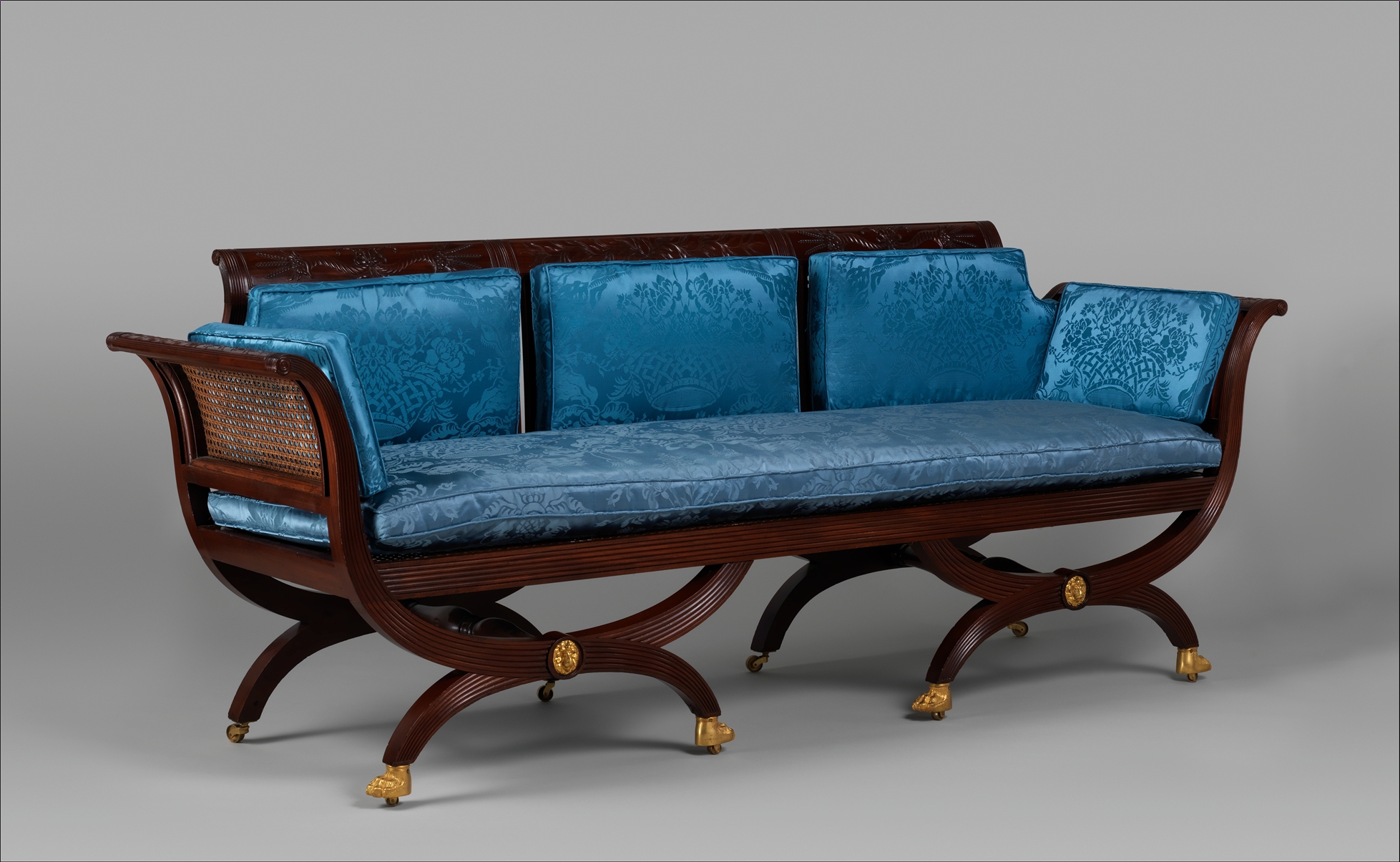
The Characteristics: What Makes Furniture Look Neoclassical
Symmetry and Architectural Proportion
The organising principle is balance. A Neoclassical piece is composed like a classical building, with a clear base, body, and top, and with every element mirrored around a central axis. Where Rococo delighted in the asymmetric flourish, Neoclassicism insists that the left match the right and that the proportions relate to one another in a measured, architectural way. If a piece feels serene and orderly without your being able to say why, this symmetry is usually the reason.
The Straight, Tapered, Fluted Leg
The single clearest signal of the style is the leg. The S-shaped Rococo cabriole vanishes, replaced by a straight leg — square or round in section — that tapers toward the floor and is very often fluted or reeded to echo a classical column. Some finish in a small spade foot; French examples frequently end in a tidy gilt-bronze cap. On later Empire pieces the leg curves again, but now as the outward-sweeping sabre leg of the Greek klismos chair rather than the inward curve of Rococo.
The Classical Ornament Vocabulary
Neoclassical decoration is a fixed cast of ancient motifs, applied with restraint on the earlier pieces and lavishly on the later ones:
- Urns and vases — the single most characteristic motif, on splats, finials, and inlay
- Paterae — small round or oval rosettes
- Swags and festoons — draped garlands of husks, flowers, or drapery
- Acanthus leaves — the curling foliage from a Corinthian capital
- Anthemion and palmette — stylised honeysuckle and palm-leaf bands
- Fluting and reeding — parallel grooves or ridges, straight off a column
- Lyres, harps, and eagles — especially in French and American work
- Caryatids, sphinxes, and lion paws — the heavier Empire additions
The Materials
| Material | Where it shows up | Notes |
|---|---|---|
| Mahogany | English, American, and Empire pieces | The workhorse show wood; dense, dark, and takes crisp detail |
| Satinwood | English and Federal neoclassical | Pale gold, shimmering; favoured for veneers and inlaid panels |
| Exotic inlay woods | Marquetry and stringing | Tulipwood, harewood, boxwood, kingwood for contrast and pattern |
| Gilt-bronze (ormolu) | French Louis XVI and Empire | Cast and gilded mounts framing drawers, capping legs, applied as ornament |
| Giltwood | Mirrors, consoles, seat frames | Carved and water-gilded, especially in grand French and Italian rooms |
| Oak / pine / poplar | Secondary timbers | Drawer linings, backboards, and carcase work, hidden from view |
Decoration by Surface, Not by Carving
Compared with the deep three-dimensional carving of Rococo and Chippendale, Neoclassical ornament tends to lie on the surface. Decoration is achieved through inlay, marquetry, stringing, crossbanding, and painted detail — flat patterns of contrasting wood or paint — and, in France, through applied metal mounts. The overall effect is refined and linear rather than sculptural, which is exactly why the style reads as disciplined.
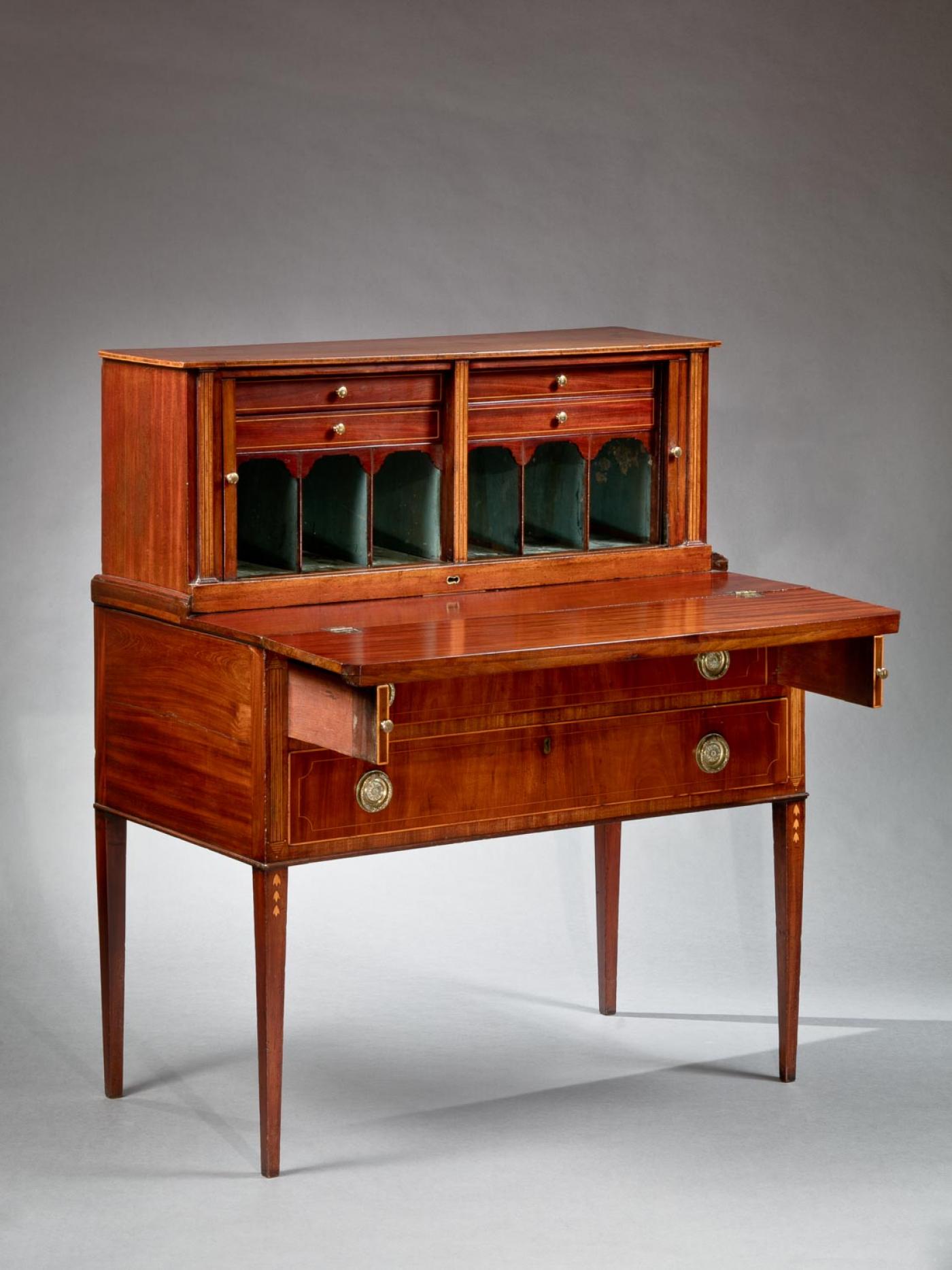
This Federal secretary displays restrained ornamentation based on fruitwood inlay rather than elaborate carving.
Neoclassical, Louis XVI, Federal, Empire: Telling the Phases Apart
These terms overlap and confuse buyers constantly. A rough guide:
- English "Adam" / Hepplewhite / Sheraton (c. 1765–1800): light, inlaid, mahogany and satinwood; shield-back chairs; tapered legs; restrained ornament.
- Louis XVI (c. 1770–1790): French; straight fluted "column" legs; marquetry and ormolu; symmetrical, refined, luxurious.
- Federal (c. 1790–1830): American; delicate, geometric, contrasting veneers; eagles, urns, and lyres; the first distinctly American style.
- Empire (c. 1804–1840): heavier and monumental; bold mahogany and ormolu; sabre legs, caryatids, sphinxes, paw feet; imperial and archaeological.
The simplest test: earlier neoclassical is light and delicate; Empire is heavy and grand. Both are neoclassical, drawing on the same ancient sources, but the earlier phase whispers where the later one declaims.

These beautiful lyre-backed neoclassical chairs are available at Evolution Home!
How to Tell a Period Piece from a Later Copy
Neoclassical forms have been reproduced continuously since the nineteenth century — the Victorians revived them, the Edwardians made fine "Sheraton revival" and "Adam revival" furniture, and factories still turn out classical shapes today. Most reproductions are honest furniture, not frauds, but they sell for a fraction of period prices. The difference lives in the parts nobody bothered to fake.
- Pull a drawer and read the joinery. Genuine eighteenth-century drawers have hand-cut dovetails — few in number, unevenly spaced, with narrow pins and wide tails, and faint scribe lines. Perfectly uniform, machine-cut dovetails point to production after the later nineteenth century.
- Check the secondary woods. English pieces use oak or deal (pine) inside; American pieces use poplar, pine, or chestnut. Show wood all the way through, or any plywood, is a warning.
- Look for hand-tool and saw marks on hidden surfaces. Straight, slightly wandering marks come from a hand or pit saw; arced circular-saw marks belong to the mid-nineteenth century and after.
- Examine the inlay and veneer. Period marquetry and stringing are real wood, saw-cut and comparatively thick, with slightly irregular lines and mellowed colour. Thin, mechanically perfect, or printed "inlay" is modern.
- Study the mounts on French and Empire pieces. Genuine ormolu is cast and mercury- or later fire-gilded, crisply chased, and has oxidised and worn honestly. Bright, soft, or seamed cast mounts that sit oddly on the surface deserve scrutiny.
- Read the patina in three dimensions. Oxidation should be uneven and logical — darker where hands and light reached, paler underneath, grimy in drawer corners. Uniform staining is a decorator's shortcut.
- Check the wear where it should be. Feet, drawer runners, chair arms, and stretcher tops carry two centuries of honest wear. Pristine wear-points on a supposedly period piece usually mean later replacement or a later piece.
- Confirm the hardware makes sense. Hand-wrought or early machine-cut screws with off-centre slots suit the period; Phillips-head screws mark a modern repair at best.
No single test is decisive. Dating furniture means building agreement between several independent clues — style, primary wood, secondary wood, joinery, mounts, wear, and hardware — and staying sceptical when one of them dissents.
Living with Neoclassical Furniture Now
Neoclassical furniture has a quiet advantage in the current market: its architectural restraint makes it unusually easy to place. Fine Louis XVI commodes, Italian neoclassical console tables, and elegant English and Federal pieces enjoy steady, global collector demand, and their clean lines sit comfortably in rooms that would reject something busier. As interiors move back toward warmth, texture, and a curated mix of old and new, a single classical piece often does the work of anchoring a whole room.
A few practical notes if you are buying to use rather than to admire from a distance:
- Buy the useful, adaptable forms. Console and card tables, sideboards, chests and commodes, sets of dining chairs, and mirrors all earn their keep and suit modern rooms.
- Apply the "good, better, best" rule. The pieces that hold value combine superior craftsmanship, quality materials, good condition, and, where possible, documented provenance. One outstanding piece beats several ordinary ones.
- Mix, don't theme. Neoclassical looks its best as a statement or two grounded by plainer, contemporary surroundings — the contrast flatters both. A whole suite of matching classical furniture can read as a museum diorama.
- Respect the surface. Original patina and old finishes carry much of a piece's value; avoid stripping and refinishing, and skip silicone sprays. Wax sparingly.
- Mind gilt and veneer. Ormolu, giltwood, and fine marquetry are vulnerable to damp, heat, and direct sun. Keep pieces off radiators and out of the sun's path, and clean gilding only with the gentlest methods or professional help.
Frequently Asked Questions
What years is Neoclassical furniture from?
Roughly 1760 to 1830, though the taste began forming in the 1750s and the heavy Empire phase runs into the 1840s. It overlaps the later Georgian, Regency, Louis XVI, Federal, and Napoleonic eras, since all of these drew on the same classical sources.
What is the difference between Neoclassical and Rococo furniture?
Rococo (c. 1730–1760) is asymmetric, curvy, and playful, built on the S-shaped cabriole leg and naturalistic shell-and-scroll carving. Neoclassical is its deliberate opposite: symmetrical, rectilinear, and restrained, with straight tapered legs and ornament drawn from ancient Greece and Rome. The change came as archaeological discoveries made the classical world newly fashionable.
Is Louis XVI furniture the same as Neoclassical?
Louis XVI is the French national expression of Neoclassicism, named for the king who reigned from 1774 to 1793. It shares the movement's straight lines, symmetry, and classical motifs, distinguished by fluted "column" legs, fine marquetry, and gilt-bronze mounts. So Louis XVI furniture is Neoclassical, but not all Neoclassical furniture is Louis XVI.
What is the difference between Federal and Empire furniture?
Both are American phases of Neoclassicism. Federal (c. 1790–1830) is light, delicate, and geometric, with contrasting veneers and inlay and motifs like eagles and urns. Empire (c. 1815–1840) is heavier and more monumental, with bold mahogany, ormolu mounts, sabre legs, caryatids, and paw feet. Federal whispers; Empire declaims.
What wood is Neoclassical furniture made from?
Mahogany is the primary show wood across English, American, and Empire pieces, with satinwood favoured for lighter English and Federal work. Marquetry and inlay used tulipwood, harewood, boxwood, and other exotics, while French Louis XVI and Empire pieces added gilt-bronze (ormolu) mounts. Oak, pine, and poplar served as hidden secondary timbers.
How can I tell if my Neoclassical furniture is genuine?
Look past the classical silhouette, which is easy to copy, to the construction. Hand-cut, irregular dovetails; oak, pine, or poplar secondary woods; hand-saw and plane marks; thick, saw-cut inlay; honestly oxidised ormolu; and consistent age-appropriate wear all point to a period piece. Machine-cut dovetails, circular-saw marks, plywood, printed "inlay," or modern screws point to a later reproduction.
A Short Glossary
Anthemion — a stylised honeysuckle or palmette ornament used in classical bands. Caryatid — a carved female figure used as a support, borrowed from Greek architecture. Federal — the American neoclassical style, c. 1790–1830. Fluting / reeding — parallel grooves (fluting) or raised ridges (reeding) echoing a column. Klismos — an ancient Greek chair with a curved back and out-swept legs, revived in the period. Louis XVI (Louis Seize) — the French neoclassical style of the 1770s–1790s. Marquetry — a picture or pattern built from shaped pieces of contrasting veneer. Ormolu — gilded cast bronze, used for mounts on French and Empire furniture. Patera — a small flat, round or oval classical rosette, carved or inlaid. Sabre leg — an outward-curving leg copied from the Greek klismos chair. Swag / festoon — a draped garland of flowers, husks, or drapery. Transitional — furniture of the 1760s–70s mixing Rococo curves with early neoclassical form.
Evolution Home Insider publishes guides to period furniture, materials, and the craft of living with old things. If you are weighing up a particular piece and want a second opinion, send us photographs of the drawer joints, the underside and back, and any mounts or inlay — that is where the answers are.
Sources and further reading: Encyclopædia Britannica, "Furniture: the 18th-century Neoclassical style" and "Duncan Phyfe"; A. Hepplewhite & Co., The Cabinet-Maker and Upholsterer's Guide (1788); Thomas Sheraton, The Cabinet-Maker and Upholsterer's Drawing-Book (1791–94); Thomas Hope, Household Furniture and Interior Decoration (1807); Victoria and Albert Museum, Catalogue of Adam Period Furniture; collection records and period-room essays of the Metropolitan Museum of Art.
