

The Evolution Home Insider #10: Villeroy & Boch Audun
Villeroy & Boch Audun: History, Characteristics, and How to Buy It Right
Some dinnerware wants to be admired from across the room. Audun would rather you pull up a chair, pour a second cup of coffee, and get a good look at the fellow napping under a tree on your salad plate. Who is he? Where did his sheep wander off to? Why does he look so relaxed? Audun raises these questions every morning, and we can't think of a better job for a breakfast plate.
The pattern comes from Villeroy & Boch, a European company that's been making ceramics since 1748. Audun is one of their most popular modern collections, using engraved country scenes your great-great-grandmother would've recognized in sunny frames of butter yellow. The effect is that of a halcyon Saturday morning in Provence.
Better still, it's built to be mixed. Audun comes in several sister patterns that all share the same yellow, the same charcoal ink, and the same leafy borders, so a table set with three of them looks intentional and clever. If you've ever wanted to try mixing patterns, this is the safest playground in the tableware world.
The company's home address is a good story too. Villeroy & Boch is still headquartered in Mettlach, Germany, inside a Benedictine abbey whose roots go back to the late 7th century. Its founder, the Frankish duke turned bishop and saint Lutwinus, is honored by the Old Tower out in the garden, built as his burial chapel and now the oldest surviving building in the Saarland. There's even a deep connection to Van Gogh, which we'll get to. Good taste clearly runs in the family.

Key Takeaways
Maker: Villeroy & Boch, founded 1748 in Audun-le-Tiche, Lorraine. Headquartered since 1809 in a former Benedictine abbey in Mettlach, Germany. Still family-controlled.
The pattern: Audun is named for the company's birthplace. The original design dates to 1830, and the collection was relaunched in 1998 with the yellow that defines it today.
Design DNA: charcoal engraving-style scenes on white porcelain, a warm yellow rim, laurel-leaf garlands, trellis borders, and little script captions under the pictures. Think French country toile, moved from the curtains to the dinner table.
The family: Ferme (farm life), Fleur (botanicals), Chasse (the hunt), Promenade (strolls and village views), and the limited-edition Maison (2023), all designed to mix and match.
Best tells: a Villeroy & Boch backstamp with the pattern name, crisp printed decoration, even color across the yellow, and clean rims with no chips or gray utensil marks.
Market note: Audun is still in production, so new pieces are easy to find at full retail. The smart money buys big assembled sets on the secondary market, where the per-plate cost drops dramatically.
A Quick Timeline
| Year | Moment | Why it matters |
|---|---|---|
| 1748 | François Boch, an iron founder, starts making pottery with his three sons in Audun-le-Tiche | The company's birthday, and the town that gives Audun its name |
| 1767 | The Boch works near Luxembourg begins serial production of tableware | Dinnerware becomes the family's main business |
| 1770 | The Brindille pattern debuts | Still made today as Alt Luxemburg, one of the longest-running patterns anywhere |
| 1791 | Nicolas Villeroy opens a rival earthenware works at Wallerfangen | The future business partner enters the picture |
| 1809 | Jean-François Boch buys the old Benedictine abbey at Mettlach | Still the company headquarters |
| 1824 | A copperplate-engraving studio opens in Mettlach | The printing technique behind Audun's look |
| 1830 | The original Audun design is produced | The ancestor of the plates on our floor |
| 1836 | Boch and Villeroy merge | Villeroy & Boch is born |
| 1852 | Mettlach tiles go into production | They become so famous that "Mettlacher Platten" turns into a generic word for tile |
| 1888 | Van Gogh paints family member Eugène Boch | The company's most famous brush with art history |
| 1892 | Villeroy & Boch tiles every surface of Pfund's dairy in Dresden | A milk shop made entirely of decorated tile, still open today |
| 1998 | Audun is relaunched with its signature yellow | The modern collection takes shape |
| 2023 | Limited-edition Audun Maison is released | A double celebration of Audun's 25th and the company's 275th |
The History: How Audun Happened
1. From Cannonballs to Crockery
Every great dinnerware story should start with artillery. François Boch ran an iron foundry in the little Lorraine village of Audun-le-Tiche, and his specialty was cannonballs. Steady work, but not exactly the career a father dreams of for his kids. So in 1748, he and his three sons fired up a small pottery instead.

Adun-le-Tiche, the town that gave the pattern its name. This photo is from 2022.
It turned out they were good at it. Then in 1766, Lorraine became part of France, and the Bochs’ best customers in Luxembourg suddenly sat across a brand-new border. Instead of fighting the map, they moved. Empress Maria Theresa, whose Habsburg empire then included Luxembourg, gave them permission to build a factory at Septfontaines, along with the right to call it the Imperial and Royal Manufactory and hang the imperial coat of arms over the door. Not bad for a family that started out making cannonballs! By 1770 they were producing a twiggy blue pattern called Brindille, and you can still buy it today as Old Luxembourg, which is a pretty strong argument that the Bochs knew what they were doing.

The Alt Luxembourg, or Brindille, pattern.
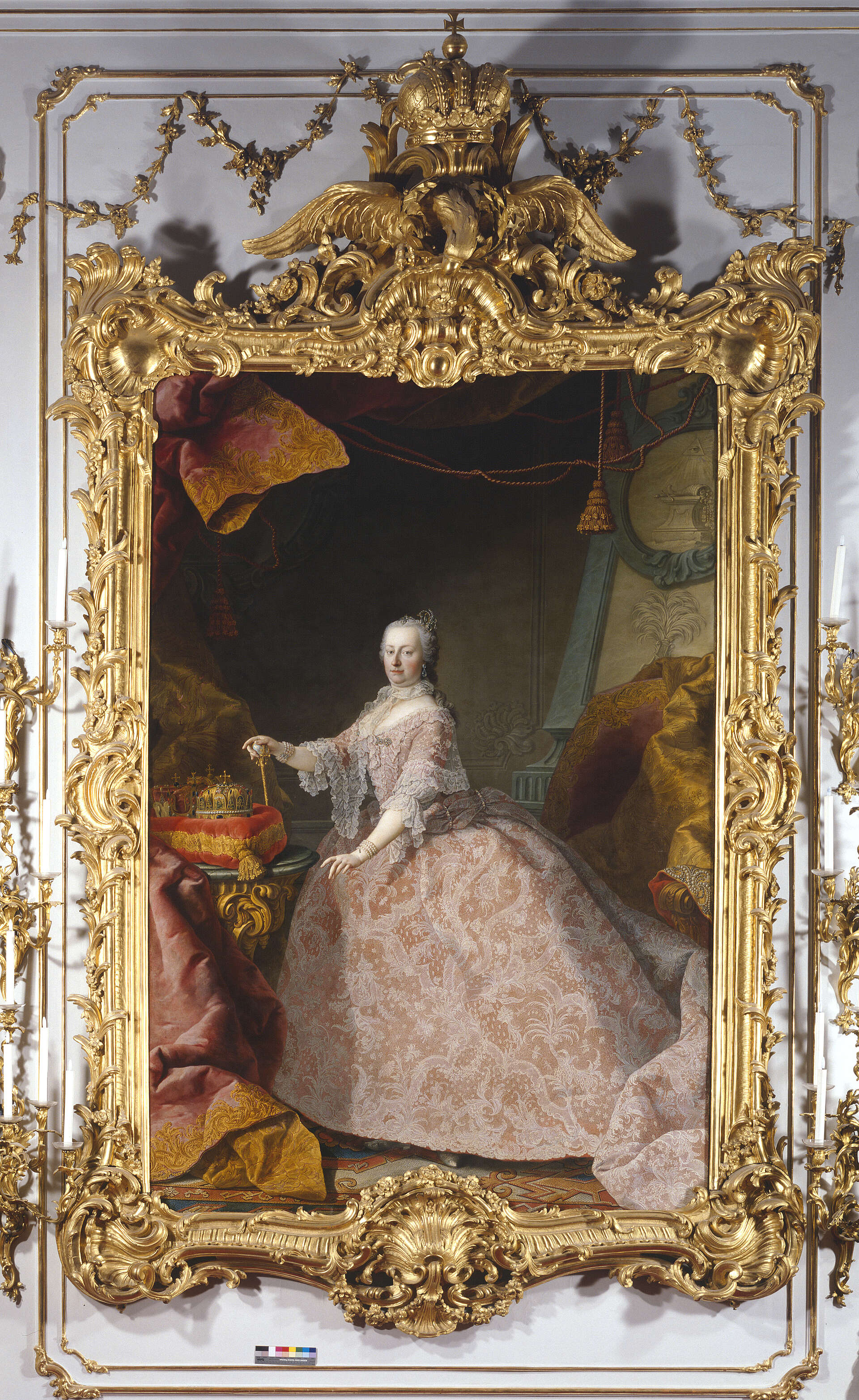
Empress Maria Theresa in her natural habitat, Schönbrunn Palace.
2. An Abbey, a Rival, and a Wedding
In 1809, Jean-François Boch bought a grand baroque Benedictine abbey on the Saar River in Mettlach and filled it with the most modern pottery machinery he could find. The abbey still serves as the company’s headquarters, which makes it one of the more elegant corporate offices in Europe.
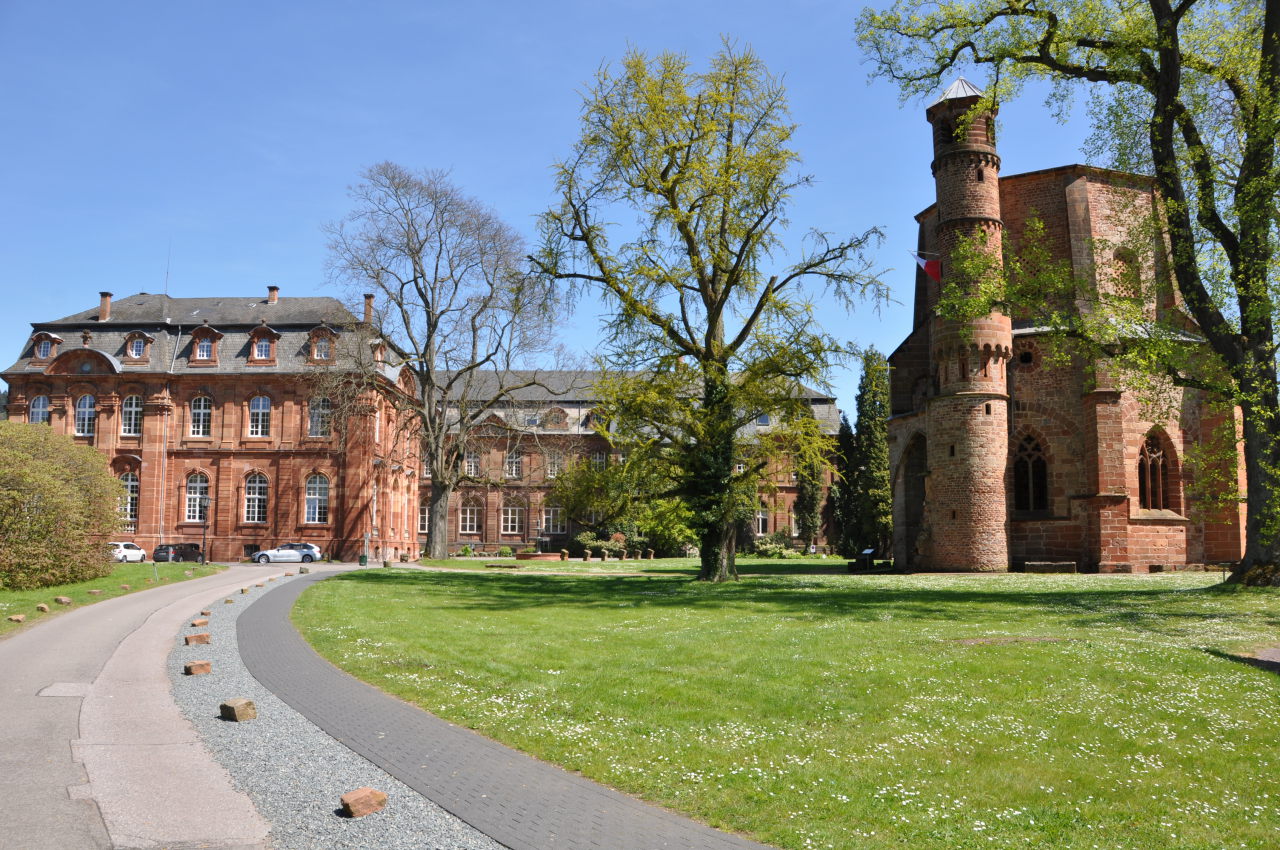
Mettlach Abbey today.
The property came with a lot of history. The monastery was founded in the late 7th century by Lutwinus, a Frankish duke who became a bishop and then a saint, and the Old Tower in the garden was built as his burial chapel around 1000 AD. It’s the oldest surviving building in the Saarland.
The Bochs added a ghost story of their own. During the French Revolution, the family rescued the bones of John of Bohemia, the blind king who died charging into battle at Crécy in 1346, and hid them in an attic in Mettlach. In 1833, the Prussian crown prince passed through, and Jean-François Boch offered him the remains as a gift. The prince counted John as an ancestor, so he had the great architect Karl Friedrich Schinkel build a chapel on a cliff for them and sent Boch a Schinkel-designed fountain, topped with a figure of the king, which still stands near the Old Tower. As for John, he finally went home to Luxembourg’s cathedral in 1946, which makes him one of the best-traveled kings in Europe.

The Old Tower and the Schinkel fountain.
Just down the road in Wallerfangen, Nicolas Villeroy was running a competing earthenware works. Both men were losing sleep over the same thing, which was cheap, excellent English ceramics flooding the market. Instead of fighting each other, they joined forces in 1836. The deal got even cozier when Boch's son Eugen married Villeroy's granddaughter Octavie, the oldest kind of merger there is.
3. Copper, Ink, and a Very Fancy Dairy
Here's the bit that matters most for Audun. In 1824, Jean-François Boch opened a copperplate-engraving studio in Mettlach. Engravers cut fine lines into copper, inked the plates, and transferred the image onto ceramic, which let a factory reproduce detailed pictures across hundreds of plates with remarkable consistency. Delicate hatching, shaded trees, tiny figures in the distance: suddenly all of it was possible on a dinner plate. The original Audun design came out of that world in 1830. It's like a printed picture book you can eat off of!

Hand engraved copper transfers are used to create these designs.
Meanwhile, the company was becoming famous for tile. Mettlach tiles were such a hit that people across Europe started calling any decorative floor tile "Mettlacher Platten," the way Americans say Kleenex. By 1870, tiles made up 60 percent of the company's sales. The most charming result is Pfund's Molkerei in Dresden, a dairy shop the company designed in 1892 where the walls, floor, columns, and even the counter are covered in hand-painted tile. Happily, it came through the 1945 bombing of Dresden, and people still line up to buy cheese there, partly for the cheese and mostly for the walls.

Villeroy & Boch tiled every inch of Pfund's Molkerei in 1892. It's still in business!
4. The Family Painter
Villeroy & Boch credits Audun's engraved scenes to drawings by a Boch ancestor named Eugene. The family had more than one Eugen (or Eugène) over the generations, so the archive gets a little crowded, but one of them earned a very famous portrait.
Eugène Boch, born in Belgium in 1855 to the ceramics side of the family, became a painter instead of a pottery executive. He studied in Paris, ran with a crowd that included Toulouse-Lautrec and Émile Bernard, and in 1888 he met Vincent van Gogh in Arles. Van Gogh painted him against a deep blue starry background and called the picture The Poet. It hangs today in the Musée d'Orsay.

Portrait of Eugène Boch (The Poet)
September 1888, Arles
Oil on canvas, 60 x 45 cm
Musée d'Orsay, Paris
His sister Anna Boch, also a painter, went one better. In 1890 she bought Van Gogh's The Red Vineyard for 400 francs, which is traditionally considered the only painting he sold in his lifetime. Van Gogh later admitted to his brother, a bit sheepishly, that the Bochs had paid full price when they probably should've gotten a friend discount.
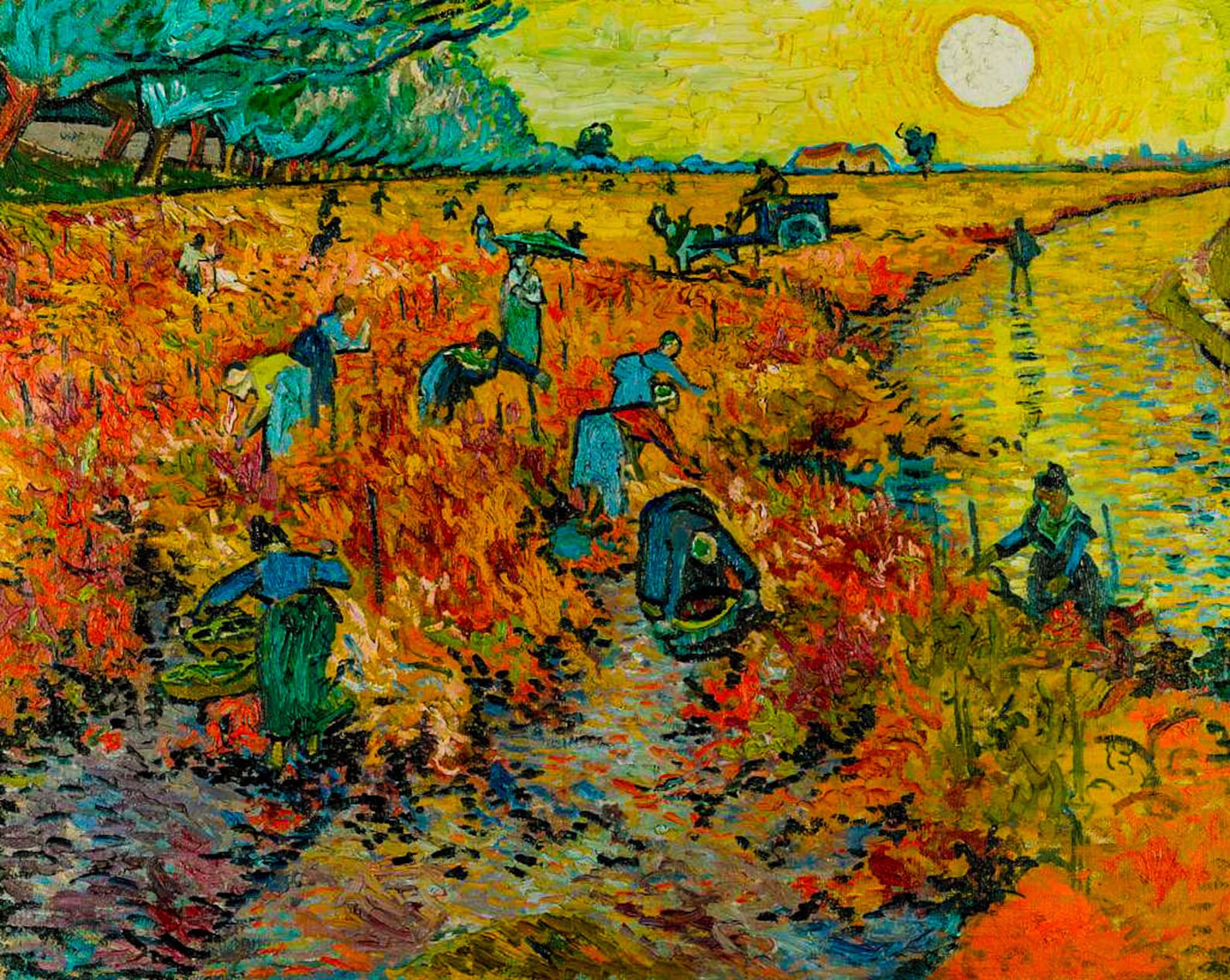
The Red Vinyard (The Red Vinyard near Arles)
November 1888, Arles
Oil on canvas, 75 cm × 93 cm
Pushkin State Museum of Fine Arts, Moscow
5. 1998: Somebody Turned On the Lights
For most of its life, Audun's look was black ink on white. Handsome, a little serious. Then in 1998, Villeroy & Boch relaunched the collection and wrapped those engraved scenes in a warm, creamy yellow. That one decision changed everything. The charcoal suddenly looked crisp instead of somber, and the pastoral scenes started feeling sunny instead of scholarly.
The relaunch was organized as a family of patterns rather than a single design, a genius move that deepened its identity. Ferme, Fleur, Chasse, and Promenade each tell a different story, but they share the same palette and borders, so you can mix them freely. In 2023, the company added a limited-edition sister called Maison, which swaps country scenes for Villeroy & Boch's own buildings in Mettlach, including the Old Abbey and Saareck Castle. It celebrated two birthdays at once: 25 years of Audun and 275 years of the company.
The Characteristics: What Makes a Piece Look Like Audun
The Yellow
It's a soft, buttery yellow rather than a lemon, and on many pieces it has a faint brushed or striated texture that keeps it from looking flat. On the mugs you can see it clearly, almost like the color was swept on in one long stroke. That subtle movement is what makes the yellow read as warm and handmade-looking instead of plasticky.
The Charcoal Scenes
Villeroy & Boch calls the ink color "coal." It's a deep anthracite gray rather than a hard black, which softens the engraving and makes it feel like an old print. Look closely and you'll see the hatching and cross-hatching that copperplate engravers used to build shadows: leaves made of tiny strokes, clouds built from fine parallel lines, with figures that seem to have stepped out of an eighteenth-century storybook.
The Laurel Garland
A ring of small laurel leaves circles the center of nearly every plate, whether there's a picture inside or not. It's the thread that ties the whole collection together. Often the center is left plain white inside that garland, which gives your food a clean stage and keeps the table from feeling too busy.
The Trellis
Some pieces, including the bread and butter plates and the bowls in this set, trade the yellow rim for a charcoal diamond lattice with tiny dots at the crossings, resembling a garden trellis. Put a trellis plate on top of a yellow-rimmed plate and the two patterns snap into place.
The Captions
Many of the scene pieces carry a little script title beneath the picture, just like a print hanging in a gallery. It's a small detail with a lot of charm. It turns every course into a mini exhibition.
The Sister Patterns
| Pattern | What’s on it | Personality |
|---|---|---|
| Ferme | Farm life: shepherds, livestock, cottages, and fields | The cozy one. Perfect for breakfast. |
| Fleur | A plain white center ringed with a botanical garland | The quiet one. It hands the spotlight to your food. |
| Chasse | Hunting scenes with horses, hounds, and riders | The sporty one. Wonderful for fall dinners. |
| Promenade | A crosshatched trellis pattern, like garden lattice or tile | The matchmaker. It pulls every other pattern together. |
| Maison | Villeroy & Boch’s buildings in Mettlach (limited edition, 2023) | The collector’s piece. Harder to find. |
One thing worth knowing: Audun is printed porcelain, and the decoration is applied as a transfer and fired on. That's the whole point of a copperplate look, and it's exactly how the pattern should be made. Don't expect brush strokes in the scenes, and don't be suspicious when two plates match perfectly. They're supposed to.
How to Buy It Right
Good news first. Audun isn't a pattern that attracts counterfeiters, so you can relax about fakes. The real questions are what you're getting, what condition it's in, and whether the pieces actually work together.
Flip it over. A genuine piece carries a Villeroy & Boch backstamp, usually with the company name, the 1748 founding date, the pattern name, and care symbols. The backstamp is also how you'll figure out which sister pattern a piece belongs to, which helps a lot if you plan to add to the set later.
Expect perfect printing. Crisp lines and identical repeats mean the transfer was applied well. Blurry, smeared, or misaligned scenes are a quality issue, and you should check the price accordingly.
Hunt for gray scratches. The most common wear on any white porcelain is utensil marking: thin gray lines left by knives and forks. Hold the plate at an angle under good light to spot them. Light marks often clean up with a gentle mineral-based cleanser, but deep scratches through the glaze are there to stay.
Run a finger around every rim. Chips love the rim and the foot, and they're easy to miss in a stack. Gently tap the edge of a plate with a fingernail. A clear ring means you're in good shape, while a dull thud can mean a hairline crack.
Check the yellow under daylight. Different production runs can vary a little in tone. When you're assembling a set from several sources, compare the yellows side by side so your dinner plates don't look like they came from three different summers.
Count what you need, then buy a few extra. Mugs and bread plates seem to disappear from sets over the years, and salad plates are the first to chip. Having a spare or two saves you a scramble the night before a big dinner.
Know where to find replacements. Because Audun is still in production, Villeroy & Boch and major department stores carry individual pieces, and replacement services stock older items. That makes a big secondhand set an excellent foundation: you get the bulk at a bargain and fill gaps at retail.
Living with Audun Now
Audun is a working pattern. It was designed to be used every day, and it gets better the more often it comes out of the cabinet. A few ideas to get the most out of it:
Lean into the mix. The trellis plates are your secret weapon. Stack one on top of a plain-center dinner plate, add a scene bowl on top of that, and you've got a layered place setting that looks like you hired a stylist.
Dress it up or down. For everyday, pair Audun with wooden boards, linen napkins, and simple glassware. For a dinner party, black flatware and charcoal chargers make the yellow glow, which is the same idea Villeroy & Boch suggests with its matte black Manufacture Rock line.
Celebrate the season. It's October, and Audun is practically built for autumn: sunflowers, mums, a pile of little gourds down the center of the table, and a pot of something braised on the stove. The Chasse pattern was born for this time of year. Come Thanksgiving, this set makes a very convincing case for hosting.
Hang a few. The scene plates look terrific on a wall, especially in a kitchen or breakfast nook. Group five or seven of them with a mix of trellis and scene pieces for a gallery that'll start conversations.
Wash it the easy way. Audun is rated dishwasher safe, which is a gift for anyone who actually cooks. Check the backstamp for microwave guidance on individual pieces. As with any porcelain, load it so the plates aren't knocking together, and the rims will thank you.
Closer to Home: The Audun Set on Our Floor
If all this has you picturing sunflowers and a long table, you don't have to piece a set together plate by plate. We've got a big, beautiful Villeroy & Boch Audun set at Evolution Home right now, ready to take on your holiday hosting.
Here's what's in it: ten dinner plates with the plain center and laurel garland, eight rim bowls for soups and pastas, eight salad plates with charming pastoral scenes, eight trellis bread and butter plates, six trellis bowls, and five yellow mugs for the coffee crowd. That's enough to set a full table and still have breakfast covered the next morning. Buying all of that new, piece by piece, would cost you well beyond what it's tagged at here.
Sets like this tend to leave with whoever shows up first! Come see it at 861 South Pickett Street in Alexandria, or shop it online here.
Frequently Asked Questions
Where does the name Audun come from? It's named for Audun-le-Tiche, the tiny village in Lorraine where François Boch and his three sons opened their first pottery in 1748.
How old is the Audun pattern? The original design dates to 1830. The collection was relaunched in 1998 with the yellow accents it's known for today, and it's still in production.
Is Audun hand-painted? No, and it isn't supposed to be. The scenes are printed in the style of copperplate engraving and fired onto porcelain, which gives them their fine, crisp detail.
Can I mix different Audun patterns? Absolutely. Ferme, Fleur, Chasse, Promenade, and Maison were designed to work together. Mixing them is the whole idea.
Is Audun dishwasher safe? Yes, Audun is rated dishwasher safe. Check the backstamp on individual pieces for microwave guidance.
Is vintage Audun worth more than new? Generally no. Since the pattern is still made, value comes from completeness, condition, and quantity. A large, clean, matched set at a secondhand price is where the real deal is. The limited-edition Maison pieces are the exception and can be harder to track down.
Can I still buy replacement pieces? Yes. Villeroy & Boch and many department stores sell Audun open stock, and replacement services carry pieces too.
Is Villeroy & Boch still run by the family? The family no longer runs day-to-day operations, but descendants still hold the voting shares, and eighth-generation family member Isabelle von Boch remains closely associated with the brand.
A Short Glossary
Anthracite: a deep charcoal gray, the color of Audun's printed scenes. Backstamp: the maker's mark on the underside of a piece, often including the pattern name. Copperplate engraving: a printmaking technique where lines are cut into copper, inked, and transferred to paper or ceramic. Mettlacher Platten: "Mettlach tiles," Villeroy & Boch's decorative floor tiles, so popular the name became generic. Open stock: pieces sold individually rather than only in sets. Porcelain: a dense, hard, vitrified ceramic fired at high temperature, often slightly translucent. Rim bowl: a shallow bowl with a wide flat rim, ideal for soup or pasta. Toile: a decorative style of single-color pastoral scenes on a light ground, originally on fabric. Transfer printing: the process of moving an inked design onto ceramic before firing. Trellis: a diamond lattice border, used in Audun as a mixing neutral. Utensil marks: gray scratches left on glaze by knives and forks.
Evolution Home Insider publishes guides to period furniture, materials, and the craft of living with old things. If you've got a stack of plates in the cabinet and you're wondering what they are, send us a photo of the backstamp and one of the rim in good light. That's usually where the story starts.
Sources and further reading: Villeroy & Boch company history and Audun collection materials; the Villeroy & Boch Audun Maison product playbook; the Walters Art Museum on the Boch family's origins; Keramikmuseum Mettlach; Mettlach abbey and Old Tower history; Musée d'Orsay on Van Gogh's portrait of Eugène Boch; and histories of Anna Boch and The Red Vineyard.
